INTRODUCTION
Atalanta of the Wild began not with a plot outline or a character sketch, but with a question that Ovid refused to answer. In the Metamorphoses, the transformation of Atalanta and Hippomenes into lions occupies a handful of lines—a swift, almost casual punishment appended to the story of the golden apples. I could not let it rest there. What follows is the Author’s Note that opens the novel: my account of the research, the landscapes, the linguistic choices, and the friendship at the heart of the story. If you have ever wondered what drives a novelist to trade the comfort of his desk for the mountain streams of Boeotia and the dusty plains of Arcadia, read on.
On Sources, Landscapes, and the Art of Mythic Retelling
Long ago, when I first encountered Atalanta’s tale in Ovid’s Metamorphoses, I was struck not by the footrace or the golden apples, but by what comes after: the curse, the transformation. The moment when Atalanta and Hippomenes, overcome by a spell of passion, defile the sanctuary of the Great Mother and are turned into lions in punishment. Ovid passes over this in only a few lines, as though the tragedy were little more than an epilogue to a clever story of apples and desire. Yet I saw something else: a woman who defied every expectation of her world, who chose her own path in the face of divine will, and who paid the ultimate price for love.
Atalanta of the Wild grew out of that sense of absence—the story Ovid sketched, then brought to an abrupt close. What does it mean to be transformed into a beast? What does Atalanta lose, and what does she carry with her into her leonine form? These questions pressed upon me. I knew I could not answer them from a desk in Rio de Janeiro; I needed to walk the ground where her myth first took root.
Over many journeys to Greece, I traced Atalanta’s world with my own feet. I stood on the plain of Tegea in Arcadia, where the summer air hangs heavy with the scent of sun-dried hay and dust, and the mountains rise like sentinels over the land. I climbed the slopes of Mount Helikon in Boeotia, where the oak and pine forests still stand thick, where mist lingers in the hollows long after dawn, and where the streams Permessos and Olmeios, sacred to the Muses and named by Hesiod, run cold and clear over limestone and shale. (Perchance I found them. Their present courses are unknown, lost to time.) I biked the route from Tegea through Argos to the Isthmus of Corinth, imagining Periklos, Néos, and their fellows making a similar passage in search of their transformed companion, the distance measured not in kilometers or miles, but in days of dusty roads and aching limbs.
These were not touristic excursions. They were acts of embodied research. I needed to know how the light falls on an Arcadian valley in early autumn. I needed to feel the bite of a mountain stream swollen with snowmelt. I needed to understand what it means to search a forested mountain for sixty days, how the body exhausts, how hope and despair trade places with each turning of the sun. The landscapes in this novel are not imagined—they are remembered. Every description of mist-veiled folds, every mention of fertile fields and cicada song, every detail of the greenwood wilderness arises from direct encounter with the terrain. If the novel feels lived-in, it is because I lived in it first.
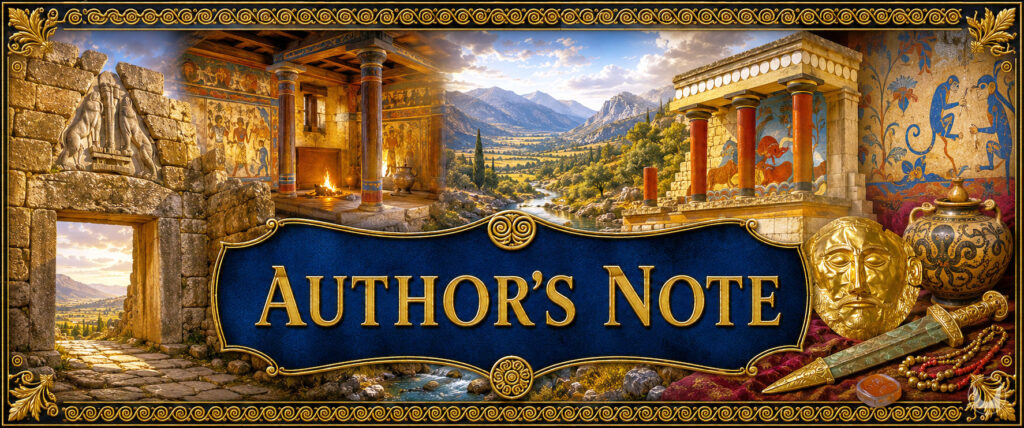
But landscape alone does not make a world. I wanted Atalanta of the Wild to reflect the Bronze Age as faithfully as archaeology and philology allow. The characters speak in titles and terms drawn from Linear B tablets: wanax for king, maῖa for midwife or mother, megaron for great hall. The material culture—the architecture of Tegea’s palace, the design of Mycenaean metalwork, the presence of lions in Greece during this period (a fact confirmed by ancient sources and modern paleontology)—is rendered with close fidelity to the historical record. I consulted not only Ovid but Apollodorus, Pausanias, Hesiod, and the fragments of lost epics. I studied Minoan and Mycenaean art, examined museum collections in Athens and Heraklion, and read extensively in Bronze Age archaeology to ensure that Atalanta’s world feels tangible and specific.
And yet this is not a work of historical reconstruction. It is a mythic retelling, and myth operates by different rules than history. Ovid wrote in Latin in the age of Augustus; I have chosen to write in archaic English, a tongue that did not exist in Atalanta’s time, but which allows me to evoke a voice outside modernity, a narrator who dwells at a temporal distance and speaks with the gravity of old chronicles. Some readers may find the archaic register—salutacioun, goddesse, fairnesse—unfamiliar or challenging. I ask only that you trust the music of the language. These spellings are not arbitrary; they follow the conventions of Middle English as it was written in the fourteenth and fifteenth centuries. They are intended to slow your reading, to make each sentence a deliberate act rather than a casual glance. This is a tale meant to be savored, not consumed.
The novel’s narrator is, I believe, at once present and elusive. Attentive readers may notice moments when the third-person voice slips into first-person, seamlessly, when grief or another emotion pierces the narrative. This is intentional. The narrator is not a disembodied chronicler but a participant, one who knew Atalanta and Néos, who cherished them, and who bears their memory across the centuries. I will say no more. Let the prose reveal what it will.
Ovid’s Atalanta is a composite figure, blending elements of the Arcadian huntress, daughter of Iasius, with the Boeotian Atalanta, daughter of Schoeneus. One liberty I have taken is to foreground the Arcadian tradition, setting the story in Tegea and highlighting Atalanta’s bond with Artemis, her prowess in the hunt, and her role in the Calydonian boar hunt. The footrace and the golden apples remain, yet they are woven into a broader tapestry of duty and the irreconcilable demands of personal agency and social custom. Moreover, Hippomenes is no mere suitor in this account. He is a prince of Onchestos, a man of intelligence and devotion to Aphrodite, whose love for Atalanta exacts the ultimate price. Their transformation into lions is not a whim of myth but the novel’s emotional and thematic climax: the moment when all choices converge into tragedy.
At the heart of this novel lies the friendship between Atalanta and Néos, two souls who acknowledge each other across the boundaries of gender, lineage, and fate. Néos is my own creation, though he belongs to a long tradition of loyal companions in Greek epic (Patroclus to Achilles, Pylades to Orestes). His love for Atalanta is not romantic, yet no less profound for that. It is the love of one who beholds another fully and refuses to look away, even when such seeing brings unbearable sorrow. If this novel moves you, it will likely be because of them.
I do not know whether Ovid would recognize his Atalanta in mine. I wish he could understand that I have honored his brevity by expanding it, that I have taken his sketch and rendered it in full color. Myth allows this: each generation reshapes the stories it inherits, discovering in them new truths for new times. Atalanta’s defiance—her refusal to conform, her willingness to bear the cost of living by her own code—these are not relics of the Bronze Age. They are eternal.
If you have come this far, esteemed reader, I thank you. May you journey with Atalanta to the end, and perceive, as I do, that some loves are too vast for a single lifetime. They require myth to hold them.
Rio de Janeiro, the vi day of Aprille, MMXXVI

POSTSCRIPT
If the Author’s Note has brought you this far, then you are precisely the reader I wrote Atalanta of the Wild for.
This novel has been many years in the making—years of reading, traveling, walking, and listening to what the landscapes of Greece have to say when you are quiet enough to hear them. The archaic English, the Linear B terminology, the careful archaeology: none of these are obstacles. They are the vessel. The story they carry is one of friendship, defiance, and a love too vast for a single lifetime.
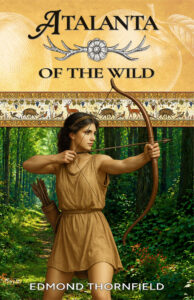
Atalanta of the Wild is available now on Amazon and Barnes & Noble. If you would like to follow the journey—the literary travel, the mythological research, the world behind the novels—explore the boards on my Pinterest profile and subscribe to this blog. There is much more to come: guided tours of Cortona and Florence, deep dives into Bronze Age material culture, and the story of how four published works grew from one author’s stubborn conviction that ancient tales demand archaic language.
The stars are waiting. Come and find them.
Edmond Thornfield
Rio de Janeiro, the xv day of May, MMXXVI