An exploration of Donatello’s revolutionary contribution to Renaissance sculpture, psychological realism, and the rediscovery of the human form in fifteenth-century Florence.

IN THE LONG HISTORY OF WESTERN ART, THERE ARE PERHAPS A DOZEN MOMENTS WHEN A SINGLE ARTIST SO FUNDAMENTALLY altered the way human beings see that the world before and after their work are, in the deepest sense, different worlds. Donatello—born Donato di Niccolò di Betto Bardi in Fiorenza around 1386, known to his contemporaries simply as Maestro Donato—is one of those artists. He did not merely make beautiful things. He taught the Western eye what beauty could mean when freed from the constraints of a millennium of sacred convention and returned to the natural complexity of the human form.
To understand what Donatello accomplished, one must understand what came before him. Medieval sculpture had its own profound logic, which portrayed the elongated figures in the great Gothic cathedrals, their faces serene and typological rather than individual, their bodies subordinated to spiritual meaning rather than physical truth. These were not failures of observation but deliberate theological choices: the body as symbol, the face as emblem of the soul’s condition before God. It was a visual language of extraordinary power, and it governed European art for a thousand years.
Donatello looked at that language and, with the quiet radicalism of a man who has understood something new and cannot unsee it, began to speak a different one entirely.
Donatello and the Florentine Renaissance
He was born into a city in the first flush of its extraordinary destiny. Fiorenza in the late Trecento and early Quattrocento was a place where ancient certainties were dissolving and new ones had not yet hardened. The great banking families were accumulating wealth on a scale that demanded new forms of display; the rediscovery of classical antiquity was proceeding with the excitement of archaeology and the urgency of ideology; and a generation of extraordinary minds—Brunelleschi, Ghiberti, Masaccio, Alberti—were converging on the same radical insight that the ancient Greeks and Romans had advanced understanding of beauty, proportion, and the human form that the intervening millennium had lost. It was the task of their generation to recover it.
Donatello trained in the workshop of Lorenzo Ghiberti, whose famous bronze doors for the Florentine Baptistery were among the most celebrated artistic projects of the age. It was Ghiberti who gave him his technical foundation in metalwork and relief sculpture. But the student would surpass the master in ways the master could not have predicted, 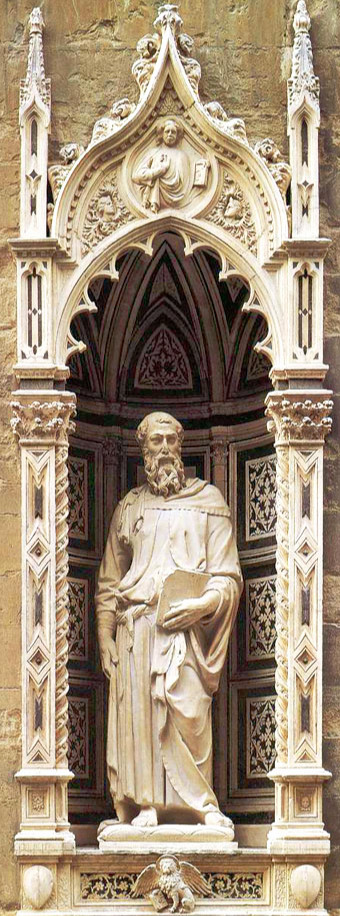 because what Donatello pursued was something Ghiberti‘s more decorative and graceful aesthetic was not equipped to find: the full psychological truth of the individual human being rendered in stone and bronze.
The Statues That Look Back
The defining quality of Donatello‘s mature work is a characteristic so simple to name and so radical in its achievement that it is easy to underestimate: his figures possess an interior life. They are not merely beautiful forms or sacred symbols or formal exercises in classical proportion. They think. They suffer. They doubt. They desire. They are present in the way that human beings are present, with the full weight of consciousness behind their eyes.
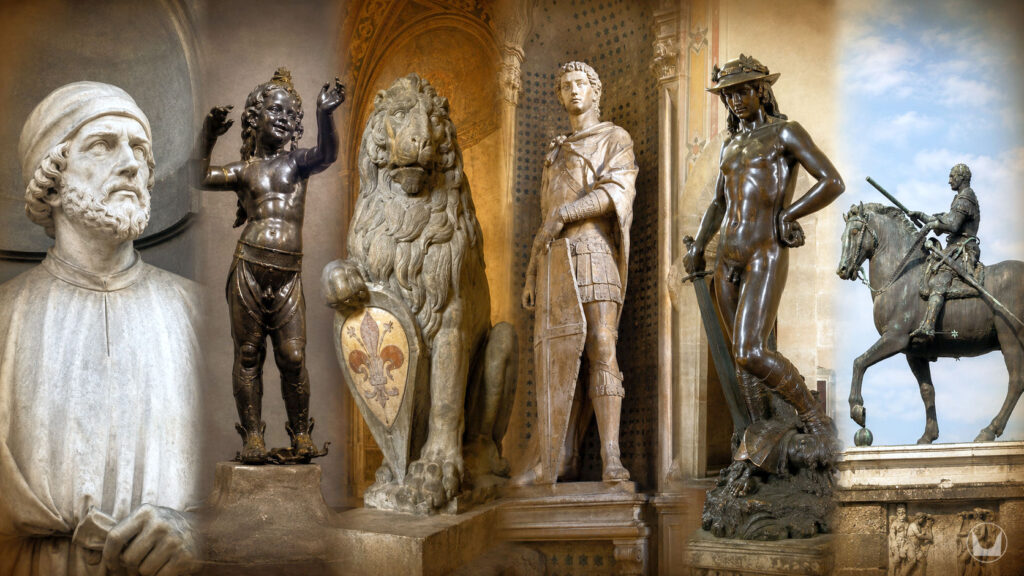
His Saint Mark for Orsanmichele, completed around 1411, is the first statue in the history of Western art since antiquity in which the human body is depicted as genuinely supporting its own weight—the famous contrapposto stance in which the figure’s weight shifts to one leg, the hip rises on that side, the shoulder drops, and the body organizes itself around a central axis of living tension rather than the rigid frontality of medieval convention. This seems a small thing. It is not. It is the rediscovery, after a thousand years, of how a human body actually stands, and with it comes the implicit claim that 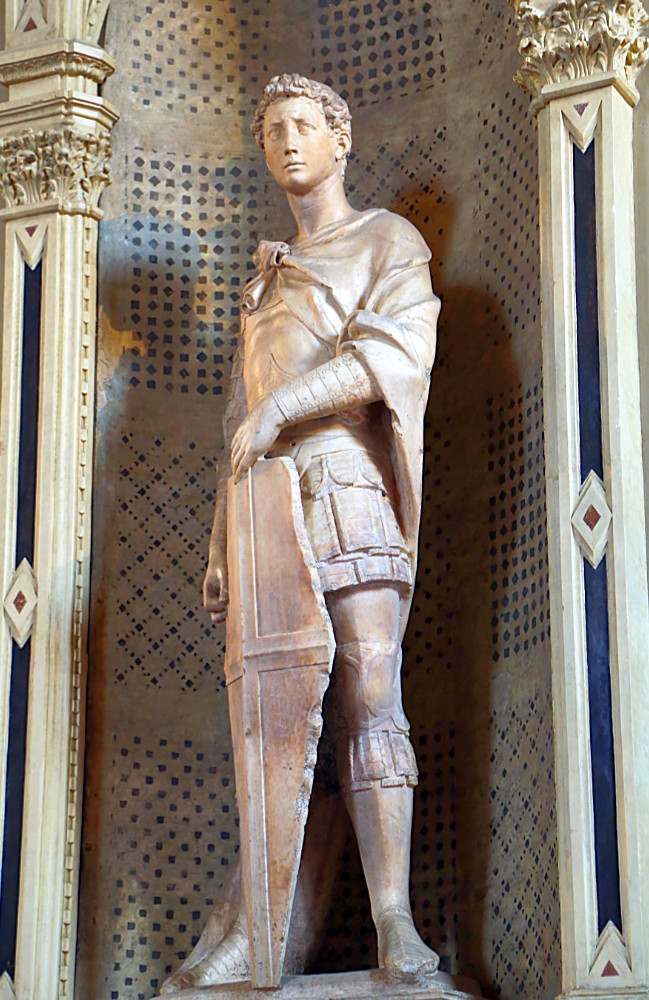 the human body in its natural physical truth is a worthy subject for the highest art.
His Saint George, carved for the same building around 1415, goes further still. The young warrior stands with an aggressive alertness: his weight forward, his gaze directed outward, his face bearing an expression of both courage and anxiety, the face of a young man who has chosen to stand his ground and is not entirely certain of the outcome. It is the face of someone we recognize. It is the face of a person, not a type.
The Prophet Who Wept
If the early work established Donatello as the master of the individual in repose or readiness, the middle period—the series of prophets carved for the Campanile of Santa Maria del Fiore in the 1420s and 1430s—shows him pursuing psychological fidelity into territory that bordered on the disturbing.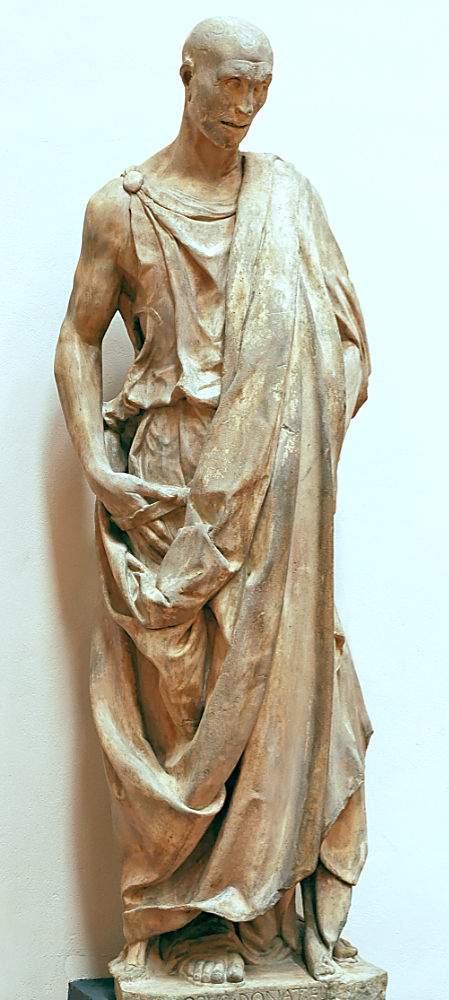
The prophet known as Lo Zuccone (the Bald One) is perhaps the most radical piece of public sculpture produced in the Quattrocento. The figure is not beautiful by any conventional measure. He is gaunt, his skull nearly bare, his face deeply lined, his expression one of such fierce inward concentration that he seems barely aware of his surroundings. He is consumed by vision, by the burden of what he has been given to see and compelled to say. Donatello reportedly spoke to this figure as he worked on it, demanding that it speak. In a sense, the demand was answered: no statue in the Western tradition before this one so convincingly suggests that speech is imminent, that the figure’s silence is a held breath rather than an absence.
Vasari tells us that Donatello was so attached to Lo Zuccone that he used it as his most solemn oath, swearing per la fede ch’io porto al mio Zuccone—by the faith I bear to my Bald One. Whether or not the story is true, it captures something real. The relationship between this artist and his creation had crossed from craft into something closer to recognition.
 Donatello’s David and the Rediscovery of the Nude
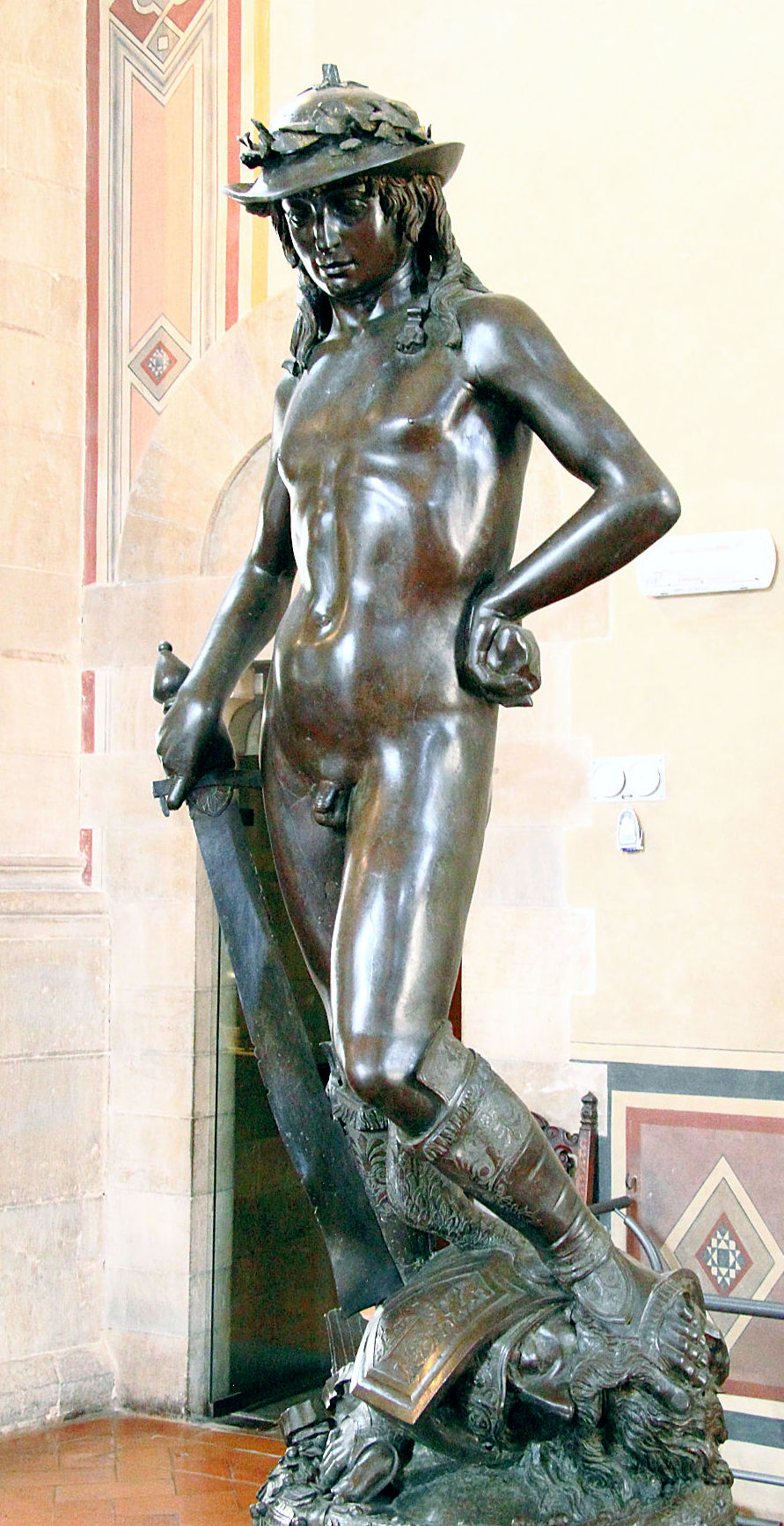
Donatello‘s David, the first freestanding nude statue produced in Europe since antiquity, is among the most discussed and most enigmatic works in the history of sculpture. Cast in bronze, probably in the 1440s for the Medici, it depicts the young shepherd-king in the moment after his victory over Goliath: his foot resting on the severed head, Goliath‘s sword in his hand, his expression one of absolute calm.
The figure is young, slight, androgynous in its beauty, wearing only a shepherd’s hat and greaves, its nakedness both completely natural and deeply charged. The relationship between the triumphant boy and the great head beneath his foot, with Goliath‘s wing-feather touching the inside of David‘s thigh, has generated five centuries of interpretation. What is beyond dispute is that Donatello looked at the male body with an attention that was simultaneously sculptural, classical, and intensely personal, and that what he made from that attention is a work of art that repays every form of looking brought to it.
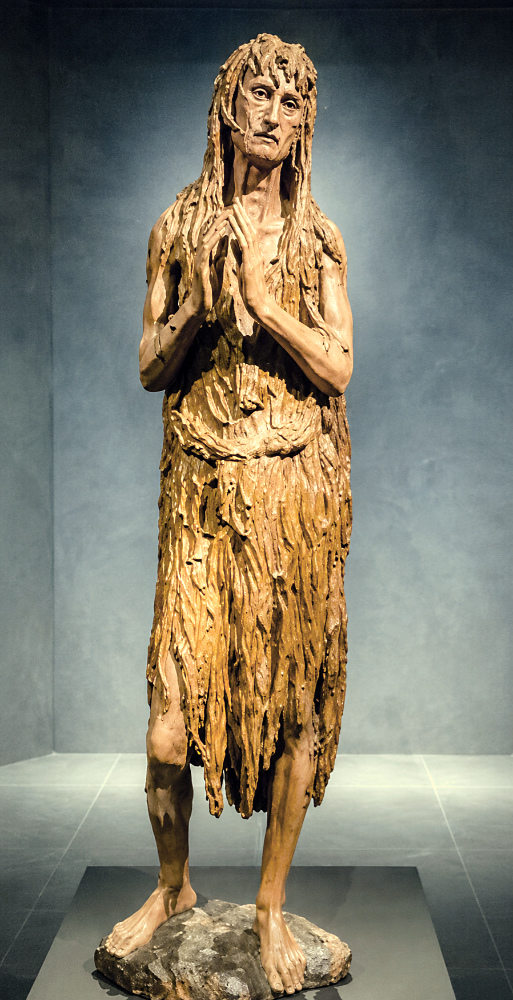 He worked with equal mastery in wood, as his late Mary Magdalene demonstrates, a figure of such ravaged, penitential beauty that it stands at the opposite pole from the David, showing not the perfection of youth but the devastation wrought by suffering and time on a body that was once beautiful. It seems to show that devastation as something more profound than beauty: holiness, in the full sense of the word.
The Life of the Maestro
What do we know of Donatello the man, beyond the works he left? The historical record is fragmentary, as it is for most artists of the period who were not also writers. We know that he was born the son of a wool comber, that he trained with Ghiberti, that he traveled to Rome with Brunelleschi in the early years of the century to study ancient sculpture with the systematic attention of an archaeologist. We know that he maintained a close and lifelong relationship with Cosimo de’ Medici, who was among his most important patrons and who, according to Vasari, left him a provision in his will so that the old sculptor would not have to worry about money in his final years.
We know that he was, by all accounts, a man of great personal freedom—careless of money, indifferent to the social performances that Florentine civic life demanded of men of his standing, absorbed in his work to a degree that made conventional domesticity impossible. Vasari describes him as generous to his assistants, impatient with fools, and entirely without the competitive bitterness that marked many of his contemporaries. He lived, Vasari suggests, entirely for his work and for the company of those who understood it.
He never married. He left no legitimate children. He died in Fiorenza in 1466, in his late seventies or early eighties, having outlived most of his generation, and was buried near Cosimo de’ Medici in the Basilica di San Lorenzo, a proximity that speaks to the depth and equality of the relationship between the sculptor and his patron.
What the historical record does not give us—cannot give us, given the conventions of the age and the silences they enforced—is a full account of his interior life, his desires, the nature of his most intimate relationships. That territory belongs to historical imagination, which is another name for historical fiction.
Maestro Donato in Meeting Donatello
The short story is set in Fiorenza in the autumn of 1450, when Donatello would have been in his mid-sixties, an old man by the standards of the age, but one whose creative powers were far from exhausted, whose reputation was at its height, and whose presence in the city’s intellectual and artistic life remained a defining fact.
The gathering depicted in the story, a riunione riservata at a palazzo on Via Porta Rossa, attended by poets, painters, philosophers, and men who take delight not only in art but in one another, belongs to a Florentine social reality that the historical record acknowledges, however obliquely. The city’s relationship with what its own laws called sodomia was famously contradictory: severe in its official prohibitions, remarkably permissive in its actual practice, generating the paradox of a city that criminalized same-sex love and simultaneously produced, in its art and its intellectual culture, some of the most sustained and beautiful celebrations of male beauty in the Western tradition.
Donatello‘s David did not emerge from nowhere. It emerged from a city, and from an artist, who looked at the male form with a particular quality of attention that was simultaneously aesthetic, classical, and deeply personal. Meeting Donatello imagines the human context from which that attention grew—the gatherings, the conversations, the recognitions across a room, the world of hushed understandings in which men of a certain sensibility found each other and, for an evening, did not have to pretend.
In this sense the story is not an embellishment of history but a restoration of it. It is an act of literary justice toward a dimension of Florentine Renaissance life that the official record suppressed and that the art, stubbornly, preserved.
Why Donatello Still Matters
Three of the most celebrated works of art produced in the fifteenth century—the David, Lo Zuccone, and the Gattamelata equestrian statue in Padua—are his. Michelangelo, who transformed European sculpture a generation after Donatello‘s death, is incomprehensible without him. The line from Saint Mark to the David of the Accademia runs directly through Donatello‘s workshop, his innovations, his insistence that the human body in its full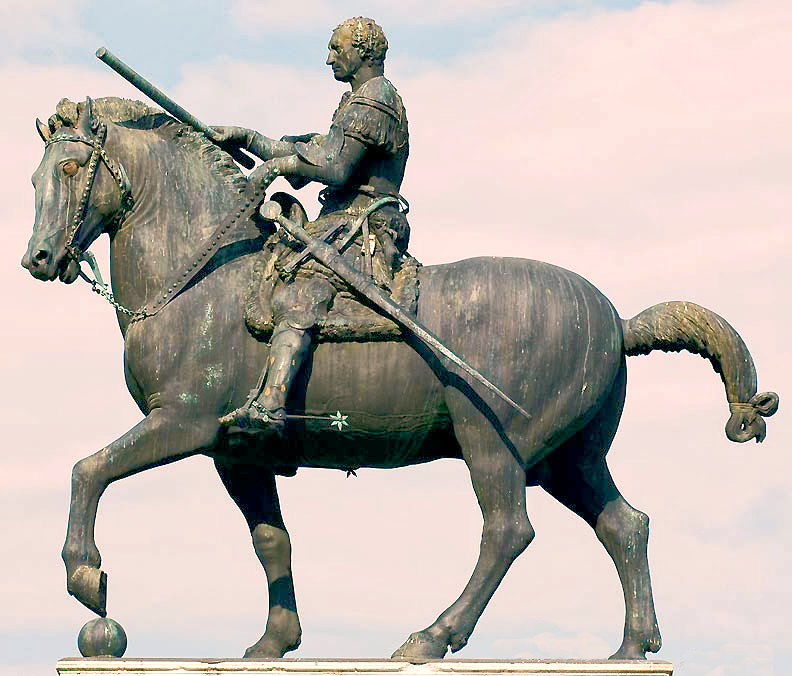 physical and psychological truth was the proper and supreme subject of art.
But beyond the art historical argument, Donatello endures because he was among the first artists in the Western tradition to insist, in marble and bronze, that the interior life of the individual human being, with all its complexity, doubt, desire, and suffering, was worthy of the highest craft and the most serious attention. That insistence seems obvious to us now because Donatello and those who came after him have made it so. Before him, it was revolutionary.
He looked at the human being and saw what was actually there. Everything else followed from that.

Rio de Janeiro, Autumntide of MMXXVI.


Click any cover to read a preview chapter and learn more. Meeting Donatello serves as a prequel to A Tale of Paris & Paris: Echoes of Troy, a literary historical novel set in Cortona, Tuscany, in 1450 AD.