
There is a moment known to every writer who has ever chosen a nom de plume when the invented name becomes more real than the given one. I cannot say when that moment arrived for me. I know only that it has.
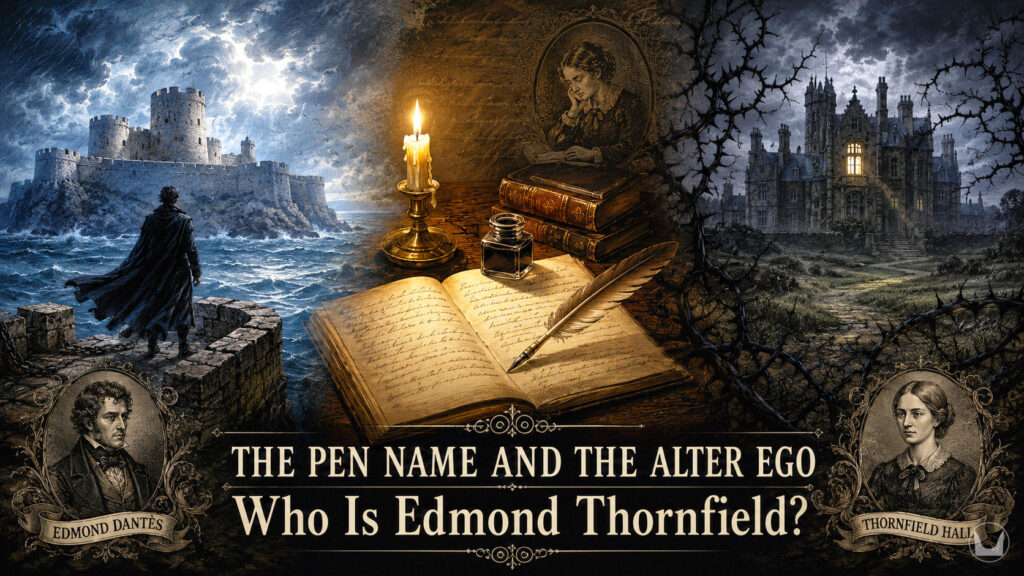
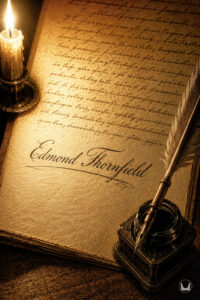
The name Edmond Thornfield was not assembled at random. Each of its two words carries the full weight of a literary inheritance—one French, one English—and between them they describe, more accurately than my given name ever could, the writer I set out to become and the imaginative world I set out to inhabit.
 Edmond: The Man Who Waits and Executes
The first name is my homage to Edmond Dantès, the protagonist of Alexandre Dumas‘s The Count of Monte Cristo, and one of the great creations of nineteenth-century fiction. Since my adolescence, I have identified with Edmond Dantès in a way that has never entirely loosened its grip: his intelligence, his directness, his capacity for loyalty and for patient, implacable purpose. He represents something I have long sought in the world and rarely found in living persons—the figure who would choose you without reservation and come for you regardless of the cost. A man of absolute fidelity to those he loves and absolute precision toward those who have wronged him.
If Dantès taught me anything, it is that one may spend years working toward a plan, refining it in silence, waiting for the precise moment, and then execute it. That quality of long-prepared, unhurried action is not merely a character trait I admire. It is a description of how I write.
 Thornfield: Where Love and Suffering Keep House Together
The surname is my homage to Charlotte Brontë, or rather, to the most memorable setting she ever created. Thornfield Hall, in Jane Eyre, is not merely a house. It is a living presence: powerful, passionate, secretive, damaged, and morally divided, yet capable of flaring into warmth precisely when the darkness is deepest. It is a field of thorns—a place where beauty and suffering are not opposites but inseparable companions, where hidden realities press constantly against every surface, and where love arrives in full knowledge of the cost.
That is my ideal of a romantic dreamscape. Not the sanitized garden, but the place where roses grow through stone and the stone draws blood. When I discovered that Thornfield could stand as a surname, the decision required no further deliberation.
 The Persona and Its Liberation
Several years ago, the compulsion to write A Tale of Paris & Paris: Echoes of Troy came upon me with a force I could not ignore and did not attempt to resist. Yet as I set to work, my style drawn toward Shakespeare and Marlowe, toward Aeschylus and Euripides and Sophocles, toward the grand architectures of language that the stage bequeathed to the page, my given name felt entirely at odds with what I was creating. The work demanded a different signature. So I made one.
In my imagination, Edmond Thornfield is a blend of Mark Twain and Oscar Wilde at the summit of their respective careers—or so I wish, with full awareness of the audacity the wish requires. What I can say with greater certainty is what the persona has done for the work. From the moment Edmond Thornfield took up the pen, my imagination soared to heights I had not previously dared to approach. I found myself writing verse in iambic pentameter, an achievement I had never thought  myself capable of, and discovering, with no small astonishment, that I was capable of it. The alter ego did not constrain me. It freed me.
There is one further consideration in the determination of my nom de plume, and I will state it without apology: English is not my native language. It is my fifth. I do not write as a foreigner. More than twenty years of living in California settled that question to my satisfaction long ago. But the concern remained, in the early days, of how I would be perceived by native English readers encountering prose written in a register as deliberately archaic and stylistically ambitious as mine. Edmond Thornfield addressed that concern with characteristic elegance. It fit then. It fits more and more with each novel I publish, as though the name has been quietly accumulating the authority it always claimed.
 The Question That Remains Open
I cannot foretell by which name the world will eventually choose to call me. History is full of authors whose invented names outlasted every other fact about them; it is also full of authors whose real names reclaimed their proper precedence in the end. Both outcomes seem to me honorable.
Of one thing, however, I am entirely certain: Edmond Thornfield possesses the sprezzatura of the man of letters I see in my dreams. That effortless authority, that studied carelessness of the master who has worked harder than anyone watching will ever know, belongs to him naturally.
Whether I have grown into him or he has grown out of me, I leave to others to determine. In the meantime, the novels speak for themselves.
Rio de Janeiro, the xxvii day of May, MMXXVI.

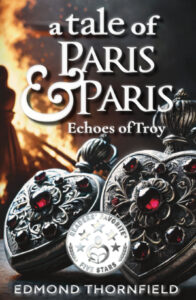
Click the cover to read a preview chapter and learn more.
Your writing is captivating and thoughtfully crafted. The way you express ideas feels both insightful and engaging, making it easy for readers to connect with your work. Your voice is distinctive, and it’s clear that a great deal of care and talent goes into what you create. Thank you for sharing your work—it was a pleasure to read.