
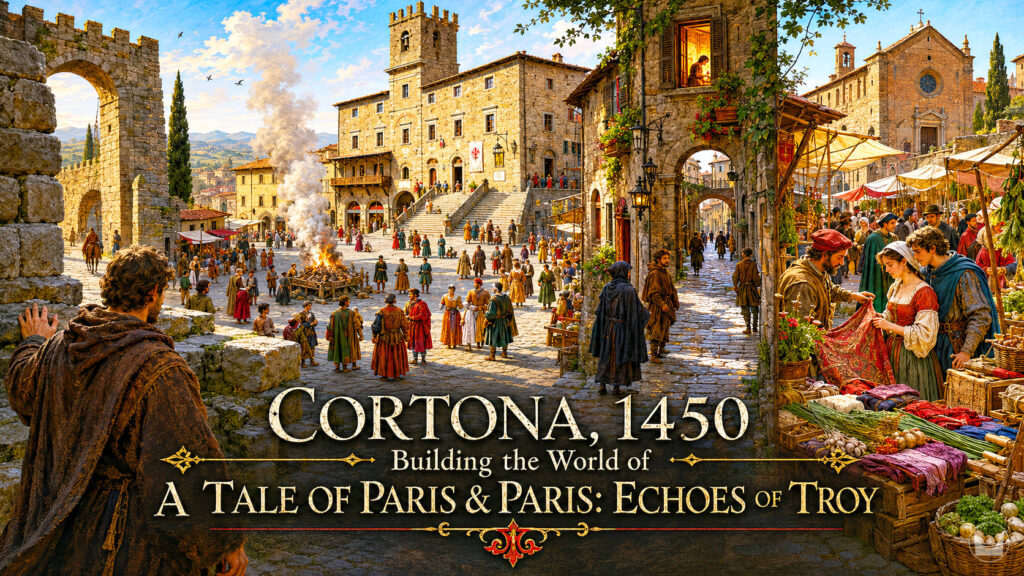
In my visits to Cortona, I always enter the citadel at the beginning of Via Nazionale, still known by the Cortonesi as Via di Ruga Piana, as it has been for centuries, the only leveled street in the whole city. The first time I did, the moment I laid my hands upon the remaining stones of the ancient wall, I knew what a singular place that city is. It called to me as 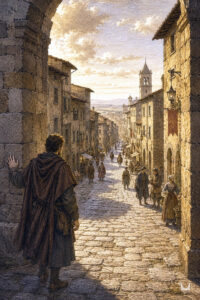 no other place had ever done before. It calls still, across a vast ocean, thousands of miles into another continent—or so runs my rampant imagination. In this essay, I would share the locations within the medieval citadel that feature with prominence in my Renaissance-set novel A Tale of Paris & Paris: Echoes of Troy, the first book in the series Chronicles of Cortona. Some are real to this day; others are wrought out of inspiration and dreams.
In a companion essay devoted to Brother Elias of Cortona, I present the Convent and Church of San Francesco, where many of the novel’s characters interact throughout the tale. Yet for readers who have traveled to Cortona, or who harbor a hope of visiting someday, below are other sites no less essential to the story: the streets, squares, and 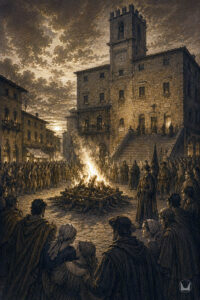 shadowed doorways through which my people move, quarrel, love, conspire, and occasionally come to grief.
La Piazza (Known today as Piazza della Repubblica)
This has always been the beating heart of Cortona, the great square where one finds the Palazzo Comunale and the Palazzo del Capitano del Popolo, where during the Middle Ages the governing bodies of the town held their councils and the people assembled for every occasion that mattered. Market days and civic ceremonies, proclamations of war and declarations of peace, all of them shared the same stones under the Tuscan sky. As viewed through the eyes of this novelist, it is the perfect 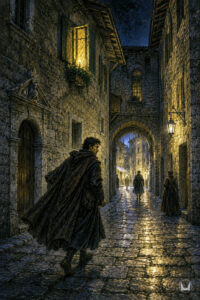 location to light the pyres that consume witches, heretics, and deviates.
Via Ghibellina
Enter through the arch on the left of the Palazzo Comunale, and you find yourself on Via Ghibellina. Just before the end of the block, in a house that I have furnished entirely in my imagination and entirely to my satisfaction, lives Lorenzo di Ranieri—one of the two Parises of the novel—together with his cousin Matteo, their Aunt Marina, and the inimitable Signora Giulia. It is a household of considerable warmth and considerable noise. Lorenzo would not have it otherwise.
Via di Santa Maria (Present-day Via Roma)
Pass through the arched passage in the middle of the Palazzo Comunale, at ground level, and you enter Via di Santa Maria. One block down, near the alley connecting to Via Ghibellina, stands the Varani residence, the home of Uncle Guido and Aunt Anna, where Vittorio dei Varani, the other Paris of the novel, lodges with his wife Elena and their children. They have moved back recently from Arezzo, awaiting the restoration of his father’s old house in the city. Signora Benetta and young Margherita also live and work here. It is a house of quiet industry and, beneath its respectable surface, of private sorrows.
Via San Benedetto
Down on Vicolo Bacarelli from Via Ghibellina, to the side of the Chiesa di San Benedetto, stands the Briani house, home to Costanza—Aunt Anna’s spirited niece and Lorenzo’s hopeful bride—together with her brother Lino, Signora Cornelia, and Maria Paulina. After a prolonged absence traveling on business, the cocksure Lino returns from Venice by Chapter Twenty-Two. In his machinations to advance his fortune and influence upon the Florentine Signoria, what ensues from his despicable threats is nothing short of heinous.
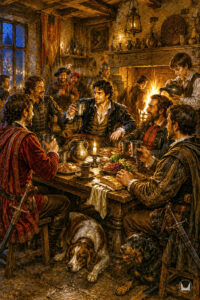 Dardanos: The Gentlemen’s Tavern
I have envisioned it somewhere along Via Dardano, on the way to Porta Colonia. It is a proper establishment by the standards of the Quattrocento, where a man of standing may take his ease without embarrassment. Lorenzo, Stefano, Angelo, Rocco, and all the officers serving the Civic Militia under Lorenzo’s command gather here when they are off duty. Vittorio eventually becomes a regular. The name I have given it is not accidental. Dardanos was the legendary ancestor of the Trojans, and the shadow of Troy falls long across this novel.
The Cock’s Yard
A casual-pour tavern on Via Guelfa, near the Convent of Sant’Agostino, a step or two below Dardanos in refinement. Vittorio goes there once and does something unexpected of a respectable Florentine cloth merchant. It is the first time the reader sees his true self. It is also, as it happens, the first time that his deed temporarily hinders the opening of the Inquisition‘s investigations in Cortona. A 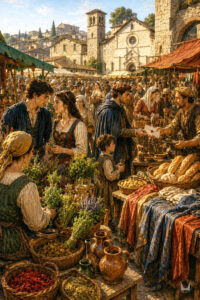 man may stumble into history without the least intention.
Mercato di San Domenico
Outside the citadel, in the Borgo of San Domenico, past the church and convent, the market spreads itself across the open air in all the cheerful abundance of a medieval trading day. The Cortonesi come here to purchase herbs, spices, food, and every manner of wares; to hire couriers for the delivery of letters; to exchange the news and gossip of the week. Within this cheerful tumult, Margherita and Gianmaria spend time together that neither they—nor the reader—will forget.
The Cheeky Sow: The Liveliest Establishment in All of Cortona
Also in the Borgo of San Domenico, a place where everything is permitted and all patrons, by one means or another, contrive to have a merry time. It becomes Vittorio’s chosen escape when he craves peace of mind. Here, too, Friar Giacomo, the scribe of the Greyfriar inquisitors, conducts his frequent rendezvous with his twin flames, the sisters Isabella and Libera. Sometimes men of the cloth suffer crises of faith. Friar Giacomo will either overcome his soon enough, or be taken out of the story altogether—whichever comes first.
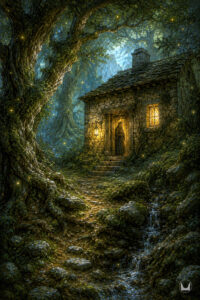 These are only a few of the unforgettable locations in A Tale of Paris & Paris: Echoes of Troy. Milena the Ancient’s cabin in an enchanted glade of the Apennine Mountains is sure to charm anyone who crosses its threshold. Further still: two souls entwined across the centuries may once again find each other therein, as they do in the novel I have written.

Rio de Janeiro, the xxvi day of May, MMXXVI.


Click the cover to read a preview chapter and learn more.
Interesting article about your novel. You’ve made up my mind to read it. Thanks!
Congratulations on the novel, Edmond Thornfield is a very talented writer.