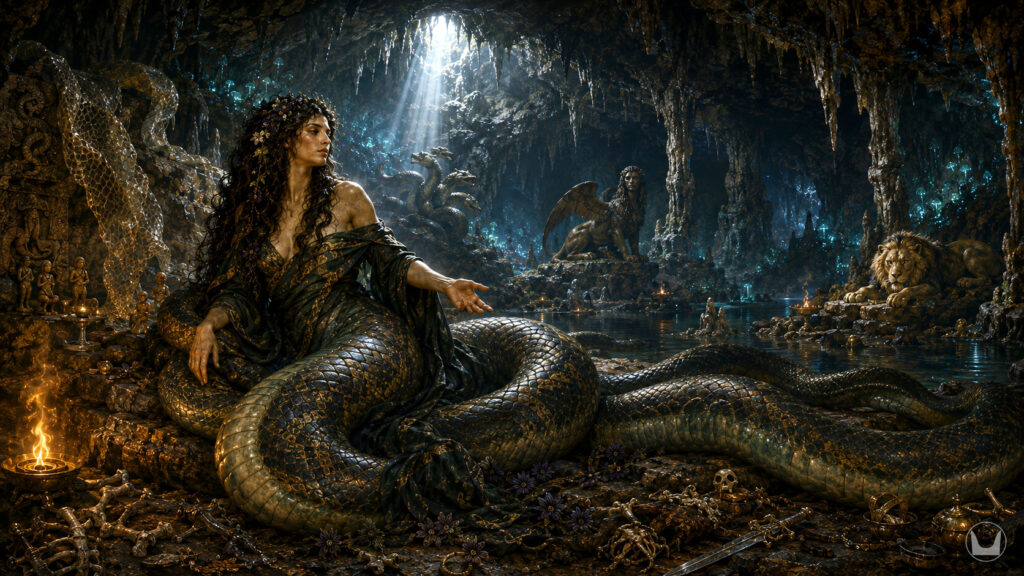
In the deepest places of the Greek mythological imagination—below Olympus, below the world of heroes and city-states and clever men with clever plans—there is a darkness that was never conquered. Zeus defeated the Titans and imprisoned them in Tartaros. He defeated the Giants and buried them beneath volcanoes. He defeated even Typhon, the last and greatest challenger to Olympian supremacy, and crushed him beneath the weight of Mount Etna. But he did not defeat Echidna. He looked at her in her cave beneath the earth, immortal and ageless, nursing her monstrous children in the dark, and he left her there.
This is perhaps the most remarkable single fact in all of Greek mythology. The king of the gods, who imprisoned Kronos and reorganised the entire divine hierarchy to suit his authority, looked at Echidna and decided to let her be.
 Hesiod, who gives us the most complete early account of Echidna in his Theogony, is characteristically precise about what she is: half beautiful woman, half enormous speckled serpent, immortal and ageless, dwelling in a cave far beneath the earth, eating raw flesh. She is not a goddess in the Olympian sense. She holds no portfolio, presides over no domain that Zeus has assigned her, receives no formal cult; she simply exists, as she has always existed, in the deep places of the world, and the monsters she generates are as necessary to the mythological order as the heroes who eventually slay them. Without Echidna, there is no Hydra for Hēraklēs to overcome, no Sphinx for Oedipus to outwit, no Nemean Lion for any hero to face. She is the source of every great test, the mother of every worthy adversary, the generator of the challenges without which heroism would have no meaning.
To understand Echidna fully, one must understand three things: her nature as a chthonic being, her relationship with Typhon, and her role as the necessary darkness that makes the light meaningful. Asterios and the Labyrinth places her at the centre of a sorcerous alliance with Pasiphaë and Kírkē, and this essay explores the mythological foundations that make that alliance not merely plausible but inevitable.
The Chthonic Inheritance
Echidna‘s parentage is disputed in the ancient sources, a fact that is itself mythologically significant. Some traditions make her the daughter of Phorkys and Kētō, the ancient sea deities of the deep waters who also generated the Gorgons and the Graeae. Others give her parents as Tartaros and Gaia, the abyss and the earth herself, which would make her a creature of the most fundamental geological darkness. Still others assign her to Khrysaōr and the Oceanid Kallirrhoē.
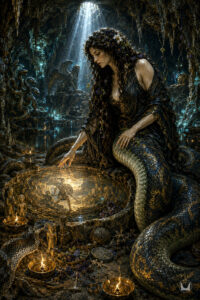 What all these genealogies share is a consistent placement of Echidna at the margins of the Olympian order and deep within the older, pre-Olympian world. Whatever her specific parentage, she belongs to the generation before Zeus, to the time when the world’s creative forces had not yet been organized into the tidy hierarchy of the twelve Olympians. She carries within her the generative power of that older world—the raw, undirected creativity of the earth’s deep places, which produces monsters because monsters are what the deep places naturally generate when left to themselves.
This pre-Olympian quality is what makes her friendship with Pasiphaë and Kírkē so mythologically resonant. The daughters of Hēlios are themselves figures who straddle the boundary between Titan and Olympian. Their father is the son of Titans, their power older than Zeus‘s dispensation, their magic drawn from sources that predate the Olympian order. In Echidna they find a kindred: another being whose authority derives not from Zeus‘s assignment but from the world’s own deep creative forces. They are, all three, women of the old world — the world before the gods tidied everything up and assigned everyone a role.
Typhon: The Last Great Titan
No account of Echidna is complete without her mate, Typhon, the most terrifying being in all of Greek mythology, the last great challenge to Zeus‘s authority, the creature whose existence threatened to undo the entire Olympian order.
Hesiod describes Typhon in terms that leave no doubt about his scale: from his shoulders grew a hundred serpent heads, each capable of breathing fire, each producing a different terrible sound—the roaring of lions, the bellowing of 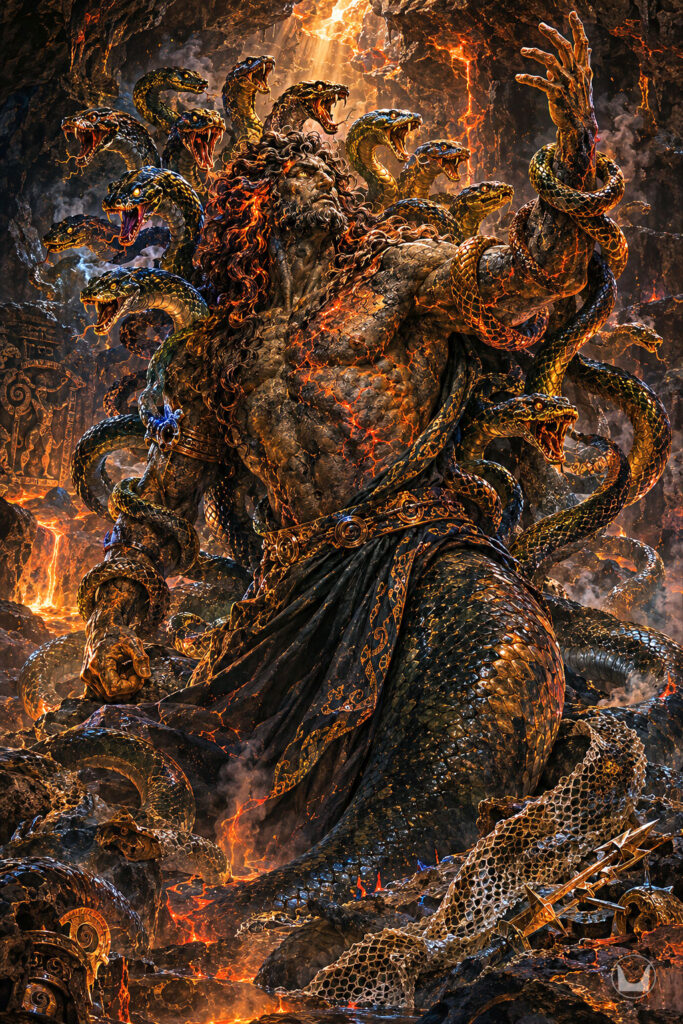 bulls, the hissing of serpents, and sometimes, most terrifyingly of all, the articulate voice of the gods. He was vast enough to touch the stars with his heads and broad enough to span the horizon. When he moved, the earth shook. When he roared, the gods themselves fled to Egypt and disguised themselves as animals in terror.
Zeus alone stood his ground, and the battle between them is one of the great set pieces of Greek mythological narrative. Typhon initially prevailed. He tore the sinews from Zeus‘s hands and feet and left him helpless in a cave, a moment of divine vulnerability so radical it is almost impossible to imagine in the context of the mature Olympian mythology. It was Hermes and Aigipan who recovered the sinews and restored Zeus to his power, after which the king of the gods pursued Typhon across the world, hurling thunderbolts, until he finally buried him beneath the weight of Mount Etna in Sicily, where the volcano’s eruptions and earthquakes are his eternal attempts to escape.
What is remarkable about Typhon is not his defeat but what his existence represents. He is the last gasp of the old creative chaos, the world’s tendency to generate things beyond the control of the new divine order. Zeus can defeat him, but he cannot unmake what Typhon and Echidna have already created together. The Hydra, the Chimaera, the Sphinx, the Nemean Lion, Kérberos, the Lernaean serpents, these are Typhon‘s children as much as Echidna‘s, and they are already in the world, already playing their necessary roles in the mythological order, providing the challenges that will make heroes of mortal men.
In this sense, Typhon‘s defeat is not entirely a victory for Zeus. The old chaos has been contained—Typhon buried under a volcano, Echidna left in her cave by divine sufferance—but its products are everywhere, woven into the fabric of the heroic world, as necessary to that world as the heroes who face them.
The Children of Echidna and Typhon
To speak of Echidna is inevitably to speak of her children, for it is through them that her creative power most fully manifests in the mythological tradition. Each monster she generated with Typhon is simultaneously a natural force, a moral test, and a work of creative imagination of the highest order.
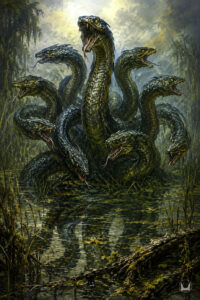 The Lernaean Hydra—the many-headed water serpent of the swamps of Lerna, whose heads multiplied when severed, whose breath—was poisonous, whose blood was lethal, was the second labour of Hēraklēs, defeated only when Iólāos thought to cauterize each neck as his companion severed the head. From the Hydra‘s blood, Hēraklēs poisoned his arrows, and those poisoned arrows eventually caused his own death. Echidna‘s child reached forward
 through time to claim the hero who destroyed it.
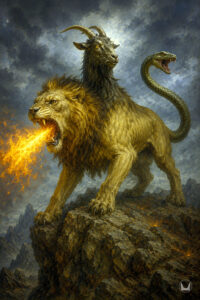
The Chimaera—lion in front, serpent behind, goat in the middle, breathing fire from the goat’s head—was slain by Bellerophōn riding Pēgasos. She is the most purely fantastic of Echidna‘s children, the one whose composite nature seems designed to challenge the mind’s ability to hold contradictory things together simultaneously. She is what the deep creative unconscious produces when freed from the constraint of natural taxonomy.
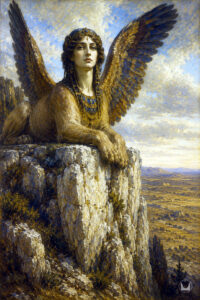 The Sphinx—woman’s face, lion’s body, eagle’s wings, serpent’s tail—sat on the road to Thebes and devoured those who could not answer her riddle. She was the only one of Echidna‘s children who was also an intellectual adversary, her monster-nature expressed not in physical threat but in the challenge of meaning. Oedipus defeated her not with weapons but with understanding, and she threw herself from her rock when her riddle was answered. She is Echidna‘s most philosophical child.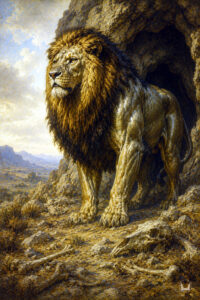
The Neméan Lion—invulnerable to weapons, its hide impenetrable by any mortal blade—was the first labour of Hēraklēs. After strangling it, he wore its impenetrable hide as armor, making his mother’s child into his own protection. This is perhaps the most poignant of the hero-monster relationships: the monster defeated becomes the means of the hero’s survival, Echidna‘s child continuing to protect even after death. (In Atalanta of the Wild, my other Bronze Age novel, I place the Neméan Lion as 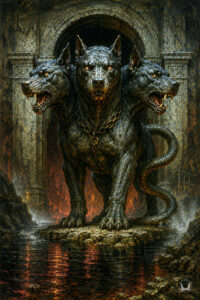 the second labor, to better fit my narrative.)
Kérberos—the three-headed hound of the Underworld, guardian of the boundary between the living and the dead—is perhaps Echidna‘s most enduring creation. He does not attack the dead; he prevents the living from entering and the dead from leaving. He is a guardian rather than a destroyer, and his role in the Underworld‘s order is as necessary as that of any Olympian deity. Hēraklēs dragged him briefly into the upper world as his twelfth labour; Orpheus lulled him to sleep with music; the Sibyl drugged him with honey cakes. He always returned to his post.
Echidna in Asterios and the Labyrinth
In the world of Asterios and the Labyrinth, Echidna is not merely a mythological background figure. She is a presence: the childhood friend of Pasiphaë and Kírkē, the third power in a sorcerous alliance that exists outside the Olympian hierarchy and draws its authority from the old world’s creative forces.
Her friendship with the daughters of Hēlios makes a profound mythological sense. All three are women whose power predates or exceeds the Olympian order. All three are figures the mythology could not entirely domesticate—too powerful for simple condemnation, too ancient for simple reverence. All three exist at the margins of the divine hierarchy, drawing their authority from sources older and stranger than Zeus‘s thunderbolt.
In the novel’s world, Echidna‘s contribution to the alliance that protects Asterios’s kingdom is characteristically chthonic: she provides what neither Pasiphaë‘s Hekataean magic nor Kírkē‘s transformative pharmaka can: the generative darkness of the earth’s deep places, the creative power that produces monsters as naturally as a spring produces water, and the absolute, unhurried patience of a being who has been waiting in her cave since before the gods were young and knows that she will still be there when they are gone.
She is, in the fullest sense, the necessary darkness, the deep creative force without which the world’s light would have nothing to define it against. Zeus understood this when he left her in her cave. The novel understands it too.
Why Echidna Endures
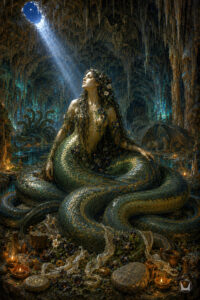 Three thousand years of mythological transmission have not diminished Echidna. She endures not despite her marginality but because of it. She represents something the Olympian order could regulate but never eliminate: the world’s tendency to generate things beyond the control of any divine authority, the creative darkness that produces monsters because monsters are part of the world’s necessary structure.
She is the mother of every test, the source of every challenge, the generator of every worthy adversary. Without her, heroism is impossible. Without her, the world is too tidy, too safe, too fully under divine control to require the particular human qualities of courage, intelligence, endurance, and love that the heroic tradition celebrates.
She is, after all, a mother. Ferocious, unconditional, ancient beyond measure. Her children are monsters, and she loves them without reservation, still in her cave, immortal and ageless, tending the darkness that the world requires.
Zeus was wise to leave her there.
Rio de Janeiro, Autumntide of MMXXVI.

Click the cover to read a preview chapter and learn more.
Asterios and the Labyrinth, winner of Literary Titan’s FEB 2026 Gold Book Award. To explore the mythological world behind the novel, visit the boards on my Pinterest profile and subscribe to my newsletter.