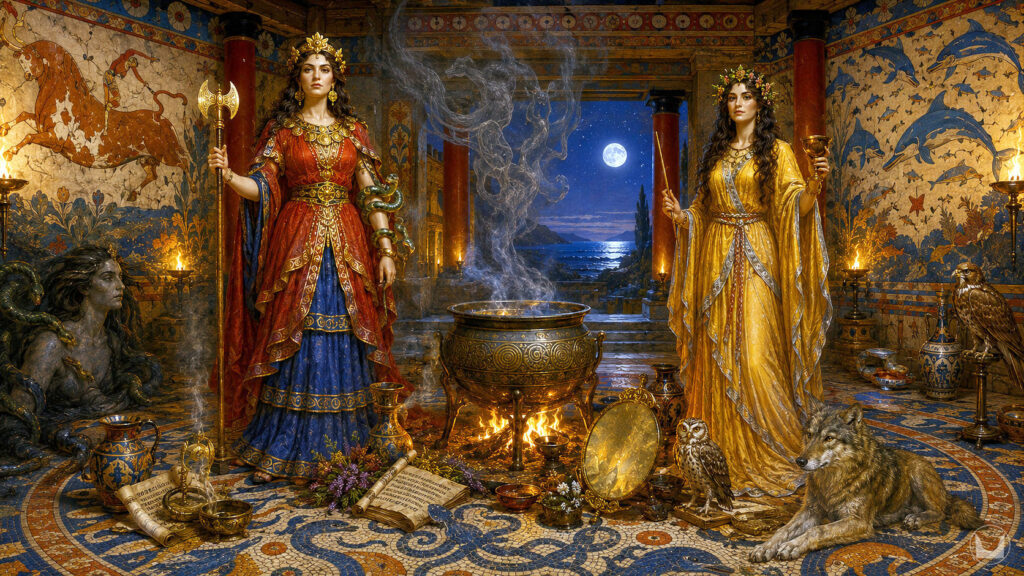
In the vast pantheon of Greek mythology, sorcery is rarely a solitary gift. It runs in bloodlines, transmitted from divine parent to mortal child like the color of eyes or the timbre of a voice. No mythological family demonstrates this more powerfully than the daughters of Hēlios, the Sun God, and the Oceanid Perseis, for from their divine union came two women whose command of magic, poison, transformation, and divine will made them the most formidable sorceresses the ancient world had ever known: Pasiphaë, Queen of Crete, and her sister Kírkē, the enchantress of Aiaía.
They are not marginal figures in the mythological tradition. They stand at its very centre—one as the mother of the Minotaur, one as the nemesis of Odysseus—and the stories that surround them are among the oldest and most theologically charged in the Greek imagination. Yet they are rarely considered together, as sisters, as heirs to a shared magical inheritance, as two expressions of the same terrifying divine power. This essay proposes to remedy that omission.
The Divine Inheritance
To understand Pasiphaë and Kírkē, one must first understand their parentage. Hēlios, the Titan who drives the chariot of the sun across the sky each day, who sees all things because his light falls on all things, is not merely a celestial phenomenon. He is an intelligence, a witness, a power whose vision penetrates every secret. From him, his daughters inherited not only their luminous beauty but their penetrating sight: the ability to see through surfaces, through pretenses, through the masks that mortals wear before the gods. A sorceress who can see truly needs no spell to compel the truth. She already knows it.
From their mother Perseis, an Oceanid of ancient lineage, they inherited the deep knowledge of the natural world—the properties of herbs, roots, and sea-plants, the pharmaceutical wisdom of a tradition older than the Olympian gods. Perseis belongs to the generation of Titans, to the world before Zeus‘s order imposed its hierarchies on the divine. Her daughters carry within them that older knowledge, that pre-Olympian power that the newer gods could regulate but never entirely extinguish.
This double inheritance, the solar vision from Hēlios and the chthonic botanical knowledge from Perseis, made Pasiphaë and Kírkē something rarer and more dangerous than ordinary witches. They were women who could see everything and transform everything. In a world governed by divine will and mortal limitation, that combination was almost without equal.
 Pasiphaë: Queen, Mother, Priestess of Hekátē
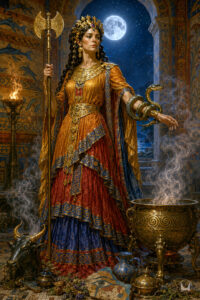
Pasiphaë arrived in Crete as the bride of Mínōs, the great king whose realm dominated the Aegean world of the Late Bronze Age. She brought with her the full weight of her divine inheritance—her father’s solar sight, her mother’s pharmaceutical wisdom, and her own considerable gifts as a priestess of Hekátē, the goddess of crossroads, dark magic, and the liminal spaces between worlds.
The mythology that surrounds Pasiphaë is dominated by the story of her union with the Cretan Bull, the divine animal sent by Poseidon as a gift to Mínōs, which Mínōs refused to sacrifice, and for whose love Poseidon cursed Pasiphaë as punishment for her husband’s impiety. From that union was born Asteriōn—the Minotaur, the star-named one, the child of a queen and a god’s instrument—whom Mínōs imprisoned in the Labyrinth that Daídalos built beneath the palace of Knōssos.
The tradition has not been kind to Pasiphaë in its transmission. Later authors, more comfortable with passive female suffering than with active female power, reduced her to a victim of divine punishment, a woman cursed, humiliated, and ultimately defined by the monster her body produced. But the older layers of the myth suggest something considerably more complex. Pasiphaë was a priestess of Hekátē before she was a queen of Crete. Her knowledge of pharmaka (magical herbs, transformative potions, binding spells) was legendary even among the gods. When Mínōs took other lovers, it was Pasiphaë who cursed him with a spell that made his seed venomous to any woman but herself. This is not the act of a passive victim. This is the act of a woman who understood power and was willing to use it.
In Asterios and the Labyrinth, Pasiphaë reclaims the full complexity the mythological tradition only partially preserved. She is a mother of ferocious devotion, a priestess of terrifying competence, and a political strategist whose sorcery is deployed in the service of her son’s survival. The Kingdom of the Labrys faces threats from without and within, and it is Pasiphaë, with her solar sight and her Hekataean magic, who sees those threats clearly and moves to counter them before they can fully form.
 Kírkē: Enchantress, Herbalist, Daughter of the Sun
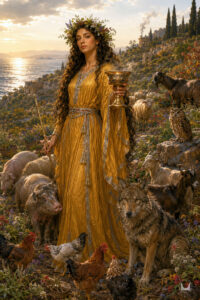
If Pasiphaë represents the maternal face of the sisters’ shared power—sorcery deployed in the service of love and protection—then Kírkē represents its more solitary and philosophically pure expression. She is the enchantress of Aiaía, an island at the edge of the world, where she lives alone with her animals and her loom and her inexhaustible knowledge of the natural world’s transformative properties.
Kírkē‘s most famous mythological episode, her transformation of Odysseus‘s men into pigs, and her subsequent year-long relationship with Odysseus himself, is often read as a story of female predation, of a dangerous woman who must be mastered before she can be trusted. This reading is both reductive and anachronistic. Kírkē transforms Odysseus‘s men because they behave like animals. They are greedy, undisciplined, heedless of the sacred obligations of guest-friendship. She does not transform Odysseus because he approaches her correctly, with intelligence and respect. The transformations are not cruelty. They are diagnosis.
This is the deeper truth of Kírkē‘s power: she sees what people truly are and gives that truth a physical form. The man who is essentially a pig becomes a pig. The man who is essentially a wolf becomes a wolf. Her pharmaka do not create new natures; they reveal existing ones. This is her father Hēlios‘s gift working through her: the solar sight that penetrates all surfaces and shows the thing beneath the thing.
Kírkē is also, in the mythological tradition, a woman of considerable tenderness. She mourns. She loves. She gives Odysseus the knowledge he needs to navigate the Underworld without which he could never return home. She is not his enemy. In some ways, she is his most honest companion, the one figure in the Odyssey who tells him exactly what he is and what he must do, without flattery and without agenda.
In Asterios and the Labyrinth, Kírkē arrives at Knōssos as her sister’s most powerful ally, the enchantress whose knowledge of transformation and whose command over the natural world complements Pasiphaë‘s Hekataean magic and solar sight. As the mythological tradition has always implied, together the sisters are unstoppable.
 Echidna: The Third Power
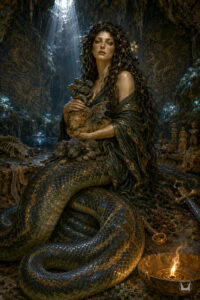
No account of the sorcerous alliance in Asterios and the Labyrinth would be complete without acknowledging the third member of that terrible sisterhood: Echidna, the Mother of All Monsters, childhood friend of the daughters of Hēlios.
Echidna occupies a unique position in the Greek mythological imagination. She is half woman, half serpent, immortal and ageless, dwelling in a cave beneath the earth where she nurtures the monsters she has generated—the Hydra, the Chimaera, Kérberos, the Sphinx, and the Nemean Lion. She is not evil in the moral sense the word implies. She is something older and more fundamental than evil: she is the generative darkness, the creative power of the earth’s deep places, the force that produces monsters because monsters are part of the world’s necessary order.
Her friendship with Pasiphaë and Kírkē, established in the novel’s mythology as a bond of childhood, makes a profound kind of sense. All three are women of enormous power who exist at the margins of the Olympian order, neither fully inside the divine hierarchy nor fully outside it, drawing their authority from sources older and stranger than Zeus‘s thunderbolt. Together they form a triangle of power: solar sight, botanical transformation, and chthonic generation—the above, the surface, and the below, united in the service of one child’s survival.
Why They Matter
Pasiphaë and Kírkē have survived three thousand years of mythological transmission not despite their power but because of it. They are women the tradition could not entirely domesticate. They are too divine for simple condemnation, too mortal for simple reverence, too intelligent and too capable for the roles that patriarchal mythology preferred its female figures to occupy.
In Asterios and the Labyrinth, they are given back the full complexity the oldest layers of their myths always suggested. They are not monsters. They are not victims. They are women of extraordinary inheritance doing what such women have always done in a world that fears them: surviving, protecting, and wielding the power that is their birthright with the full authority of daughters of the Sun.
Rio de Janeiro, Autumntide of MMXXVI

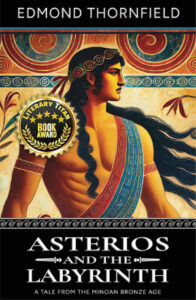
Click the cover to read a preview chapter and learn more.
Asterios and the Labyrinth, winner of Literary Titan’s FEB 2026 Gold Book Award. To explore the mythological world behind the novel, visit the boards on my Pinterest profile and subscribe to my newsletter.