There is a mountain that watches over the plain of Neméa from the north—flat-topped, unmistakable, rising above the valley with the quiet authority of a place that has been looked at for a very long time. I first saw it in April 2019, at the end of forty kilometers on a bicycle, with the Temple of Neméan Zeus before me and a storm gathering from the west. I did not know then what I know now. That mountain has a presence that compels the eye and does not release it easily.
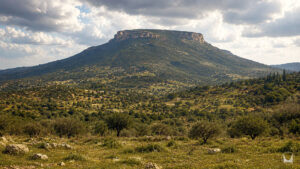
It is called Mount Phoukas today. In antiquity it was Apesas, and it belongs, before any other claim upon it, to Perseus.
The Altar and the Tradition
“Above Neméa is Mount Apesas, where they say that Perseus first sacrificed to Zeus of Apesas.“ So writes Pausanias in his Description of Greece (2.15.3), placing the hero on the summit before the passage where he also places Mycenae, the city Perseus founded, just a few kilometers further along the road to Argos. The proximity is not coincidental. This entire landscape is Perseus‘s country: Mycenae, Tiryns, the plain of the Argolid, and above it all, the flat summit where he climbed to give thanks to Zeus.
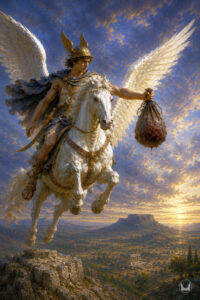 Apesantios—Ἀπεσάντιος—was an epithet and toponymic surname of Zeus, under which he had a temple on Mount Apesas. The god and the mountain took their identity from each other, each name confirming the other’s sanctity. The remains of the great ash altar of Zeus are located near the eastern edge of the summit. Pottery shards in the vicinity date from the Geometric period to the fourth century BCE, a span of worship lasting at least five hundred years, accumulating ash upon ash upon ash from sacrifices made to the memory of what Perseus did there.
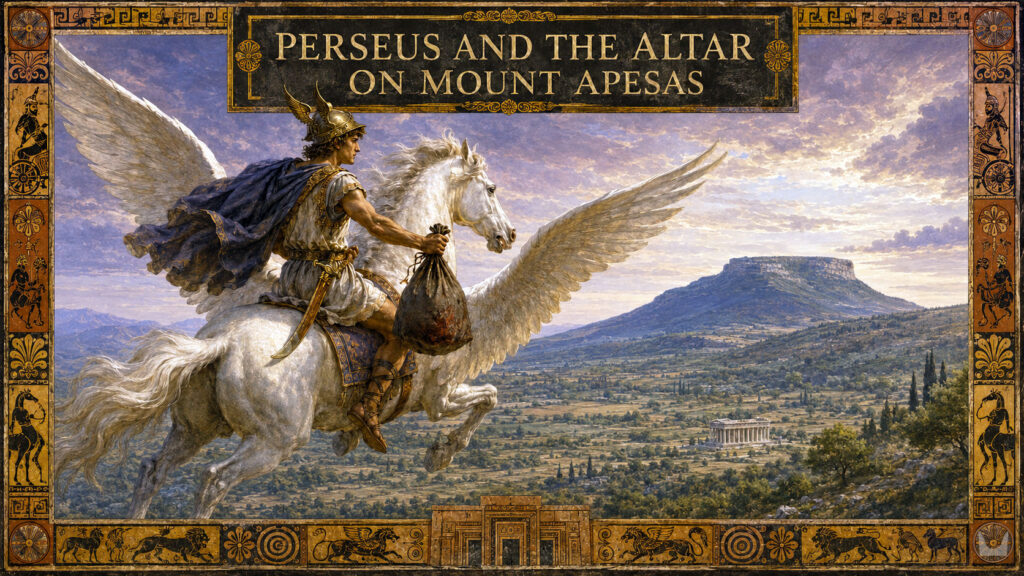
I envision him alighting from Pēgasos on that flat summit, breathing hard after the long flight from the Libyan desert, the blood still wet on his hands. In one fist, the harpe (the curved sword given to him by Hermēs). Slung at his side, the kibisis, that blood-stained sack fastened by a drawstring, its cargo the severed head of Médousa, whose gaze could still turn stone what it had not already turned. He would have set the sack down carefully, keeping his own eyes from it, and looked out across the plain that would one day bear the name of a daughter of Asopos. And then he built his altar and sacrificed, because that is what men did when they had survived the impossible.
 A Mountain Heavy with Myth
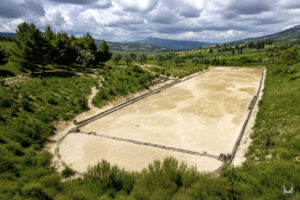
The altar of Perseus was not the only legend that settled on Apesas. The mountain bore more than one name in antiquity, and each name carried its own story.
The mountain was also called Aphesas because the horse races for the Neméan Games began at its base. The word aphesis means the starting point of a race, the release, the moment of unleashing. Horses gathered below the flat summit and were sent forward into the plain, their hooves throwing up the same earth that Perseus had walked. Sacred ground and athletic ground, consecrated by a hero and measured by runners.
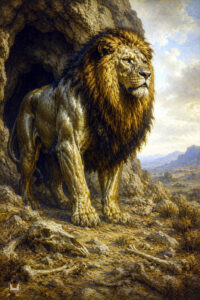 The mountain was named Fokas or Foukas because of its strange peak, which resembles a smokestack, colloquially called foka in Greek. In antiquity it was named after the hero Apesas who was king of the area. In other sources it is mentioned as the Selinountio mountain, since the goddess Selēne left the Neméan Lion there. There is something vertiginous about a mountain that holds all these identities simultaneously: a hero-king’s name, a goddess’s deposit, a starting gate, an altar. The ancient world did not require its sacred places to carry only one story. They accumulated meaning the way altars accumulate ash.
The Neméan Lion connection is particularly compelling for a reader of Atalanta of the Wild. Before Hēraklēs came to slay it, before Atalántē hunted the hills of Arkadía, the lion was here—delivered to this flat-topped mountain above the plain, and released into the world that would make it famous.
In a Greek version of the Flood Myth, Deukalíon‘s boat stopped on Fokas mountain, and a son of Prometheus established an altar to Aphesios Diós on its top. The mountain thus held two competing foundation myths for the same altar: Perseus the hero-king, and the survivor of the great flood. Both arrived at the summit with something to be grateful for, and both raised their eyes to Zeus.
The View from Below
I have not yet stood on the summit of Mount Apesas. I have seen it from below, from the plain of Neméa, from the direction of Mycenae, from the road that runs between them. Yet I have felt the pull of it. It is on my list of destinations, the list that drives my literary travel and that grows longer the more I research. At the northern end of the valley of Archaia Neméa, the flat summit reads as a natural dais, a place prepared as if the mountain itself had been shaped with sacrifice in mind.
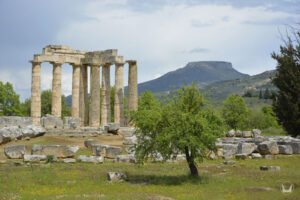
This is what literary travel does to a landscape. It does not reduce a mountain to geology or elevation. It layers it—with ash, with myth, with the imagined weight of a hero’s sandal on ancient stone. I did not need to climb Apesas to feel it watching. But when the time comes, I will climb it and stand where Perseus stood. I will look south across the plain toward the Temple of Neméan Diós, and I will understand something that cannot be understood from below.
Mark Twain wrote, in Following the Equator, that truth is stranger than fiction because fiction is obliged to stick to possibilities, and truth is not. A flat-topped mountain above a Peloponnesian valley, consecrated by the slayer of Médousa, frequented by a moon-goddess who deposited a mythic lion there, holding an ash altar with five centuries of accumulated offerings: this is not a novelist’s invention. This is ancient Greece, which was always stranger, older, and more layered than anything we could make up. The historical novelist’s task is not to invent. It is to listen carefully to the stones—and then to climb.

Rio de Janeiro, Autumntide of MMXXVI.


Click the cover to read a preview chapter and learn more.
For more on the geography and ancient sources for Mount Apesas, visit the ToposText Place Database and the Wikipedia entry on Apesantius.