Novelist Edmond Thornfield explains why literary travel is essential to writing historical fiction, from Knossos and Mycenae to Florence and Cortona.

There is a question I am sometimes asked, usually by readers who have noticed something in the novels that feels too precise to be invented. How did you know what the road from Knossos to Amnisos looks like at midmorning, when the light comes off the hills a certain way? How did you know the smell of the stones at Mycenae after rain? How did you know the sound a Cortona street makes underfoot when it is empty?
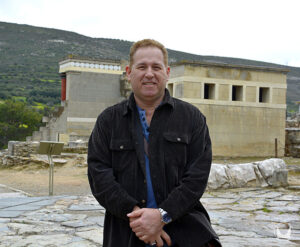 The answer is always the same. I went there.
This is not a method I chose so much as a compulsion I stopped resisting. I cannot write a place I have not inhabited with my body. I have tried. The prose comes out technically correct and emotionally false—the difference between a map and a country. The map shows you where things are. The country shows you what it feels like to be lost in them.
I am a slow traveler. I do not visit places; I occupy them. I walk the same streets at different hours. I sit in churches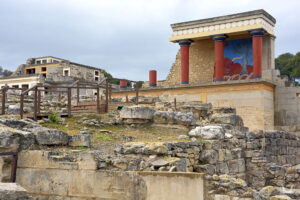 until the tourists leave and the silence comes back. I eat what is sold at the market. I note what the light does in the afternoon, which is never what any photograph suggests. I am, I suppose, a nuisance to anyone who travels with me, because I am incapable of moving on when something is still speaking.
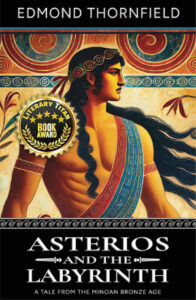
In preparation to write Asterios and the Labyrinth, I spent days at the Archaeological Site of Knossos, walking its corridors, standing in its light wells, trying to understand what the palace had been when it was alive. It was not a ruin, not a reconstruction, but a place where people woke in the morning and listened to the clamor of daily life. I walked the Royal Road that begins at the palace, one of the oldest preserved roads in Europe, its stones still legible underfoot, and tried to imagine it continuing 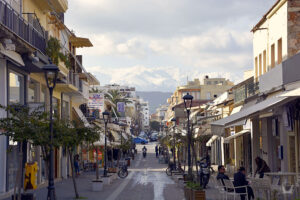 the seven kilometers to Amnisos, Knossos‘s harbour in the Bronze Age, that ancient shore from which ships once departed for a world that no longer exists. I did not walk all the way to the sea. But I stood where the road begins, and that was enough to understand something about distance.
While in Crete I also went to Chania, to stand at the old Venetian harbor and watch the White Mountains hold their snow against a March sky. I went east, to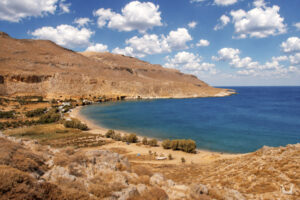 Zakros, where the palace sits at the edge of a gorge that opens onto the sea. It is one of the most remote and least visited sites on the island, and one of the most beautiful. There is something at Zakros that the guidebooks cannot give you: the sensation of standing at the edge of a vanished world, with the Aegean on one side and the hills on the other, and nothing between you and the Late Bronze Age but three thousand years of silence.
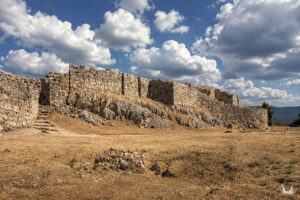
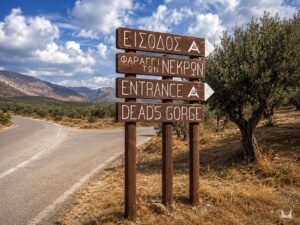 In the Peloponnese, I traced the landscapes of Arkadía, the Argolid, and Korinthía on foot and by bicycle. I know the plain of Neméa in April, when it is green and cold and the almond trees are already past their flowering. I rode eighty kilometers from Nafplion to Archaia Neméa and back in a single day—past Tiryns with its Cyclopean walls, over the hills, through villages where the road sign is the first indication that anyone else has ever been there. I came back through lightning and snow. I was fifty-five years old, soaking wet in bike shorts and a tank top, and completely happy.
 This is the thing that is difficult to explain to someone who has not done it. Literary travel is not research in the library sense. It does not give you facts. It gives you truth, which is a more demanding and irreplaceable thing. The facts I can find in Sinclair Hood and Emily Vermeule and John Chadwick. The truth of how a place feels under your feet, in your lungs, against your skin at a particular hour of a particular day in a particular season: that I can only find by going.
For Meeting Donatello and A Tale of Paris & Paris: Echoes of Troy, the territory was Tuscany, specifically Florence and Cortona, both in 1450 AD. In Florence I walked Via Porta Rossa until I could have walked it blindfolded. I stood in 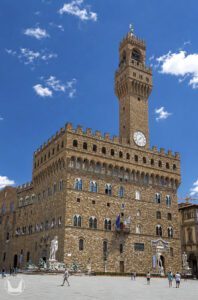 the courtyard of Palazzo Davanzati—then the Davizzi palace—and looked up at the well and the loggia and understood something about interior space in a fifteenth-century merchant’s house that no architectural study had given me. In Piazza della Signoria I stayed until the light changed and the square became what it was, rather than what the
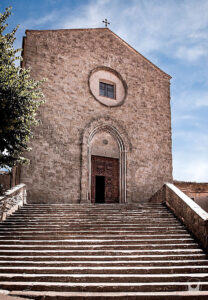
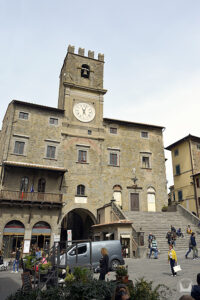 tourists see. In Cortona I walked the Ruga Piana, which the Cortonesi have always called by its old name regardless of what appears on maps, and Piazza della Repubblica, simply La Piazza centuries ago, and the path to Porta Montanina where the city ends and the Apennine Mountains loom before you. In Cortona, one thing is certain: you must climb to get anywhere. I found the Church of San Francesco and sat in it for hours, days at a time. I did not take notes. I was trying to feel what Fra Helias de Assisi felt when he prayed within it, or what a young officer of the Civic Militia might have felt in a city that was already old when he returned.
 I have been asked whether this approach is strictly necessary. Could I not, with enough archival research and enough imagination, write convincingly about places I had not visited? Perhaps. Other novelists do. But I am not other novelists, and I distrust my imagination when it is not grounded in sensation. I write archaic English because I believe language should carry the texture of its time. For the same reason, I believe that setting should carry the texture of its place, and that texture is available only to those who submit to it.
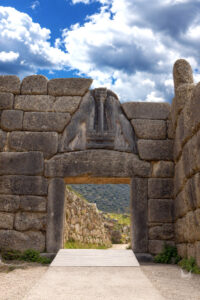 Mary Renault wrote about ancient Greece as though she had been there. In a sense, she had—through decades of reading, an exceptional historical imagination, and a discipline of attention that I can only admire. But Renault also lived in South Africa, not Athens, and I sometimes wonder what she would have written had she been able to stand beneath the Lion Gate at Mycenae and feel the weight of the lintel above her head. Not different, perhaps. Only more certain.
I go because I need to be certain. I go because my readers deserve a writer who has stood where his characters stand. I go because the stones remember things that books cannot hold, and I am, before anything else, a person who listens to stones.

Rio de Janeiro, Autumntide of MMXXVI.



Click any cover to read a preview chapter and learn more.