People sometimes ask me why I write the way I do. The question usually comes wrapped in a polite puzzlement, as if the asker suspects a rational explanation must exist but cannot quite locate it. Occasionally it comes less politely: “People don’t talk like that.” True enough. They didn’t talk like that even then, not exactly. Written language has always been a heightened register, a deliberate construction. That is the point. That has always been the point.
 I write literary historical fiction. Not historical fiction as window-dressing—a few “methinks” scattered across an otherwise contemporary prose style—but fiction that attempts, with full scholarly seriousness, to recreate the inner life of another age. For me, that means the language must carry the weight of the period. The story of Asterios and the Labyrinth inhabits the Late Minoan Bronze Age; A Tale of Paris & Paris: Echoes of Troy is set in fifteenth-century Cortona; Atalanta of the Wild renders a mythological Bronze Age through the voice of a fifteenth-century man of letters. Each of those worlds demands a different linguistic texture. None of them is served by contemporary English prose.
The Grammar of Another Time
My starting point, always, is the vocabulary and syntax of Middle English, not as a costume but as a foundation. When I began writing, I studied it with deliberation; by now I have so thoroughly internalized it that my first drafts already reflect it. But internalization is not improvisation. Every choice I make rests on a principle.
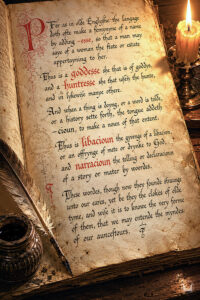
Take the suffix -ess. In modern English, nouns ending in -ess have settled into their present form: goddess, huntress, priestess, brightness, fairness. In Middle English, many of these words bore an additional syllable: goddesse, huntresse, priestesse, brightnesse, fairnesse. I adopt  this practice in Atalanta of the Wild, where the narrator’s voice belongs to the fifteenth century. The extra syllable is not mere ornamentation. It changes the music of a sentence. “She stood before the goddesse” moves differently than “She stood before the goddess.” The added breath, the slight lengthening, gives the word a weight that suits a world in which such presences were not metaphorical. I apply this rule only to nouns; adjectives and adverbs that end in -less—speechless, tireless, endless, restless—remain as they are in modern usage because they do not carry the same historical echo.
The suffix -tion receives similar treatment in Atalanta. Abstract nouns of three or more syllables—narration, revolution, libation, affection—become narracioun, revolucioun, libacioun, affeccioun. The spelling reflects the actual orthographic practice of Middle English scribes and signals, without any need of authorial explanation, that the narrator inhabits a world before spelling was standardized. I do not apply this to two-syllable words—motion, question, action, potion—because in those cases the archaic spelling would feel strained rather than natural. The eye would stumble where it should glide.
Anglo-Saxon Over Latinate, With Exceptions
One of the defining features of Middle English prose is its preference for native Anglo-Saxon vocabulary over Latinate borrowings whenever an Anglo-Saxon alternative existed. I follow this preference rigorously, but not mechanically. The verb prepare, for instance, was known in the fifteenth-century, yet people of that era were far more likely to say make ready, make all ready, make provision, ordain, array, or set in order. Each of these serves the same function as prepare, yet none of them requires a reader to reach for a dictionary. They are immediately comprehensible. They are also richer: array carries a sense of ceremonial arrangement; ordain implies a purposefulness that prepare does not; make all ready has a bustling, practical energy. The variety itself is an artistic resource.
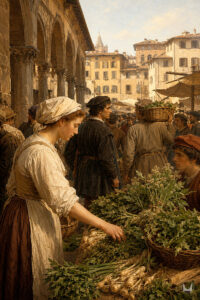 Similarly, I avoid however—not because it did not exist in Middle English, but because it was not the word people of that era characteristically chose. Their toolkit included yet, natheless, howbeit, albeit, nevertheless, howsoever, for all that, and notheless. I rotate among these not at random but with attention to the rhythm and weight each one contributes to the sentence that contains it. Natheless is heavier, more formal; yet is the quickest and most conversational; howbeit carries a slight concessive dignity. These are not interchangeable. They are instruments in different registers.
Perhaps presents a parallel case. It was uncommon in the period; people reached instead for mayhap, haply, peradventure or peraventure, it may be, percase, belike, or so might it be. Belike, which carries the specific shade of probably, is particularly useful in dialogue, where a character is not expressing genuine uncertainty but a kind of confident supposition. Again: these words are not opaque. A reader who has never encountered haply will understand it within a line or two. And having understood it, that reader now possesses a word they did not have before.
Cadence, Musicality, and Meaning
Here is what I have come to believe, after years of working in this mode: language is not merely the vehicle of meaning. It is part of the meaning. The music of a sentence—its rhythms, its syllable counts, its pauses—carries emotional information that a paraphrase into contemporary English would flatten entirely.
Consider this exchange from one of my manuscripts:
Upon the way he leans nigh her ear and murmurs, “How fare you?”
“I weep of bliss, for ever has my mother longed for me.”
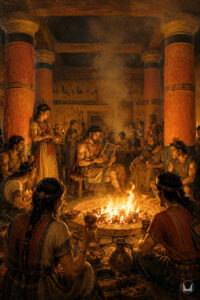 You could render this in contemporary English: Along the way he leans close to her ear and murmurs, “How are you?” “I’m crying with happiness. My mother had always wanted me.” The information is the same. The experience is not. The contemporary version is serviceable prose. The archaic version is music. I weep of bliss has a cadence that makes the emotion physical; how fare you is a question asked with an intimacy that how are you cannot achieve.
Or consider this moment from A Tale of Paris & Paris: Echoes of Troy:
“Such a gay notion you propose!” He plucks the beret from the hand of his Paris. “Tarry and break your fast with me.”
Gay meant happy in the Quattrocento. That is what the character means. I confess I made it a deliberate pun as well, a gift to readers who catch it. Tarry means to stay longer; break your fast is breakfast. None of these words requires scholarly annotation. And yet the cadence of “Tarry and break your fast with me” is entirely unlike anything a contemporary character would say, which is precisely the point: this character is not a contemporary character. He is a man of fifteenth-century Florence, and he sounds like one.
The Author’s Defense
I am aware that my prose is not transparent. I would fail any MFA program, and I do not give a rat’s arse—my adaptation of Rhett Butler‘s famous line, which I offer with full and cheerful acknowledgment. Some readers tell me that people don’t speak like that anymore, that my prose is too dense, that it has too many big words. My reply is always the same: “There is a taste for every palate. But thank you for validating my artistic vision.”
 James Joyce wrote Ulysses and Finnegans Wake in Modern English, and I have never succeeded in reading either of them. William Faulkner wrote in Modern English, and his sentences defeat me regularly. No one accuses them of willful obscurity—or rather, some do, but those accusations have not diminished their standing. Umberto Eco wandered into Latin, medieval philosophy, and semiotics without apology, and his readers followed him gladly. I am in good company.
The difference between my prose and theirs is that I impose a clear constraint upon myself: if the meaning of what I write is genuinely obscure, I rewrite it or cut it. I am not interested in obscurity for its own sake. I am interested in the recreation of a past that actually existed, a past in which people thought and spoke with a different music, a different vocabulary, a different set of assumptions about what words could do. My goal is to make that past available to a reader without falsifying it. The archaic register is not an affectation. It is an act of historical fidelity.
And beneath that fidelity lies something simpler: I find this language beautiful. I have spent years in its company. It has given me words and expressions I would not surrender: natheless, peradventure, howbeit, make all ready, weep of bliss. These are not obscure relics. They are tools, finely made, passed down from hand to hand across six centuries. I use them because nothing else does the same work in quite the same way.
In the end, that is all the justification I require.
Rio de Janeiro, the xxiii day of May, MMXXVI.

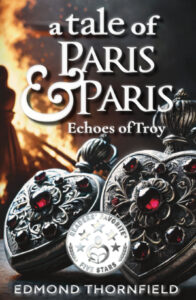
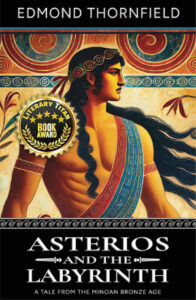

Click any cover to read a preview chapter and learn more.