On Ovid, Myth, and Historical Imagination

There is a question every novelist must answer, if only to themselves: why this story, and why now? For me the answer arrived not gradually but all at once, in the final lines of a myth I had known for years without truly seeing.
 Ovid tells Atalanta‘s story across two books of the Metamorphoses, and he tells it with characteristic elegance and speed. The Calydonian Boar Hunt occupies Book VIII, some 190 lines in which Atalanta draws first blood, wins the spoils, and ignites Meleager‘s fatal passion. The footrace, the golden apples, the transgression in the sanctuary of the Great Mother, and the transformation fill roughly 147 lines of Book X, as though the poet were summarizing a tale his readers already knew and needed only to be reminded of. In all likelihood, he was doing exactly that. Taken together, Ovid gives Atalanta perhaps 340 lines across the whole of the Metamorphoses—generous by his standards, yet still a sketch beside what the story contains.
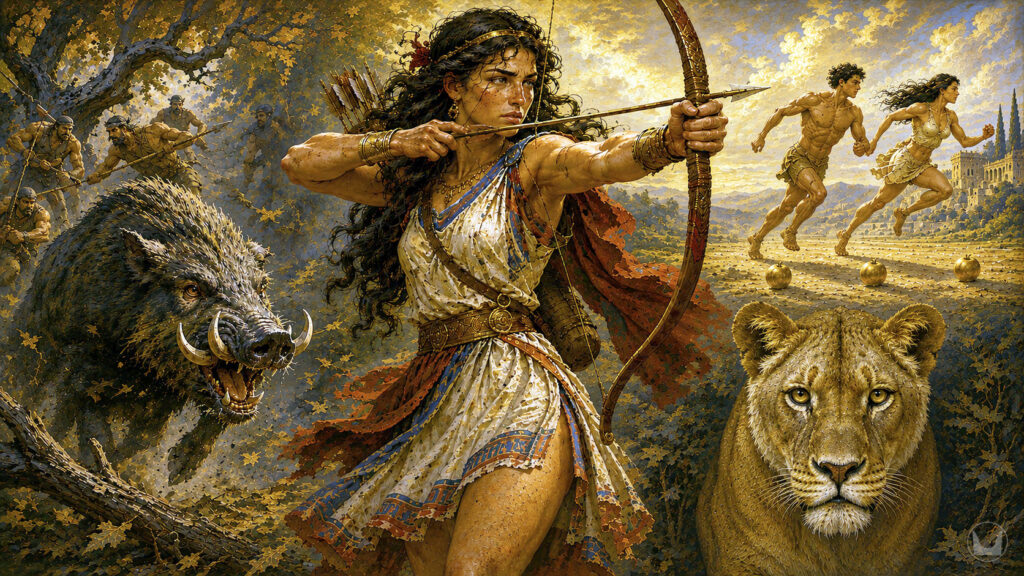
It was the Arcadian Atalanta who compelled me, the daughter of King Iasios of Tegea, exposed on the slopes of Mount Parthenion at birth because her father had wanted a son, suckled by the she-bear, Megale, sent by Artemis, raised in the wilderness, initiated into the hunt before she was initiated into anything else. This is a woman whose biography reads less like mythology and more like a provocation. Every expectation her world placed upon a woman of noble birth, she refused. She hunted. She ran. She fought  alongside heroes in the Calydonian boar hunt, drawing first blood against the great boar when the men about her had missed their mark. She killed the centaurs Rhoecus and Hylaeus when they attempted to assault her in the forest. She sat among the Argonauts, if some traditions are to be believed. She was, in the language of her own time, a figure outside category—neither the docile daughter nor the cloistered wife, but something the Greek world had no comfortable word for: a free woman, moving through a world that had not been built to accommodate her.
And then Book X brings her story to its close. Hippomenes, devoted to Aphrodite, obtains three golden apples from the goddess and uses them to win the footrace that should have cost him his life. They marry. They are happy, or something near it. And then, overcome by a divinely inflicted passion, they enter the sanctuary of the Great Mother, whose worship was ancient even then, and desecrate it. The goddess transforms them both into lions. Ovid moves on. The Metamorphoses has other business.
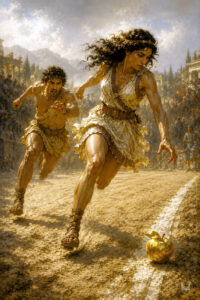 That abruptness is what stopped me, not the footrace, which is brilliant theatre, nor the golden apples, which are among the most satisfying devices in all of ancient literature, but the silence that follows the transformation. Ovid gives us the deed and the punishment; he gives us nothing of what it costs. What does Atalanta lose in that moment? What does she carry with her into the lion’s body—the memory of the hunt, the feel of a bowstring against her fingers, the sound of Néos’s voice? What does it mean to have been, in every sense that mattered, more fully alive than almost anyone around you, and then to be reduced, by a god’s displeasure, to a beast that cannot speak?
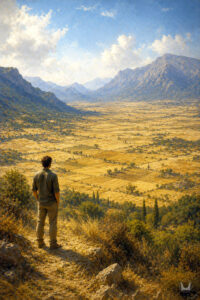
These were not questions I could answer from a desk in Rio de Janeiro. I went to Greece. I stood on the plain of Tegea and felt the weight of the Arcadian air in late summer. I climbed the slopes of Mount Helikon, where the oak and pine still stand thick and the streams run cold over limestone even in the dry season. I biked from Tegea through Argos to the Isthmus of Corinth, measuring in aching limbs what the journey would have meant to people who traveled on foot and reckoned distance in days rather than kilometers. I needed the landscapes not as backdrop but as argument because Atalanta‘s story is inseparable from her terrain. She is a creature of the Arcadian wild. Take her out of those mountains and forests and you have a myth; put her back in them and you have a person.
 The novel that grew from those journeys is not a retelling of Ovid, though it is in dialogue with him throughout. It is an expansion of what he left unwritten: the sixty days of searching on Mount Helikon, the friendship between Atalanta and Néos that outlasts transformation and death, the theological machinery by which Artemis is finally moved to act, the question of what a deity owes to the mortal who has served her faithfully. Hippomenes, in my account, is not a clever suitor who got lucky. He is a man of genuine devotion and intelligence, whose love for Atalanta is as serious as anything in the novel, and whose fate, remaining a lion in Artemis‘s keeping on Mount Helikon while Atalanta is restored to herself, is the tragedy the book builds toward.
I have been asked whether it troubles me to write about a woman’s story from the outside, as a man. The question is fair and I take it seriously. My answer is that I do not think I am writing from the outside. Atalanta‘s refusal to accept the life her world prescribed for her, her insistence on living by her own code regardless of the cost, is not a specifically female experience. It is a human one. The price she pays for that insistence, the loneliness that attends any life lived at the edges of what a society will permit, the love that is profound precisely because it is freely given and cannot be 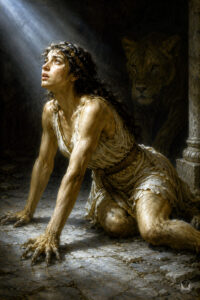 commanded, these are things I recognize. They are what myth is for: to give form to the experiences that resist ordinary language, to hold in a single story what any one life is too small to contain.
Atalanta demanded a novel rather than a chapter because her story is not a cautionary tale, not a moral fable, not an entertaining footnote to the Calydonian boar hunt. It is the story of a woman who was extraordinary by every measure her world possessed, who loved and was loved in return, and who was destroyed not by any failure of her own but by the intersection of human passion and divine caprice. That is a tragedy in the fullest sense of the word. It deserves the full weight of a novel to carry it.
Ovid may have known this, even as he moved on. He gave her three hundred and forty lines and then stepped back. I have given her the rest.

Rio de Janeiro, the xxiii day of May, MMXXVI.

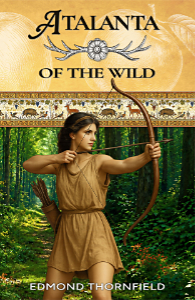
Click the cover to read a preview chapter and learn more.