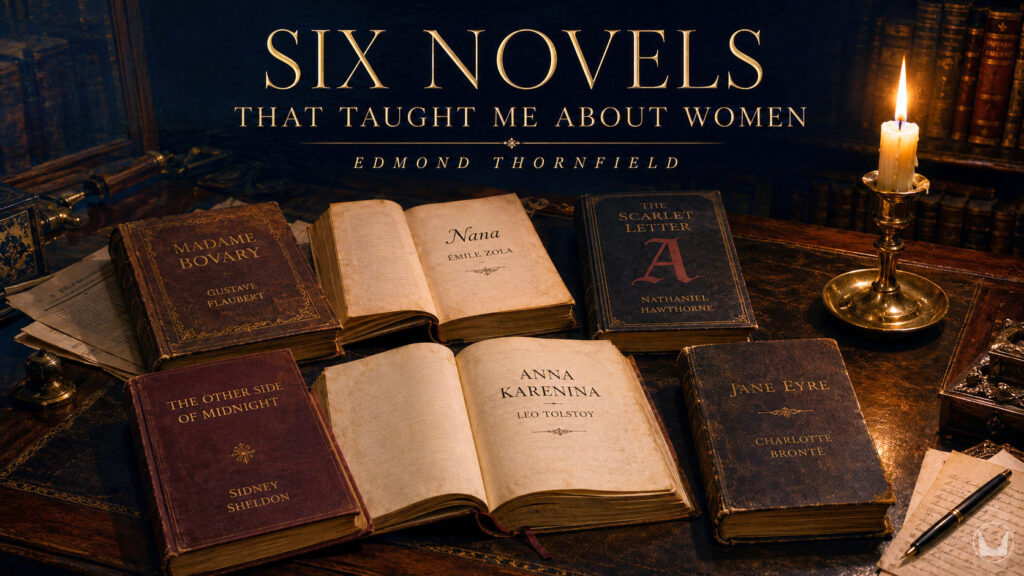
I have spent a great deal of my writing life inside the minds of women. Atalanta, Elena, Pasiphaë, Costanza, Stella—the women of my novels are not secondary figures, not love interests arranged around a male protagonist. They are the story, or so much of it that the distinction barely holds. People sometimes ask me how I came to write women the way I do. The honest answer is: I was taught. Not in any classroom, not by any writing instructor, but by six novelists who understood something about women that the world at large has always been reluctant to admit: that their inner lives are as vast, as contradictory, as heroic, and as tragic as any man’s. Possibly more so because they have had to conduct those inner lives under conditions no man has ever been asked to endure.
These are the six novels that gave me that education.
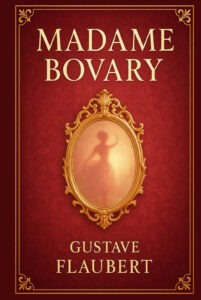
1. Madame Bovary, by Gustave Flaubert (1857)
Emma Bovary is the most dangerous woman in nineteenth-century fiction, and the danger has nothing to do with her adultery. It has to do with her imagination. Emma wants—hungers, burns, consumes herself with wanting—in a world that has decided women should not want at all, or if they must, should want only what has been assigned to them: a husband, a household, a quiet life in the provinces. Flaubert does not judge her for wanting more but does something far more devastating. He shows exactly what that wanting costs, in a world utterly indifferent to it.
What Flaubert taught me is that desire in a woman is not a character flaw. It is a form of intelligence, a recognition that the life on offer is insufficient. Emma is wrong about the men she chooses, the debts she incurs, the romantic fantasies she mistakes for reality. But she is right about the fundamental thing. The life she was given was too small for her. Every woman I have written since Emma has carried some trace of that recognition.
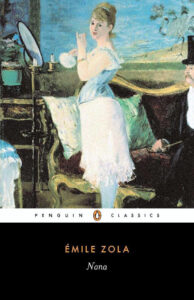
2. Nana, by Émile Zola (1857)
Where Flaubert gave me interiority, Zola gave me power and the price of it. Nana Coupeau rises from the gutters of Paris to become the most desired woman in the city, and she wields that desire like a weapon. Men ruin themselves for her. Fortunes dissolve, reputations collapse, families shatter. Zola‘s genius is that he refuses to make her either a villainess or a victim. She is simply a force of nature, beautiful, careless, and ultimately as destroyed by the system that created her as every man she undoes along the way.
What Nana taught me is that power and vulnerability can inhabit the same body simultaneously, and that a woman can be both agent and object without contradiction. She is not passive. She chooses, acts, and dominates. And yet the world in which she operates was built to consume her. I think of Nana whenever I write a woman who moves through a world that desires and despises her, which is to say I think of her often.

3. The Scarlet Letter, by Nathaniel Hawthorne (1850)
Hester Prynne stands at the center of a community that has decided to make of her a public symbol of its own repressed desires. She wears the scarlet letter not because she is broken by it but because she refuses to be. That is the novel’s great and radical gesture: Hester endures, but she does not submit. She raises her daughter alone. She earns her living with her needle. She quietly becomes a figure of counsel and compassion for the very community that condemned her. And she never accepts their verdict on her worth.
Hawthorne taught me the dignity of endurance, not passive endurance, but the active, daily choice to remain oneself in the face of a world determined to define you otherwise. Every woman I write who stands her ground in a world that would prefer her silence owes something to Hester Prynne. In my novel, A Tale of Paris and Paris: Echoes of Troy, she inspired me to create my Stella Prinelli.
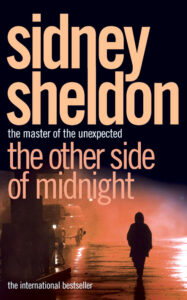
4. The Other Side of Midnight, by Sidney Sheldon (1973)
I include this novel without apology, and I anticipate the raised eyebrow from readers who consider it beneath the company of Flaubert and Tolstoy. They are wrong, or at least they are missing the point. Noelle Page is one of the most ruthlessly drawn female protagonists in popular fiction. She is a woman of extraordinary beauty and zero illusions who decides, after being abandoned and humiliated, that she will never again be at the mercy of anyone. She builds her life with the cold precision of an engineer. She succeeds. And then she destroys herself, because the architecture of revenge, however perfectly constructed, cannot bear the weight of a human heart.
What Sheldon gave me that the literary novelists sometimes withheld is this: women are capable of the full range of moral complexity that we readily grant to men in fiction—ambition, ruthlessness, calculation, obsession, and a capacity for self-destruction that is entirely their own, not the product of any man’s influence. Noelle Page taught me never to write a woman as simply good or simply wicked. The truth is always more interesting than either.
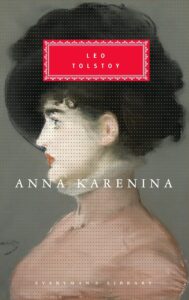
5. Anna Karenina, by Leo Tolstoy (1878)
Tolstoy did not intend to write a novel in defense of Anna Karenina. By his own account, he began with something close to moral condemnation in mind. What he produced instead is one of the great acts of artistic self-correction in literary history: a novel that set out to judge a woman and by the end found itself unable to do so. Not because Anna is innocent of the choices she makes, but because Tolstoy, with the ruthless honesty that defines his genius, could not pretend that those choices were made in freedom.
Anna lives in a society that grants her no exit. She cannot divorce without scandal and the loss of her son. She cannot love openly without destruction. She cannot even grieve without being observed and interpreted by a world that has already decided what she is. Her tragedy is not that she loved Vronsky. Her tragedy is that she was given no tolerable alternative. The train that opens the novel and closes it is not a symbol of fate so much as a symbol of the only door that Russian society of the 1870s left open to a woman in her position.
What Anna Karenina taught me is that social structure is not backdrop. It is plot. The world a woman inhabits does not merely constrain her; it shapes every choice available to her. A novelist who ignores that is writing fantasy, not fiction. I have never since written a female character without first asking: what does her world permit her? What has it already decided about her before she speaks a word?
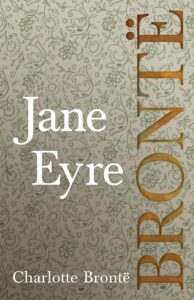 6. Jane Eyre, by Charlotte Brontë (1847)
Jane Eyre is the smallest figure in this list—plain, poor, without family or fortune or any of the conventional instruments of female power—and she is the one I return to most often. Because Jane Eyre has something none of the others possess in the same measure: an unshakeable knowledge of her own worth. She is not beautiful like Nana, not romantically inflamed like Emma, not socially grand like Anna. She is a governess with strong opinions and a stronger conscience, and she moves through a world that underestimates her at every turn without ever, for a single page, underestimating herself.
Brontë gave Jane an interior life of such intensity and clarity that the reader never doubts, even in the novel’s darkest passages, that Jane‘s own judgment of herself is the correct one. Rochester’s, St. John’s, and society’s judgments are not. That is an extraordinary technical achievement, and it rests entirely on the quality of Jane‘s voice: first-person, direct, without self-pity, brightly intelligent. She does not ask the reader to pity her. She asks the reader to see her. And the reader does.
What Jane Eyre taught me is that a woman’s moral authority in fiction need not derive from beauty, rank, or tragedy. It can derive simply from the quality of her attention to the world, the precision and honesty with which she sees and reports. Every time I write a female narrator, Jane Eyre is somewhere in the room. The influence runs so deep that Thornfield found its way into my own name, just as Edmond is my homage to Alexandre Dumas‘s character.

I did not set out to write women well. I set out to write people truly, and I was fortunate enough to learn from novelists who understood that the two are the same undertaking. Emma, Nana, Hester, Noelle, Anna, Jane—they taught me that a woman’s inner life is not a specialty subject, not a subcategory of human experience requiring particular delicacy or distance. It is simply human experience, lived under particular conditions. A novelist’s first obligation is to those conditions, and to the person living within them.
I hope I have honored the lesson.
Rio de Janeiro, the xxiv day of May, MMXXVI

PS: A special mention goes to my former wife and the women friends of a lifetime. Boy oh boy, have they taught me about women. 😂