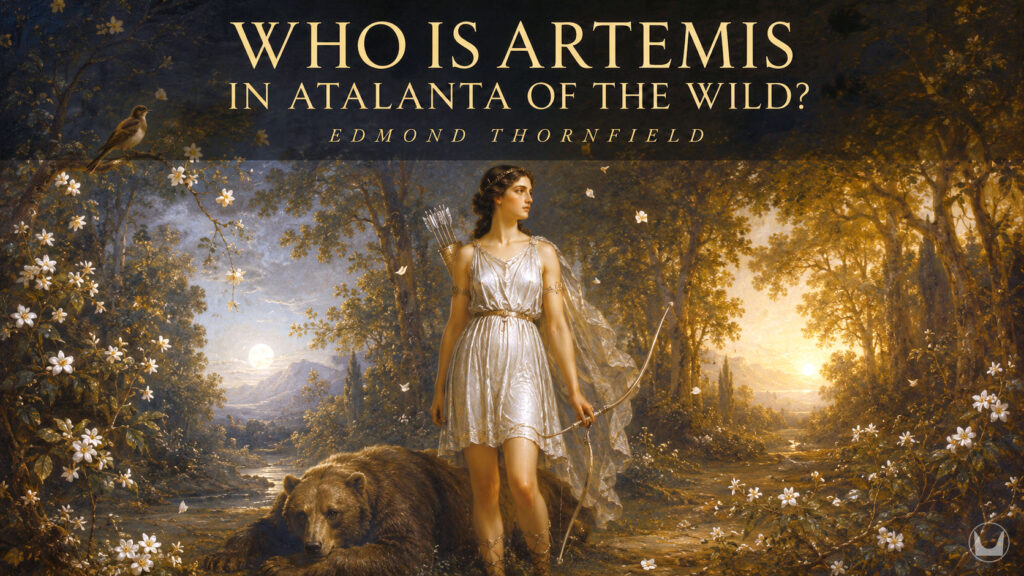
Of all the gods of the Greek pantheon, Artemis is the one most commonly misread. Popular imagination has settled on her as a figure of cold severity, the virgin huntress, remote and punishing, more comfortable among animals than  among people, quick to anger and slow to forgive. There is evidence for this reading in the myths: she sent the Calydonian boar to devastate the countryside of King Oinēos because he neglected her altar; she transformed Actaeon into a stag and watched him torn apart by his own hounds because he stumbled upon her bathing. She is not a goddess to cross.
And yet this is not the whole of her. The epithet by which she was known in the oldest layers of Greek religion is Potnia Thērōn, the Mistress of Wild Things—not the destroyer of wild things, not their indifferent sovereign, but their mistress, the one who tends them, guards them, and presides over the cycle of their lives with something closer to stewardship than dominion. It is this Artemis, older than the Olympian myths, closer to the earth, more intimate with the creatures she protects, who appears in Atalanta of the Wild. She is nothing like the cold huntress of popular imagination.
 The Goddess Who Stoops
The first thing Artemis does in my novel is stoop. A newborn infant has been abandoned on the slopes of Mount Parthénion by a father who wanted a son, exposed to the cold and the dark in the ancient Greek manner. Artemis finds her first. She sends Megálē, the she-bear, to nurse and rear the child for a season, and then she delivers the infant to Ekherāwos and Akhiléos, her priests, hunters of considerable skill, who will raise Atalanta as their own. Through Ekherāwos’s marriage to Pasiphessa, the abandoned child gains a mother, sisters, and a home in the forest she will come to love more than any palace.
This is the defining gesture of the Artemis I have written: she acts. She does not watch from Olympus with divine detachment; she intervenes, arranges, protects. The infant Atalanta is not merely saved by providence; she is saved by a goddess who chose her and has continued choosing her ever since. That choice, and what it demands of both goddess and mortal, is one of the novel’s abiding concerns.
 A Goddess Who Shows Affection
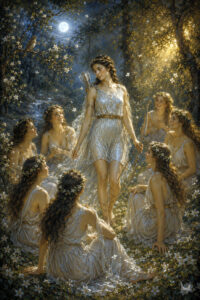
I made a deliberate decision early in the writing of this novel: Artemis would be warm. Not sentimental, not without authority, not stripped of the divine power that makes her presence felt whenever she appears, but genuinely fond of those she considers her own. Her nymphs, Atalanta, Periklos, and later Atalanta‘s younger sisters Ariswē and Nassa, all receive from her a quality of attention that the myths rarely grant their deities: affection, freely given and plainly shown.
This warmth has a sensory signature in the novel. Wherever Artemis appears, nature alters around her. The light shifts to something silvery and gold simultaneously, as though moonlight and sunlight have reached an agreement. Nightingales sing. The perfume and petals of white jasmine drift through the air. These are not arbitrary details. Jasmine is a flower associated with the moon, with purity, and with the liminal hours between night and day, the hours that belong to Artemis. When the reader encounters that scent, they know before they see her that the goddess has arrived.
 Her Relationship with Periklos
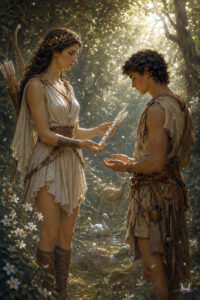
One of the novel’s quieter inventions is the bond between Artemis and Periklos, Atalanta‘s brother. He is not, in any traditional source, a figure connected to the goddess; he is my own expansion of the mythological record, Atalanta‘s companion and counterpart, the second person, after Néos, her confidant, who knows her most completely. Artemis is particularly fond of him, and she marks that fondness with a gift: a swan flute, carved with care, possessing the power to summon her or her servants in any moment of mortal peril.
The swan flute functions as one of the novel’s structural Chekhov’s guns. It is given in Chapter Six, used twice when needed, and then a last time at the novel’s climax, when Periklos and Néos discover Atalanta and Hippomenes transformed into lions on the slopes of Mount Helikon. The gift is not decoration. It is a promise—and the question the novel quietly holds across its chapters is whether Artemis will honor it, and what the cost of honoring it will be.
 The Boar, the Hunt, and the Goddess’s Permission
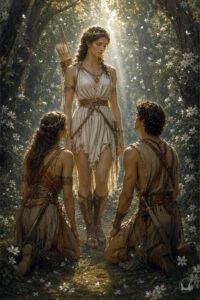
When Atalanta and Periklos prepare to join the Calydonian boar hunt, they do not simply set out with the other heroes. They go first to Artemis and ask her permission. This is entirely in keeping with their relationship. They are hers first, and the boar they intend to hunt is her instrument. It was Artemis who sent the dread creature upon the land of King Oinēos as punishment for his failure to honor her altar among his harvest sacrifices. To hunt it without her blessing would be an act of impiety; to ask for that blessing is an acknowledgment of the order of things.
The goddess’s answer is instructive. She tells them that the boar’s usefulness has run its course, that the punishment has been sufficient, the lesson delivered, and the creature may now be brought down. She hopes they win the glory of slaying it. There is something almost tender in that last detail. She is not merely granting permission but expressing hope on their behalf, as a patron expresses hope for those in her care. When Atalanta later learns that Meleager, too, is a servant of Artemis, known at her temple in Calydon as Artemis Laphría, the cult that unites hunter and huntress across regional distance becomes another thread in the novel’s texture of divine presence in mortal life.
 The News of Meleager‘s Death
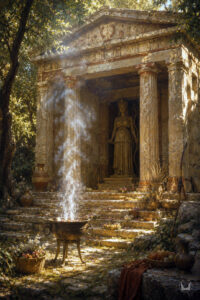
There is a technical problem that every novelist working in close third-person narration eventually encounters: how do you deliver information to a character that the character has no natural means of receiving? Ovid, writing in the omniscient voice of a public narrator, could simply tell his readers that Meleager died. I could not. My narration follows Atalanta and Néos in close alternating perspective, and neither of them is present at Meleager‘s death.
My solution was Artemis. The goddess delivers the news to Atalanta herself, not as a cold divine announcement but as the act of a protector who will not allow her charge 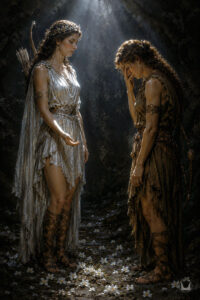 to learn such things from strangers or rumor. It is one of the most intimate scenes the goddess has with Atalanta in the novel, the moment when a deity steps into the space between what has happened and what the mortal world knows, and chooses to be the one who speaks.
Before and After the Footrace
Artemis appears twice in relation to the footrace, before it and after it, and the two appearances together constitute the novel’s fullest portrait of the goddess’s theology.
Before the race, she does not forbid it. She does not warn Atalanta away from Hippomenes or invoke divine authority to alter the course of what is coming. She is the Mistress of Wild Things, and wild things must also procreate; the cycle of life she  presides over is not limited to the hunt. What she offers instead is reassurance: that whatever the outcome, Atalanta will not lose her favor. She will not be cast aside because she takes a husband.
After the race, when Atalanta has lost and marriage is inevitable, Artemis speaks words that are among the most quietly beautiful in the novel: that unto her and Megálē, Atalanta shall forever be the babe they found upon the mount. Then she speaks with the blunt practicality of a goddess who understands biological necessity: “Go unto Hippomenes. Become his wife and bear his cubs.” It is an extraordinary line—at once divine permission, maternal tenderness, and the Mistress of Wild Things speaking in the only register that has ever fully been hers.
 The Climax and What It Costs
I will not reveal here what Artemis does at the novel’s climax when Periklos sounds the swan flute on Mount Helikon and the goddess arrives. That is the novel’s final gift to readers, and it belongs to them when they reach it.
What I will say is this: the Artemis of Atalanta of the Wild is a goddess who has made a promise and who, when the moment of reckoning arrives, must decide what that promise is worth. What she does in that moment is my contribution to Ovid’s tale, my answer to the question he left open when he moved on after the transformation and returned to other business. It cost me more thought than almost any other passage in the novel. I hope, for those who read it, that it costs something in feeling, too.
The Artemis of ancient Greek religion was never simply one thing. She was the virgin and the midwife, the huntress and the protector of the young, the sender of plague and the guardian of childbirth. She presided over transitions, the moments when one state of being passes into another, when the girl becomes the woman, when the living become the dead, when the mortal becomes, by divine intervention, something else entirely.
It is that Artemis—complex, ancient, genuinely caring, and fully capable of both mercy and its opposite—who walks through the pages of Atalanta of the Wild. She is not an abstraction. She is a presence. And wherever she appears, the jasmine is already in the air.

Rio de Janeiro, the xxiv day of May, MMXXVI.


Click the cover to read a preview chapter and learn more.