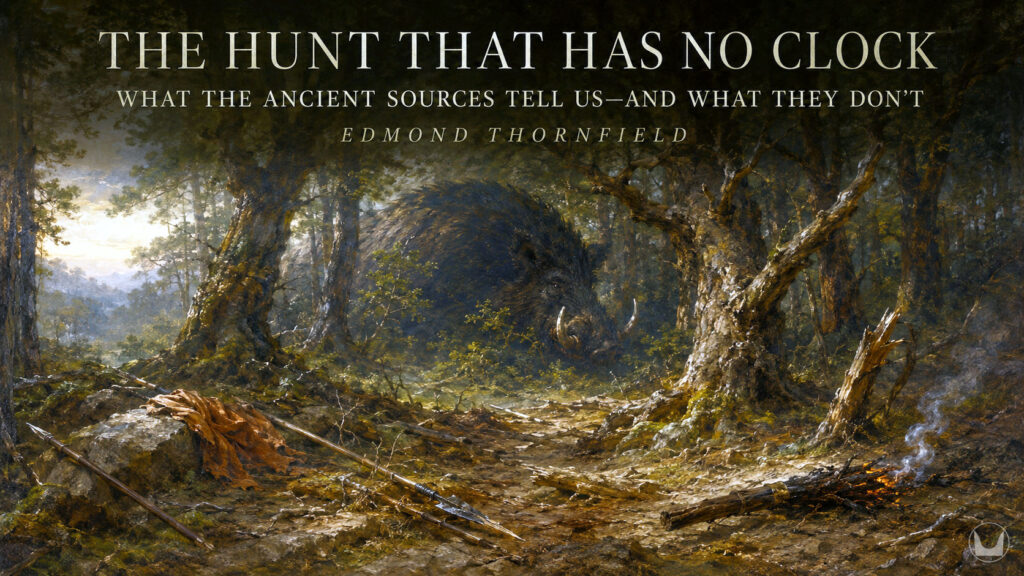
 Every novelist who works with ancient mythology eventually arrives at the same uncomfortable discovery: the sources disagree, they fall silent, or they compress into a few lines of poetry what would have taken days or weeks of human effort to accomplish. The Calydonian Boar Hunt presented me with those three problems, and the most instructive of them was the third.
When I began writing the chapters of Atalanta of the Wild in which the heroes gather at Khalydōn, track the dread boar through the forests and glens of Aitōlía, and finally bring it to its end, I needed to know one thing that no ancient source bothers to specify: how long did the hunt actually take?
The answer, after consulting every extant version I could find, is that no one knows. More precisely: no one who wrote about it thought the question worth answering.
 What the Sources Say—and Where They Fall Silent
The fullest narrative of the hunt comes from Apollodorus in the Bibliotheca (1.8.2–3). He lists the heroes, describes the boar’s ravages upon the countryside of King Oinēos, recounts the gathering of the hunters, notes Atalántē‘s wounding of the boar, records Meléagros‘s killing blow, and details the quarrel over the spoils that follows. What he never mentions, not even in passing, is how many days any of this required.
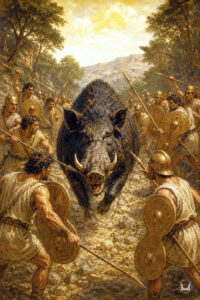
Ovid‘s account in Book VIII of the Metamorphoses (lines 260–444) is the most dramatically vivid, the one I worked closest to in my own telling. He gives us the assembly of heroes, the initial tracking, the boar’s savage attack upon the hunters, Atalántē‘s arrow drawing first blood, and Meléagros‘s final strike. The narrative reads as though the hunt unfolds over one long, continuous day. But this is poetic compression, not literal chronology. Ovid is a poet, not a historian, and his art requires momentum and dramatic unity, not the patient accounting of days spent combing through brake and thorn. He never specifies duration.
 Hyginus, in Fabulae 30, gives a brief summary that lists the heroes and the outcome. Again: no timeframe. And when I turned to Pausanias, Bacchylides, Diodorus Siculus, and the evidence of vase inscriptions, I found the same silence. Not one of them quantifies the hunt.
What Can Reasonably Be Assumed
Faced with this silence, I did what any responsible historical novelist must do: I looked at what classicists infer from the nature of the event itself, and I applied the logic of the physical world.
Two phases of the hunt must be distinguished. The first is the gathering of heroes, which would have required weeks or months. These men came from all over ancient Greece, from Lakedaímōn and Arkadía, from Ithákā and Iolkhōs, from Tirȳns and Athēna. Sea voyages, mountain roads, the logistics of travel in the Bronze Age, none of this unfolds swiftly. But this assembly occurs before the hunt proper, and so, while it shapes the dramatic situation, it does not answer the question of the hunt’s duration.
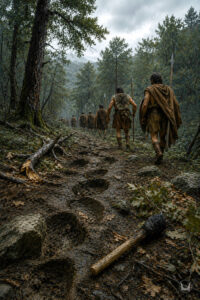
The hunt itself—the active pursuit of the boar through the wilderness of Aitōlía—is a different matter. Comparable heroic hunts in Greek myth and the practical realities of hunting a large and dangerous animal through dense 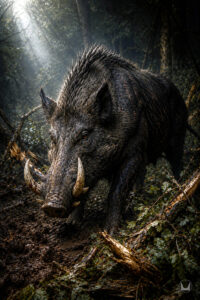 woodland both suggest the same general shape: several days of tracking, driving, and maneuvering through difficult terrain, culminating in a final confrontation that, once joined, would have been resolved within hours. The tracking is slow; the kill is fast.
This is the assumption I brought to my novel, that the hunt lasted several days in the field, though the decisive battle was fought and finished within a single day. It is not a fact that any ancient source records. It is a reasonable inference from the silence of those sources, arrived at honestly and applied transparently. That transparency—the willingness to say this is what the evidence permits, and this is the narrative decision I made within those limits—is one of the obligations of historical fiction written in good faith.
For those who wish to render that duration in the language of the period, here are three phrasings that occurred to me during the writing:
Many days they ranged the wilds of Aitōlía in chase of the dread boar, till at the last they hemmed him in and brought him low.
For days uncounted they hunted through brake and thorn, yet only in one fierce aftertide did they bring the monster to his end.
Long did the chase endure, though the slaying itself was wrought within the compass of a single day.
 Many days they ranged the wilds of Aitōlía in chase of the dread boar, till at the last they hemmed him in and brought him low.
Any of these serves the purpose. The important thing is that the language acknowledges duration without falsifying it. It honors the silence of the sources rather than papering over it with false precision.
Why It Mattered for the Novel
A reader of Atalanta of the Wild might reasonably ask why any of this matters. If Ovid did not specify the duration, why should a novelist feel obligated to think it through?
 The answer is that a novelist’s first obligation to the reader is consistency with physical reality. The world of the novel must obey the same laws of time, distance, and human endurance that the actual world obeys, even when the mythological sources ignore those laws for the sake of dramatic compression. If the hunt in my novel feels lived-in, if the exhaustion of the hunters is credible, if the landscape of Aitōlía accumulates weight and texture across the chapters devoted to it, it is because I spent time working out what the hunt would actually have required of real human bodies moving through real terrain.
The sources gave me the shape of the story. The silence of the sources gave me the space to fill it honestly. That, in the end, is what research is for.
Rio de Janeiro, the xxv day of May, MMXXVI.

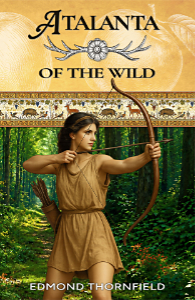
Click the cover to read a preview chapter and learn more.