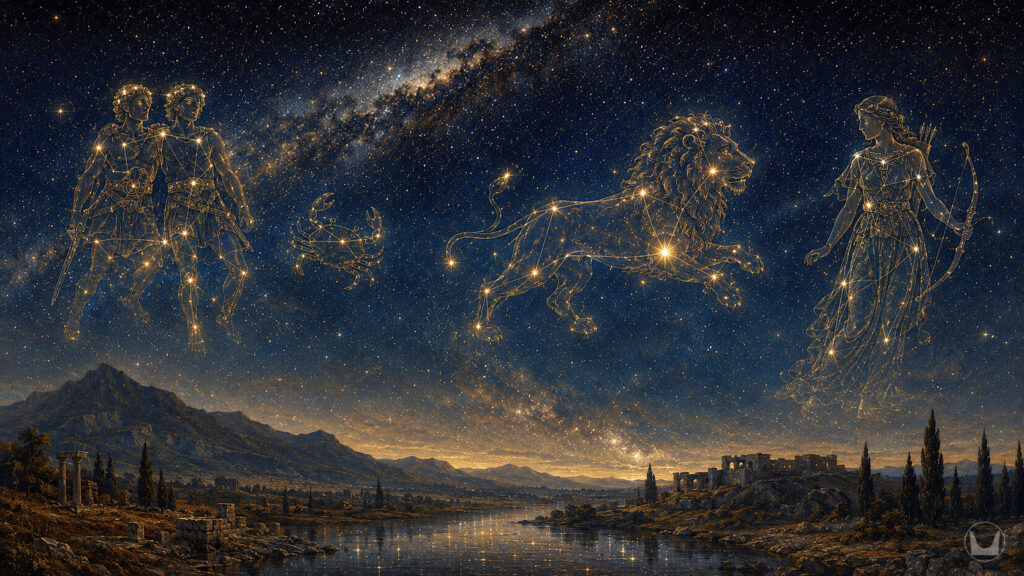
On a clear summer night in the Northern Hemisphere, four constellations rise in sequence from the eastern horizon like old friends arriving at a long-awaited reunion. Gemini the Twins appears first, their bright stars Pollux and Castor burning side by side with the easy companionship of brothers. Cancer the Crab follows, small and subtle, easy to overlook. Then Leo the Lion strides into the sky, his royal star Regulus blazing at his heart with the quiet authority of a king who requires no announcement. And finally, Virgo the Virgin rises—the largest constellation in the zodiac, her brightest star Spica a cool blue-white point of light, steady and unwavering.
To a modern observer, these are patterns of light—beautiful, ancient, useful for navigation. To a Bronze Age Greek standing on the plains of Arcadia or the slopes of Mount Helikōn, they were something altogether different. They were persons. They were stories. They were the gods’ own record of what had happened, inscribed in fire upon the vault of heaven for as long as the world should turn.
It is into this sky that Atalanta of the Wild releases its characters.
The Mythology of Stellar Placement
The Greeks did not merely name their constellations. They explained them. Each stellar figure carried a biography, a reason for its elevation to the heavens, a story of what had been done, suffered, or loved that merited such honor. To be placed among the stars was the highest gift the gods 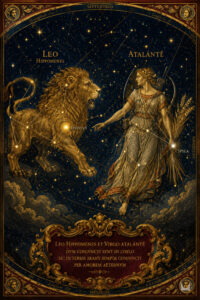 could bestow upon a mortal. It was permanence in a world that offered none. It was the final answer to death.
The tradition is ancient and consistent. Castor and Pollux—the Dioskouroi, the divine twins of Sparta—were placed in Gemini after Pollux, the immortal son of Zeus, refused to accept eternal life without his mortal brother Castor, slain in battle. Moved by such devotion, Zeus granted them immortality: they would alternate between Olympus and the Underworld, and their stars would burn together in the sky for eternity. It is one of the most beautiful gestures in all of Greek mythology, divinity choosing brotherhood over privilege.
It is beside these two that Atalanta of the Wild places its own beloved dead.
The Astronomical Logic of the Novel’s Ending
The placement is not arbitrary. It is astronomically considered.
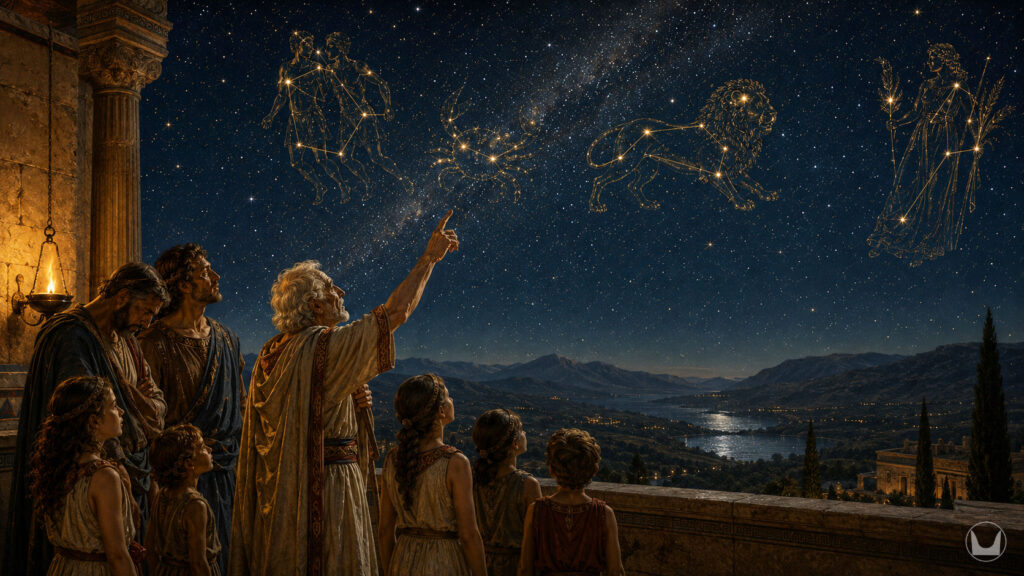
In the zodiacal sequence, Cancer sits between Gemini and Leo—a small, dim constellation serving as a threshold between the bright twins and the great lion. Leo follows, its stars forming one of the sky’s most recognizable figures: the backward question-mark of the Sickle tracing the lion’s mane and head, Regulus at his chest, the hindquarters tapering eastward. And immediately after Leo comes Virgo—vast, graceful, her figure traditionally depicted as a maiden holding a sheaf of wheat, her brightest star Spica marking the sheaf’s tip.
Gemini, Cancer, Leo, Virgo. The Twins, the threshold, the Lion, the Virgin. In the real night sky, these four constellations rise in sequence across the spring and summer months, visible together in the same sweep of the zodiac.
The novel’s elderly narrator Néos, standing on a balcony in Tegéa on a summer evening, raises his arm and traces exactly this sequence for the children gathered around him: “Mark ye the Twins? Polydeúkes lies foremost, Kástōr beside him. And there—past the Crab—the Lion, erstwhile Prince Hippomenes. Nigh unto him, the Virgin, Atalántē the Swift.”
Past the Crab. The detail is precise. Cancer is the gateway through which the eye travels from the Dioskouroi to Hippomenes and Atalántē. The astronomical adjacency is real, and it transforms what might have been a merely poetic gesture into something that feels like discovered truth. It is as though the sky itself had always been waiting to tell this story, and the novel has simply learned to read it.
Why Virgo for Atalanta?
Of all the constellations available to Zeus‘s munificence, Virgo is the right choice for Atalántē on multiple levels.
Virgo is the largest constellation in the zodiac and the second largest in the entire sky. It befits a woman who was the fastest runner in the world, the greatest huntress 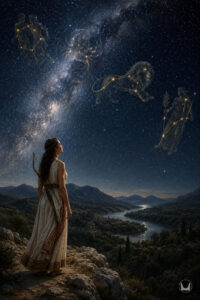 of her age, a figure whose myth spans the Arcadian wilderness, the Calydonian boar hunt, the Argonautic tradition, and the tragedy of the Great Mother‘s curse. Atalántē was never a small story. Her constellation should not be small either.
Virgo‘s traditional figure is a maiden—parthenos in Greek, the same root as Parthenopaῖos, her son, whose name encodes her virginal identity even in his own. The constellation carries within its name the central tension of Atalántē‘s story: the virgin who refused marriage, who outran every suitor, who was finally undone not by force but by golden apples and divine will. To place her in Virgo is to give her back the identity she chose rather than the one fate imposed.
And Virgo rises in spring—the season of Persephone‘s return, of earth restored after winter’s death. For a woman who spent her final years wandering the sacred groves of Mount Helikōn, mourning her lion, and waiting with patient faith for reunion with him in the Underworld, a spring constellation carries the weight of promise kept.
Leo for Hippomenes
Leo is equally apt. Hippomenes entered Atalántē‘s life as a suitor and became a lion by divine punishment. Yet in the novel’s telling, his leonine form is not merely a curse. It is the shape in which he and Atalántē finally live together without the world’s interference, ranging the holy mountain, hunting side by side, known to each other completely. The lion is his truest form in the story’s emotional logic, the body in which he gave and received the deepest love of his life.
To place him in Leo—the royal constellation, the lion of the zodiac, the figure whose star Regulus means the little king—is to restore his princely dignity within the very form that seemed to strip it away. He is not a cursed man wearing a beast’s shape. He is a lion who was also a prince, and the sky honors both.
The Night Sky as the Novel’s Final Page
There is a long tradition in Greek myth of the sky as a library, a place where the gods have stored the stories they wish to preserve beyond the reach of time and forgetting. The constellations are not decorations. They are records.
Atalanta of the Wild ends as it must: not with closure, but with constancy. The characters do not disappear into death or silence. They are elevated into permanence, placed beside the companions of their youth, written into the sky in the only ink that does not fade.
On a clear summer night, you can find them. Trace Gemini first—Polydeúkes and Kástōr, the faithful twins. Let your eye travel east past the dim stars of Cancer. Find the Sickle of Leo, Regulus burning at its base. Then move further east into the vast figure of Virgo, her brightest star cool and unwavering.
There. The huntress and her lion, reunited at last, keep their eternal measure beside the daring Dioskouroi.
Radiant evermore unto the last turn of time.
Rio de Janeiro, the xvi day of May, MMXXVI.

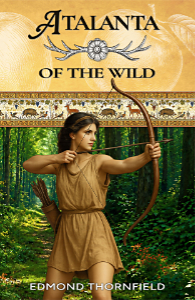
Click the cover to read a preview chapter and learn more. To explore the mythological and archaeological world behind the novel, visit the boards on my Pinterest profile and subscribe to my newsletter.