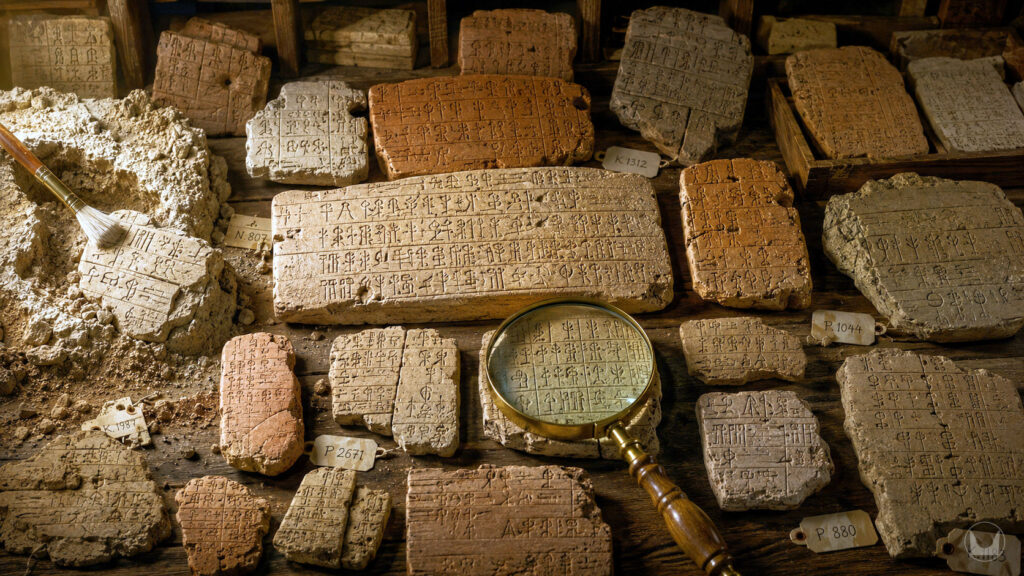
In the summer of 1952, a young English architect and philologist named Michael Ventris made one of the most extraordinary announcements in the history of scholarship. He had deciphered the writing on the clay tablets  recovered from the ruins of Knossos, Mycenae, Pylos, and Tiryns—tablets inscribed with a script that had resisted decipherment for half a century, written in an archaic form of Greek. The language of the Bronze Age Aegean, preserved by accident in fired clay, was suddenly legible. A world that had been silent for three thousand years began to speak.
I was not there in 1952. But when I encountered Linear B for the first time, I felt something of what Ventris must have felt: the excitement of a door opening into a secret room.
What Linear B Is—and Is Not
Linear B is a syllabic script, each sign represents a syllable rather than a single sound, as in an alphabet. It was used by Mycenaean Greek palace administrators from approximately 1450 to 1200 BCE, when the Bronze Age collapse swept away the palatial civilizations of the Aegean. The tablets were bureaucratic records 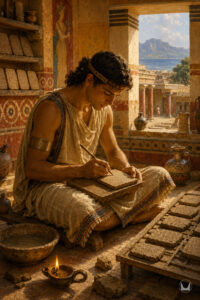 (inventories of grain, lists of rowers, tallies of bronze weapons, records of land tenure and religious offerings.) The Bronze Age scribes who inscribed them were not writing poetry or history. They were doing the palace’s accounting.
And yet, in their very ordinariness, they are irreplaceable. Because the tablets record the administrative vocabulary of Mycenaean palatial society, they give us something no later source can provide: the words these people used, in the language they actually spoke, to describe the structures and hierarchies of their world.
This is the gift Linear B offers to the historical novelist: not stories, but the vocabulary in which stories were lived.
The Words That Built a World
When I began writing Atalanta of the Wild, I made a decision that shaped every subsequent page: the characters would speak and think in terms drawn from the Linear B tablets wherever the record allows. Not as scholarly decoration, but as the lived texture of their world. These are not labels applied from outside. They are the words these people would have known from childhood, the words that organized their understanding of power, kinship, and the sacred.
Wanax—the tablets’ term for king, or paramount ruler. Not the later Classical basileus, which in the Mycenaean period denoted a lower administrative official. The wanax of a Mycenaean palace was a figure of immense authority, his person and his household the organizing center of the entire palatial economy. When Néos speaks of the wanax of Tegéa, he is not using a poetic archaism. He is using the correct title for the correct office in the correct period.
Maῖa—attested in the tablets as a term for mother or nurse, the word that would survive into Classical Greek as the term for midwife, and into modern languages through the Roman Maia, goddess of growth, from whose name our month of May descends. In Atalanta of the Wild, it carries the warmth of its original register, not a title of office but a word of intimate relationship, the word a child would use.
Megaron—the great hall of the Mycenaean palace, the central architectural space around which the palatial complex was organized. Archaeology has confirmed the megaron’s form at Mycenae, Tiryns, and Pylos: a rectangular hall with a central hearth, four columns supporting the roof, a throne to the right of the entrance. When the novel’s characters gather in the megaron of Tegéa‘s palace, they move through a space whose dimensions and details are drawn from the archaeological record, its very name preserved in the tablets that administered it.
The Limits of the Record
Honesty requires acknowledging what Linear B cannot tell us. The tablets record administrative vocabulary with great consistency, but they are almost entirely silent on the inner lives, emotional registers, and conversational idioms of the people who used them. We know how many jars of olive oil the palace of Pylos held in its final year before the fires came. We do not know what a Mycenaean mother said to her child at bedtime, or what words lovers used in private, or how a warrior prayed before battle.
This silence is not an obstacle. It is an invitation.
The novelist’s task, working with the historical record, is not to reproduce what is known but to inhabit what is known so thoroughly that what is unknown can be imagined with integrity. The Linear B vocabulary provides the skeleton, the structural terms that organized Mycenaean society. The novelist’s imagination provides the flesh: the emotional texture, the sensory detail, the human particularity that no administrative tablet could ever record.
There is also the question of pronunciation. Linear B‘s syllabic script does not record consonant clusters with full accuracy, and the vowel system it encodes reflects a dialect of Greek significantly different from the Classical Attic that most readers recognize. The diacritical accents I use throughout Atalanta of the Wild (Atalántē, Polydeúkes, Hēraklēs, Tegéa) follow the conventions of ancient Greek scholarly transliteration rather than Linear B orthography directly. They are a compromise between historical accuracy and readability, a way of signaling to the reader that these names belong to a world before the Classical period without demanding a degree in Mycenaean philology.
Why It Matters for the Novel
A reader might reasonably ask whether any of this philological care affects the experience of reading Atalanta of the Wild. Would the novel be diminished if its king were simply called a king, its great hall simply a hall?
My answer is yes, but not for the reasons one might expect.
The Linear B vocabulary matters less as information than as atmosphere. When a character addresses the wanax, the unfamiliar title creates a subtle but real distance between the reader and the scene, a distance that says you are not in your own world. These people are not you. Their categories of power and kinship and the sacred are not yours. That distance is not an obstacle to emotional engagement. It is the condition of authentic engagement. It is what prevents the Bronze Age from collapsing into a costume drama of familiar faces in unfamiliar clothes.
The archaic English register of the novel’s prose and the Linear B terminology of its titles and places work in tandem toward the same end: to make the past genuinely strange, and therefore genuinely present. A past that feels like the present with different furniture is not the past; it is a mirror with a decorative frame.
A Living Inheritance
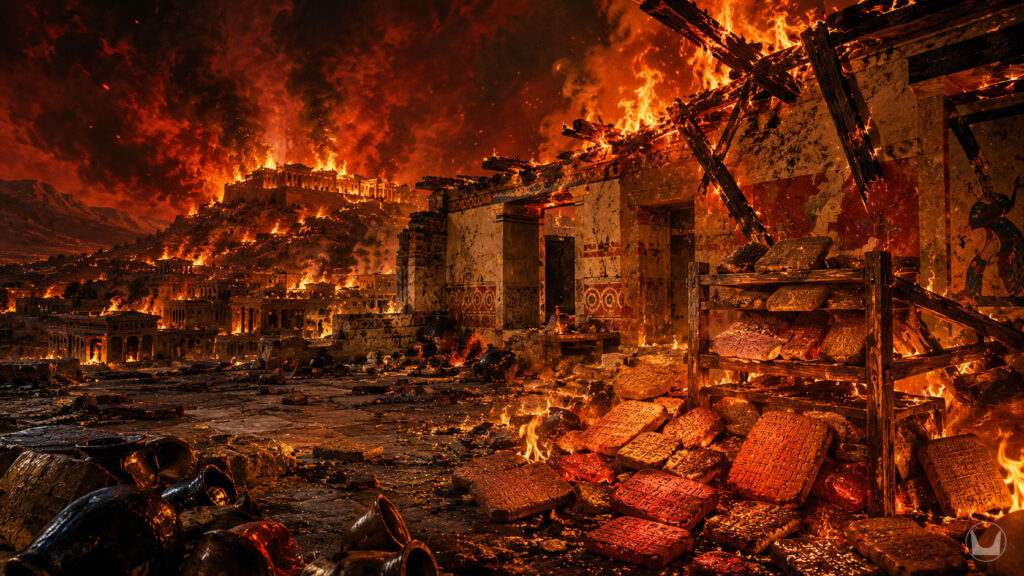
Linear B tablets survive because the palaces that housed them burned. The fires that destroyed Mycenae, Pylos, and Knossos at the end of the Bronze Age baked the clay tablets hard enough to preserve them through three millennia of burial. The catastrophe that silenced the Bronze Age world also ensured that its administrative voice would one day be recovered.
There is something both melancholy and miraculous in that accident of preservation. The scribes who inscribed those tablets were recording grain rations and land allocations, not posterity. They had no idea that their careful syllabic signs would one day be the primary evidence for an entire civilization’s vocabulary. They were simply doing their work, in the language of their world, on an ordinary day that turned out to be one of the last.
Atalanta of the Wild is an attempt to honor that world, to speak its titles correctly, to move through its spaces with archaeological care, and to imagine what it felt like to be alive in it.
The tablets made that possible. Michael Ventris made that possible. And in their terrible way, the fires of the Bronze Age collapse made that possible too.
Rio de Janeiro, the xvi day of May, MMXXVI.

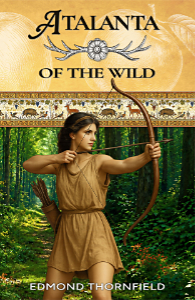
Click the cover to read a preview chapter and learn more. To explore the archaeological and mythological world behind the novel, visit the boards on my Pinterest profile and subscribe to my newsletter.