Every novelist has a private library of books that made their own work possible—not sources to be cited or influences to be acknowledged in an author’s note, but companions in the deeper sense: books that showed what historical fiction could do when it refused to compromise, when it trusted its readers with difficulty and moral complexity, when it understood that the past is not a simpler version of the present but a foreign country with its own weather.
The novels I recommend here are books I admire without reservation. They are set in the ancient world—Greece, Rome, the Aegean—and they share a refusal to make antiquity comfortable. Their protagonists are warriors and courtesans, kings and slaves, hunters and the hunted. Their authors have done the research and then done something harder: they have imagined their way into lives unlike their own and rendered those lives with the full weight of human complexity.
If you have read Atalanta of the Wild and wish to linger in that world, these six novels will hold you there. If you have not yet read Atalanta of the Wild but find yourself drawn to any of the books below, I believe we already share a reading life—and I hope you will let Atalántē’s story be the next chapter of it.
1. The Persian Boy, by Mary Renault
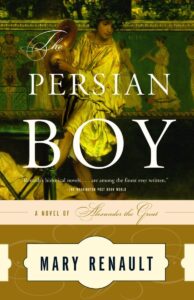 Alexander the Great has conquered half the known world, and Bagoas—a Persian eunuch of extraordinary beauty, sold into slavery as a child and made the favourite of King Darius before passing into Alexander’s keeping—watches it happen from the most intimate possible vantage. Renault tells the story of the Macedonian conquests entirely through Bagoas’s eyes, and the result is one of the most psychologically penetrating historical novels ever written. Alexander is rendered neither as legend nor as debunking but as a man of volcanic contradictions. He is generous and cruel, visionary and destructive, capable of a love as absolute as it is consuming. Renault‘s prose achieves a kind of sustained elevation that never tips into purple; her research is invisible because it has been entirely absorbed into imagination. The Persian Boy is, among other things, the finest novel ever written about what it means to love someone whose greatness is also their devastation.
2. The Bull from the Sea, by Mary Renault
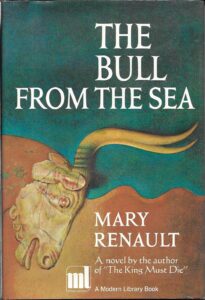 The second of Renault‘s Theseus novels takes up where The King Must Die leaves off. Theseus has survived the Labyrinth, returned to Athens, and now rules a kingdom with the hard-won authority of a man who has looked into the darkness and come back changed. But the gods are not finished with him. The Bull from the Sea follows Theseus through the years of his maturity and decline: his capture of the Amazon queen Hippolyta, his friendship with Pirithous, and the shattering tragedy of his son Hippolytus, destroyed by Phaedra’s obsession and his own inflexible piety. Renault writes the Theseus myth from the inside, as though she had been there and was now setting the record straight. For readers of Atalanta of the Wild, this novel offers a direct companion in its treatment of Artemis, the Amazonian world, and the particular loneliness of those who belong to the goddess rather than to the ordinary human world of marriage and children.
3. The Song of Achilles, by Madeline Miller
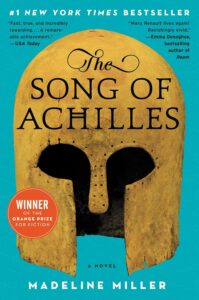 Before the walls of Troy, before the rage and the grief and the funeral pyre, there was a friendship between a golden prince and a quiet boy nobody expected to matter. Miller‘s debut novel retells the Iliad through the voice of Patroclus—companion to Achilles, witness to his glory, and ultimately the sacrifice that sets the Iliad‘s tragedy in motion. What distinguishes The Song of Achilles from the vast literature of Troy retellings is its emotional directness. Miller does not hedge or qualify the love between Achilles and Patroclus, and the result is a novel of devastating tenderness. The prose is cleaner and more contemporary than Renault’s, accessible to readers who might find the older novelist’s register demanding, yet it never sacrifices depth for readability. The final pages are among the most quietly devastating in modern historical fiction. Readers who responded to the friendship between Atalántē and Néos at the heart of Atalanta of the Wild will find in Patroclus a kindred soul.
4. Gates of Fire, by Steven Pressfield
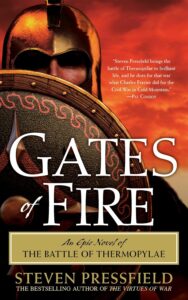 In 480 BCE, three hundred Spartans held the pass of Thermopylae against the Persian army of Xerxes for three days, buying Greece the time it needed to survive. Pressfield tells this story through the voice of Xeones, the sole Greek survivor, dictating his account to a Persian scribe at the command of Xerxes himself. Gates of Fire is the finest novel ever written about the Spartan warrior ethos, not a celebration of it, but a rigorous, unflinching examination of what it costs a society and an individual to build a culture entirely around the willingness to die well. Pressfield‘s research into Spartan military practice, religious observance, and social structure is extraordinary, and his battle scenes achieve a visceral immediacy that no film has ever matched. This is historical fiction as moral inquiry. What does courage mean when it is the only value a civilisation recognises? Readers who responded to Atalanta of the Wild‘s treatment of Bronze Age warrior culture and the demands of divine service will find in Gates of Fire a worthy companion in seriousness.
5. The Silence of the Girls, by Pat Barker
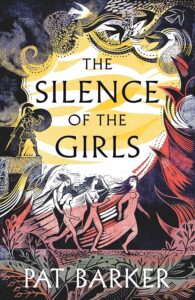 When Achilles sacks the city of Lyrnessus, Briseis—queen of the city, widow of its king—becomes his prize. Homer gives her almost no voice in the Iliad; she is passed between Achilles and Agamemnon like a token in a dispute between gods, her inner life entirely absent from the epic that determines her fate. Barker restores that voice with the controlled ferocity of a novelist at the height of her powers. The Silence of the Girls tells the story of the Trojan War from the slave women’s quarters, from the perspective of those who cooked and cleaned and were taken to bed by the heroes whose glory the epic celebrates. It is a devastating and necessary corrective, not a repudiation of Homer but a completion of him, filling the silence the Iliad left behind with everything it chose not to say. For readers of Atalanta of the Wild, Barker‘s novel offers a direct meditation on the same question that drives Atalántē’s story: what does it cost a woman to exist on the margins of a world built entirely around male heroism?
6. The Wolf Den, by Elodie Harper
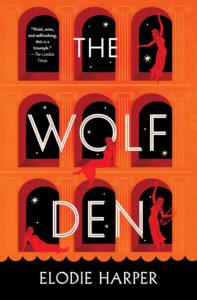 In first-century Pompeii, a young woman named Amara has been sold into slavery and now works in the city’s most notorious brothel, the Wolf Den of the title. Harper‘s novel is neither exploitative nor sentimental. It is a precisely observed portrait of a world in which intelligence and beauty are simultaneously a woman’s only assets and her greatest vulnerabilities. Amara is one of the most fully realized protagonists in recent historical fiction: calculating, tender, ruthless when necessary, capable of genuine friendship and genuine betrayal, always aware of the exact distance between where she is and where she needs to be. Harper‘s research into Roman social history, the economics of slavery, and the material culture of Pompeii is worn lightly but is everywhere present, and the looming knowledge of Vesuvius gives the novel’s world a particular fragility—beauty and pleasure and human connection existing in the shadow of obliteration. For readers drawn to Atalanta of the Wild‘s portrayal of a woman navigating a world that has assigned her a role she refuses to accept entirely, Amara’s story will feel like a recognition.
A Final Word
What these six novels share, and what I hope Atalanta of the Wild shares with them, is a conviction that the ancient world is not a simpler place than our own but a more dangerous one, and that the people who inhabited it were not lesser versions of ourselves but fully realized human beings whose lives were shaped by forces we can understand only through the sustained act of historical imagination made possible by the best fiction.
These are not easy books. They do not offer the past as escape or entertainment in the cheap sense. They offer it as encounter—and encounter, by definition, changes you.
I hope you read them all. And I hope that somewhere in this list, you find your way to Atalántē.

Rio de Janeiro, the xvi day of May, MMXXVI.

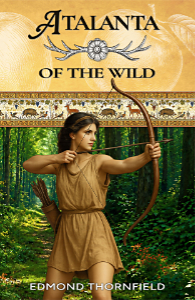
Click the cover to read a preview chapter and learn more. To explore the archaeological and mythological world behind the novel, visit the boards on my Pinterest profile and subscribe to my newsletter.