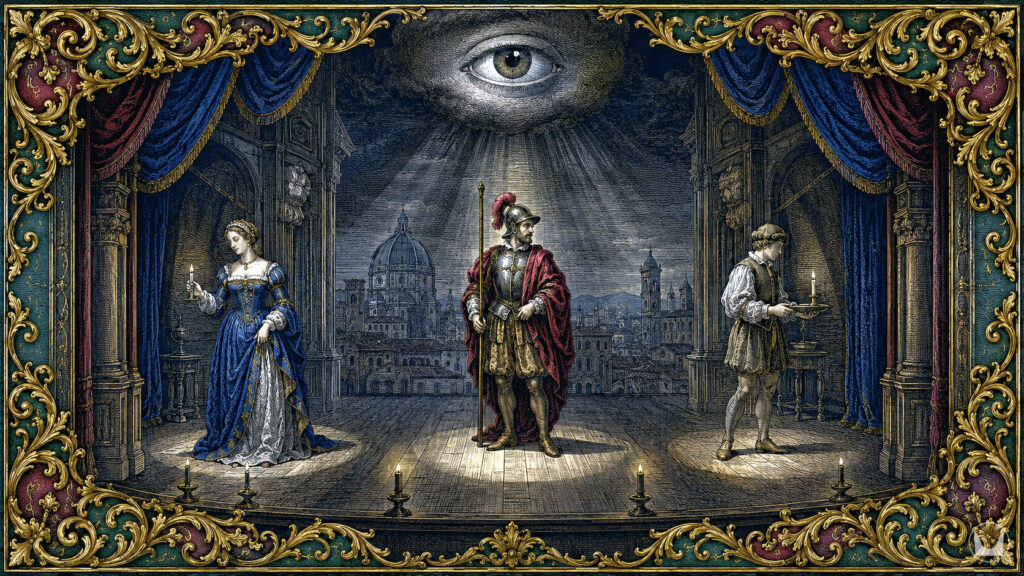
Why Does AI Fiction Lose Track of Whose Eyes We Are Looking Through?
This is Essay 4 of 22 in the series Why Choose 100% Human Authors, addressed to readers who want to understand what a human author does that a machine cannot and why that difference matters to the experience of literary fiction.

The Contract Between Writer and Reader
When you open a novel and read the first page, something is established before the plot begins. You learn whose mind you are inside and how close the narration will hold to it, whether you will know only what the character knows, or whether the narrator will sometimes step back and tell you things the character cannot see. This is the point-of-view contract. It is one of the most fundamental agreements a writer makes with a reader.
 It need not be stated; it is felt. Within a paragraph or two, a reader knows whether they are behind one pair of eyes or hovering above the scene; whether the narration will grant them access to private thought or maintain distance; whether the world of the fiction will be filtered through a single consciousness or assembled from many. When the contract holds, the reader moves through the story with the confidence that comes from knowing where they stand. When it breaks, the reader may not be able to name what went wrong but will feel it at once.
AI-generated fiction breaks this contract with remarkable consistency. And it breaks it in two distinct ways.
Head-Hopping: The Uninvited Guest
The first failure is called head-hopping: the narration moves without warning from one character’s interiority to another’s, sometimes within a single paragraph.
Here is an example:
Elena watched him cross the room and felt her pulse quicken. She had not expected him to come. Thomas, for his part, was nervous—he had rehearsed this moment a dozen times and still did not know what he would say. Behind them, the maid wondered why the young mistress looked so pale, and made a mental note to mention it to the housekeeper.
Three consciousnesses in four sentences. Elena’s pulse, Thomas’s rehearsed nervousness, the maid’s private observation: all offered with equal access, as though the narration were a camera that can pass through walls and skulls without friction. The reader is given everything and grounded in nothing. No single perspective accumulates the weight it needs to carry meaning. We observe, but we do not inhabit.
A human author working in close third person understands that the power of the technique lies in its restriction. If the scene belongs to Elena, the reader knows Thomas is nervous only if Elena can read it in his face, his hands, his posture. The reader does not know what Thomas rehearsed. They know only what Elena sees, and that limitation is the source of all the scene’s tension. What Elena cannot know is exactly what the reader most wants to discover.
 The AI system does not experience the scene from inside a consciousness. It has no preferred position. It grants equal access because, from the outside, it is the path of least resistance. The result is prose that is technically informative but empty of experience.
The Unearned Shift: When Omniscience Arrives Uninvited
The second failure is more disorienting. This is the unearned shift between close third person and omniscient third person—the narration that establishes an intimate, limited perspective and then, without signal, steps outside it to offer information that the viewpoint character cannot possess.
It looks something like this:
Marcus pressed his back against the cold stone wall and listened. He could hear nothing beyond the door. He told himself this meant the corridor was empty. What he did not know—could not know—was that three floors above him, the man who had sent the letter was already dead, and that the seal Marcus had trusted had been broken two hours before he received it.
The first three sentences are close third person: Marcus’s perception, Marcus’s reasoning, Marcus’s self-reassurance. The fourth sentence is omniscient: it tells the reader something Marcus cannot know, framed as information withheld from him.
This can be done well. Omniscient narration is a legitimate mode, and the pivot between close and distant can be handled with great skill. But it requires preparation. The reader must know that the narrative voice has this freedom to stand at a distance from its characters and may, at any moment, draw back to show the larger picture. When the close perspective has been established without that preparation, the omniscient intrusion feels like a violation.
 AI systems shift between these modes not because the story requires it but because both modes are present in the training data, and the model has no governing sense of which one this story has committed to. The shift is the absence of a choice.
What Consistency Costs and Why It Is Worth It
A human author who has chosen a point-of-view commits to its discipline and its costs. In close third person, you cannot tell the reader what another character is thinking. You cannot show the scene from an angle the viewpoint character cannot occupy. You cannot step back and deliver context the character does not have. Every one of these restrictions is a temptation refused.
In my historical novel, A Tale of Paris & Paris: Echoes of Troy, the twelve point-of-view characters carry their own section of the story, and the transitions between them are deliberate acts of craft: the reader moves from one consciousness to another at scene or chapter breaks, with full awareness of the shift. Within each character’s section, the narration holds. What Lorenzo sees, Lorenzo sees. What Costanza does not know, Costanza does not know—and the reader does not know it either, not until Costanza does, or until the narration moves to a character who does. That consistency is an ethical achievement: it respects the reader’s experience of the story as something that unfolds through minds unknowing of what comes next.
An AI system has no investment in that unfolding. It has processed the end of the story as readily as the beginning. It has no experience of suspense, no memory of what it was like not to know. For a language model, the point-of-view contract is a stylistic feature rather than a commitment. As such, it can be set aside whenever another element presents itself.

In the end, what a human author offers is presence: the presence of a mind that has chosen a position, felt the discipline of restriction, and understood why that constraint is the story’s strength. The reader who finishes a novel with a consistent, managed point of view has spent hours inside a consciousness not their own and has come to trust it. That trust is the deepest reward fiction can offer. It cannot be assembled from tokens. It can only be kept, one sentence at a time, by a writer who understood the promise they made when they began.
Rio de Janeiro, the xxv day of June, MMXXVI.