August turns toward six works that share a single obsession: the moment a soul, a marriage, or a kingdom comes apart under its own weight and what remains once it has.

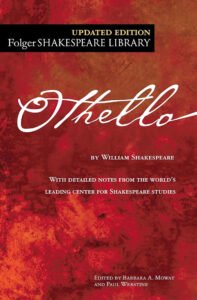 Othello (1603), William Shakespeare
Othello, a Moorish general in the service of Venice, newly wed to Desdemona, is dispatched to defend Cyprus when his trusted officer, Iago, sets to work unmaking him from within. Iago needs no dagger: a whispered suspicion or a name repeated at the right moment are enough to turn Othello’s trust in his wife into a conviction of her betrayal and his trust in Iago into the very weapon used against her.
Unpublished in Shakespeare’s lifetime and surviving only through a 1622 quarto and the First Folio, Othello has stood among his four great tragedies, alongside Macbeth, King Lear, and Hamlet, since its earliest performances. Its roles remain among the most coveted and punishing in the canon, and its treatment of race, jealousy, and manipulation continues to draw fresh readings four centuries on, from a play first staged with white actors in dark makeup before nineteenth-century black actors began assuming the role as their own.
The Taming of the Shrew (circa 1590-1592), William Shakespeare
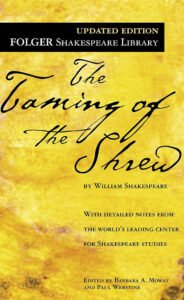 Set among the merchant houses of Padua, this early comedy follows Petruchio, a fortune-hunting gentleman from Verona, as he takes on the sharp-tongued Katherina in pursuit of her dowry, vowing to marry her and break her will in the same breath. Her sister Bianca cannot wed until Katherina does, which turns one household’s standoff into the engine of the entire plot.
Among Shakespeare’s earliest and most vigorous comedies, it remains one of his most staged and most disputed: three centuries of audiences have never agreed whether the play endorses Petruchio’s campaign or exposes it, and that unresolved argument over gender, dominance, and marital obedience is what keeps producers returning to it.
 Doctor Faustus (1588), Christopher Marlowe
A scholar who has exhausted every branch of human learning turns to necromancy, and Faustus seals a pact with Lucifer, brokered by the demon Mephistopheles, trading his soul for twenty-four years of magical power. He spends those years on spectacle and trickery rather than anything higher, and as the bargain runs its course, he wavers between despair and the possibility of repentance until the choice is no longer his to make.
The play survives in two competing versions, the shorter 1604 “A” text and the expanded 1616 “B” text, whose additional scenes remain a matter of scholarly dispute. Built on a five-act structure with a classical chorus, it fuses Elizabethan spectacle with the theological anxieties of the Reformation. Its Faustus and Mephistopheles have carried supernatural legend onto stage and screen ever since.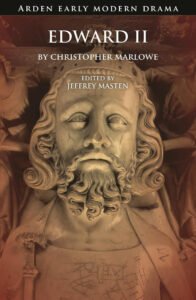
Edward II (circa 1594), Christopher Marlowe
King Edward’s devotion to his favorite, Piers Gaveston, becomes the fault line that splits his reign: Gaveston’s recall from exile enrages the nobility, chief among them the ambitious Mortimer, and sets a grinding collapse of royal authority in motion, ending in the king’s imprisonment and death.
Written before Shakespeare’s own Richard II and credited with shaping the English history play as a form, Edward II trades the towering overreachers of Marlowe’s Tamburlaine or Doctor Faustus for something colder and more exact: a tightly built political tragedy about weakness, obsession, and the ordinary machinery by which power destroys a man who holds it too loosely.
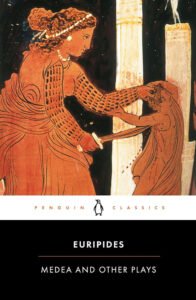
Medea, once a princess of Colchis, finds herself cast aside when her husband Jason abandons her for a Corinthian princess, stripping her at once of marriage and of any claim to safety in a foreign land. Her answer is extreme: she murders Jason’s new bride and father-in-law, then kills her own two sons rather than leave him anything, before escaping to Athens.
First staged in 431 BC as part of a trilogy now lost, the play has become the most performed Greek tragedy of the modern era, read and reread through political, psychoanalytic, and feminist lenses. Its portrait of a woman seizing agency inside a world built to deny her power has only grown sharper with each new generation of readers.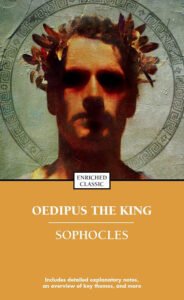
Oedipus Rex (circa 429 BC), Sophocles
Oedipus, king of Thebes, opens an investigation into the murder of his predecessor Laius to lift a plague from his city, unaware that the killer he hunts is himself. Truth arrives in pieces, each one narrowing the circle, until he learns he has killed his own father and taken his own mother, Jocasta, as his wife and queen.
First in the story of Thebes, though written after Antigone, the play was later held up by Aristotle in the Poetics as the model of tragic structure, and it remains, by wide agreement, among the greatest achievements of Western drama.

Rio de Janeiro, the i day of August, MMXXVI.