There is a grave irony embedded in the Church of San Francesco of Cortona. The man who built it, who brought its most precious relic from Constantinople, who wished with all his heart to be buried there—and was—that man died outside the order that bore his master’s name, expelled, excommunicated, and unredeemed by any Franciscan habit. Yet there he lies still, beneath the stones of the church he raised to Francis‘s memory, which is perhaps the most eloquent testimony to the paradox that was Friar Elias.
 The Companion of the Poverello
Elias Bonusbaro was born around 1180 in or near Assisi. Before holiness found him, he assisted in his family’s confectionery and mattress business and taught children to read the Psalter. He later worked as a notary in Bologna, likely pursuing additional education. He was a man of modest trade and cultivated mind, not a cleric, not a scholar of theology, not the sort of man whom the Church of Rome customarily elevated to authority. That Saint Francis chose him says everything about what Francis saw in him.
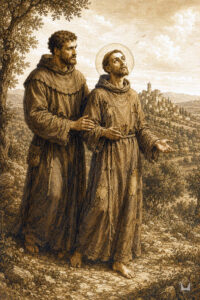
Elias appears to have been among the earliest companions of Saint Francis. The exact time and place of his joining the order are lost to history, though Franciscan historian Luke Wadding proposes Cortona in 1211. Throughout his life he remained a lay brother, never taking priestly vows; yet his practical gifts made him indispensable to an order that was expanding faster than anyone had anticipated.
Following a brief stay in Tuscany, Elias was appointed head of a missionary group sent to the Near East in 1217. Two years later, he became the first provincial minister of the then-extensive Syrian province. The East left its mark on him. He returned with an appreciation for grandeur, for architecture, for the power of sacred objects. These sensibilities would later set him on a collision course with those who believed the Friars Minor should be barefoot wanderers sleeping in ditches.
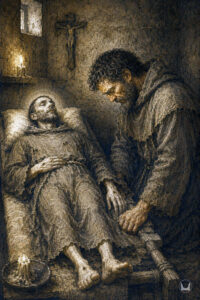 When Francis died in 1226, it was Elias who announced the death of the saint to the order and supervised the burial. The letter he wrote is considered a masterpiece of medieval epistolary prose: spare, grief-stricken, and lit from within by something that still reads as genuine love.
Builder and Controversialist
Pope Gregory IX, a great patron of the Franciscans and their official protector as Cardinal Ugolino, entrusted Brother Elias with the task of building a magnificent church to house the body of Saint Francis. Elias planned a grand basilica in Assisi to enshrine the remains of the Poverello. The result was the Basilica of Saint Francis of Assisi, a structure of soaring ambition, double-naved, frescoed by Cimabue and later Giotto, unlike anything the humble Francis himself would have sanctioned. It endures as one of the supreme buildings of medieval Italy.
This was the heart of the controversy. Some of his fiercest critics were the first companions of Saint Francis, such as the humble Brother Giles, Brother Masseo, and Brother Leo, St. Francis‘s secretary and companion. All of these earlier followers opposed what they saw as an abandonment of Saint Francis‘s beloved commitment to poverty under Elias‘s initiative. Elias divided the order in two—those who wished to build, to grow, to plant themselves in cities and become scholars and administrators; and those who wished to walk dusty roads and own nothing. The wound never healed. Two centuries later, in the Renaissance-set novel A Tale of Paris & Paris: Echoes of Troy, the Greyfriars were still wrestling with the questions Elias had forced upon them.
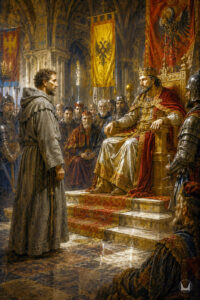 Elias‘s ambition for leadership was realized at the Franciscan General Chapter of 1232, where he was elected Minister General of the Order of Friars Minor, becoming the second to hold this position after the order’s founder. His administration was vigorous and expansive; he divided the order into 72 provinces. But in 1238, Pope Gregory IX sent Elias as an ambassador to the excommunicated Holy Roman Emperor Frederick II. Elias apparently became a supporter of the Emperor as a result of this mission. An alliance with a man the papacy considered its mortal enemy was not something the order’s reformist wing could overlook.
A General Chapter of the Franciscan Order was held in Rome in 1239, where Elias was deposed from the office of Minister General. Without permission, he traveled to Cortona and visited a house of the Poor Clares. Though Albert of Pisa, his successor, was willing to absolve him, Elias instead went to the Ghibelline city of Arezzo. This prompted Pope Gregory IX to excommunicate him.
He then made matters worse. He was summoned by Innocent IV to attend the chapter in Genoa but failed to appear. Elias was excommunicated anew and expelled from the order. The mockery that followed was swift and merciless: the news of his disgrace spread quickly “to the great scandal of the Church,” and the very children might be heard singing in the streets a rhyme that made his name a byword for shame.
This is the man Lorenzo from A Tale of Paris & Paris: Echoes of Troy describes so archly in the nave of his church. “excommunicated by two Popes, Pope Gregory IX and Innocent IV,” as he tells it, with barely suppressed delight. History bears him out.
 Exile and the Church of Cortona
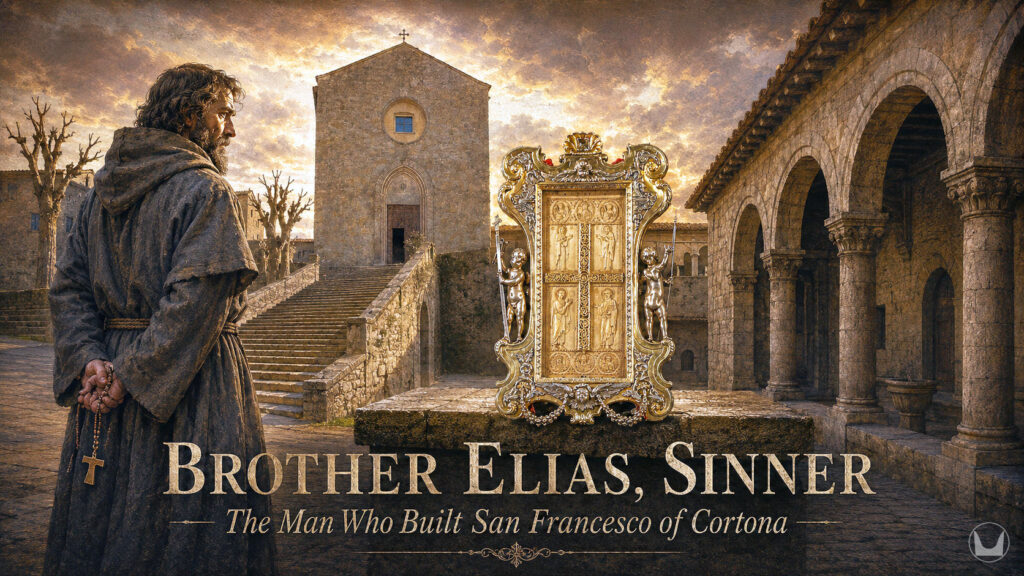
Cortona became Elias‘s refuge. Protected by the Florentine Republic and sheltered by a town that had long regarded him as one of its own, he spent his final years there. It was in those years of exile that he gave the town the church that still bears the saint’s name.
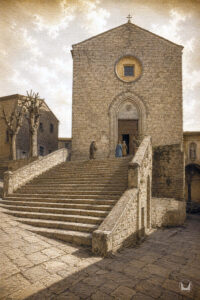
Built in 1245, the church follows the typical Franciscan pattern of a large nave ending in an apse with a groin vault, flanked by two smaller side-chapels also with groin vaults. By the standards of what Elias built in Assisi, it is a modest structure. A man trying to reconcile himself to the poverty he was accused of abandoning might well choose simplicity. The façade holds a lancet-arched main doorway with three small columns in a recess, and a large circular window set above.
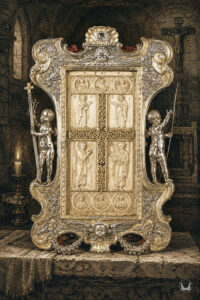
The church‘s most precious possession is the relic on its high altar: the Reliquary of the Holy Cross, an ornate 10th-century ivory tablet containing a fragment of Christ‘s cross, presented to Elias by the Byzantine Emperor in 1244. The reliquary is described as a work of Byzantine ivory and silver—magnificent, Eastern, redolent of the world Elias had encountered in Syria and Constantinople. In the novel, Lorenzo’s mention of it is consistent with the sources, though the reliquary itself is older, a holy object repurposed as a gift, passing from one civilization’s treasury to another.
Also preserved in the convent are a few relics of Saint Francis of Assisi: a habit, a finely embroidered cushion on which the dying saint laid his head, and a book of the Gospel. These, too, Elias brought. Whatever his faults of ambition and political miscalculation, he never stopped gathering the traces of the man he had loved.
 The Tomb No One Honors
He died at Cortona on 22 April 1253. His end was not entirely without consolation: the sources record that he confessed, repented, and received Holy Communion before death. Yet as Lorenzo notes with the precision of the well-read, he did not receive Extreme Unction because an interdict lay upon the town at the time. And he did not die as a Greyfriar. The excommunication had not been formally lifted; he remained outside the order whose structure he had done so much to build.
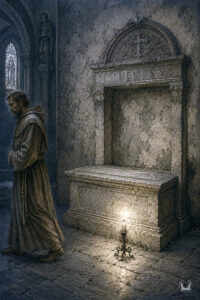
He was buried in the church he had raised. And then, in one of the smaller cruelties that institutional history records without particular emotion, a prior little moved by Elias‘s deeds had his bones dug up and cast out, as Lorenzo tells it. The tomb now holds something or someone else. No one knows what, precisely, reposes in it.
This is the church the reader of A Tale of Paris & Paris: Echoes of Troy encounters: beautiful in its plainness, weighted with relics, haunted by the absent remains of its contradictory founder. A man who built for others and ended with nothing of his own; a Greyfriar who was no longer a Greyfriar; a companion of the Poverello, who in the end was remembered as a cautionary tale.
The Shadow Over the Novel
In A Tale of Paris & Paris: Echoes of Troy, the Church of San Francesco and its adjacent convent carry the full weight of this history. In the novel’s Renaissance setting, the institution Elias founded in Cortona becomes the stage for the darkest drama: the abuse of the orphans in the convent’s care by Friar Domenico and his accomplices; the arrival of inquisitors from Perugia‘s Greyfriar house; the trials held within walls built for prayer; the dungeon beneath; and the climax in the cloister between church and convent, where soldiers of the Pope’s Army camp in the shadow of the very arched doorway that dates to the original Chapter House.
 Against this darkness stand Friars Vincenzo and Miniato, figures who demonstrate that the order Elias helped to build also produced men of courage and compassion. The order has always contained both. Elias himself was both at different moments of his long and turbulent life. He was the devoted companion who held the dying Francis in his arms and the ambitious administrator who could not resist the emperor’s court.
That is what makes San Francesco in Cortona the right setting for a novel about the gap between institutional religion and the faith it claims to serve. Elias built it in exile, under the shadow of excommunication, carrying relics of a saint whose spirit he had betrayed and honored in the only way he knew how. The church has held that contradiction for nearly eight hundred years. From the moment I stepped within, I knew that it was a natural home for the complicated men and women I write.

Rio de Janeiro, the xxvi day of May, MMXXVI


Click the cover to read a preview chapter and learn more.