This month: one Brazilian, one Italian, one from the US, and three from the English tradition. All use historical settings to grapple with larger questions of human nature and the societies that shape us.

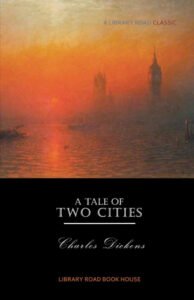 A Tale of Two Cities (1859), Charles Dickens
Dickens sets his novel across Paris and London in the years surrounding 1789 and lets the machinery of the French Revolution grind against the private griefs of ordinary people caught beneath it. Doctor Manette’s slow recovery from eighteen years in the Bastille, Charles Darnay’s flight from an aristocratic name he never wanted, and Sydney Carton’s quiet, wasted brilliance all converge under the shadow of the guillotine. The novel is less interested in the politics of revolution than in what revolution does to the people standing nearest it, innocent and guilty alike, ground down together.
What lingers after reading it is not the plot’s considerable complexity but Carton’s final act of self-erasure, offered without a trace of self-pity. Dickens builds toward it across the entire book, so that when it comes, it reads less as a twist than as something inevitable arrived at. Few endings in English fiction carry that particular weight, sacrifice made ordinary by love rather than heroism.
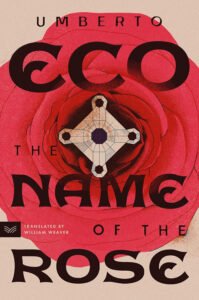 The Name of the Rose (1980), Umberto Eco
Set in an Italian monastery in the year 1327, Eco’s novel wears the costume of a murder mystery, using it as cover for a significant work of medieval philosophy. Brother William of Baskerville, a Franciscan with a mind built for logic and a past shaped by the Inquisition, investigates a string of deaths tied to a forbidden book hidden somewhere in the abbey’s library. The mystery is satisfying on its own terms, but Eco also fills it with heresy, laughter, the fear of knowledge, and the terror a closed institution feels toward anything it cannot control.
The prose requires patience. Eco makes the reader toil through long digressions on theology and architecture before rewarding that labor with meaning. This is narrative difficulty in service of depth, not for its own sake, and readers who stay with it find a novel that argues that the destruction of a book can be as violent as a murder.
 Romola (serialized 1862—1863), George Eliot
This novel is set in Florence in the final years of the fifteenth century, against the rise and fall of Savonarola. It asks a harder question than most historical fiction does: what does moral integrity cost a person surrounded by people who have none? Romola, married to the charming, hollow Tito Melema, discovers that his charm conceals a near-total absence of conscience, and she must decide, again and again, what she owes to a marriage built on a foundation that was never solid.
The Florentine setting is rendered with scholarly weight, the kind of research-heavy historical fiction that trusts its reader to sit with unfamiliar detail rather than simplifying it away. I found the book’s moral architecture heavier than its story, which may have been Eliot’s intention, though she seemed less interested in what happens to Romola than in what Romola becomes in spite of everything around her.
 Rob Roy (1817), Sir Walter Scott
Scott’s novel follows Frank Osbaldistone, a young Englishman exiled to his uncle’s household in the north and drawn against his will into the Scottish Highlands and the volatile politics of the early eighteenth century. Rob Roy MacGregor appears less often than the title suggests, a shadow at the margins of the plot, but his presence looms over the whole book as a symbol of a world already vanishing.
What Scott does exceptionally well here is atmosphere: the tension between Lowland commerce and Highland clan loyalty, between English order and Scottish defiance, rendered through landscape and dialect as much as through incident. Frank is a somewhat passive hero, more witness than actor, but his passivity lets the real subject of the novel come forward, a nation caught at the hinge between two worlds and a way of life about to be swept aside by history.
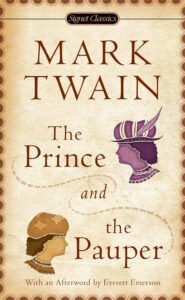 The Prince and the Pauper (1881), Mark Twain
Twain’s premise is simple enough for a fairy tale: a prince and a pauper, identical in appearance, trade places in Tudor England and each is forced to survive in a life built for someone else. But the novel uses that simplicity to do real work. Edward, heir to the throne, discovers the cruelty and hunger of the kingdom he was born to rule, while Tom Canty, thrust into a palace he doesn’t understand, learns how power insulates those who hold it from the consequences of their decisions.
Twain’s satire is no less pointed. Beneath the adventure and the mistaken-identity comedy sits a sharp argument about how easily rank substitutes for character, and how little either boy would have understood the other’s world without being forced into it. The result is a book with more serious topics than its youthful protagonists might suggest.
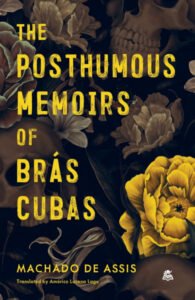 The Posthumous Memoirs of Brás Cubas (1881), Machado de Assis
Narrated by a dead man from beyond the grave, addressing the reader in a direct and often mocking voice, Machado’s masterpiece announces its strangeness on the first page and never lets up. Brás Cubas recounts his unremarkable, comfortable, largely wasted life in nineteenth-century Rio de Janeiro, and does so with a freedom only the dead can afford: no reputation left to protect, no reader’s opinion left to court. It reads like nothing else from the nineteenth century, closer in temperament to Laurence Sterne or the modernists who came decades later than to Machado’s contemporaries.
The novel’s real subject is the gap between how Brás Cubas sees himself and what his own narration reveals him to be: vain, indecisive, and capable of cruelty without recognizing it. Machado lets the irony do all the work, never underlining it, trusting the reader to catch what the narrator himself cannot. A short, strange book whose humor grows darker the longer one sits with it.

Personal Note: I read Machado de Assis in the original Portuguese and can attest that his prose style is as witty as those of Mark Twain, Henry James, and Anton Chekhov. Their critiques of nineteenth-century society and the psychological complexity of their characters share the same tradition. Readers who love Henry James’s The Turn of the Screw are likely to appreciate Assis’s The Posthumous Memoirs of Brás Cubas and his other novels.

Rio de Janeiro, the viii day of Septembre, MMXXVI.

For past book recommendations, click here.