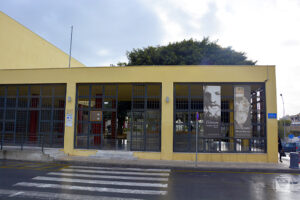
The objects in the Archaeological Museum of Heraklion are not merely remnants of Minoan civilization; they are among the most important surviving works of Bronze Age art anywhere in the world.
What each taught me about the Minoan world
Even before I knew that one day I would write a novel set in the Minoan Bronze Age, I had visited the Archaeological Museum of Heraklion—and the Archaeological Site of Knossos—more than once. Crete is the most beautiful place I have ever been to. Nature tends the isle year round as though it were a private garden, its landscapes perpetually pristine, its wildflowers abundant. I understand why the ancients deemed it an enchanted realm. It is.
I do not yet know the entire island. My literary travel has taken me to Chania (ancient Kydōnía), Kato Zakros, Archanes, and Amnisos — locations that appear in my Minoan Bronze Age novel, Asterios and the Labyrinth—but Crete is not a place one exhausts. It is a place one returns to, each time finding more.
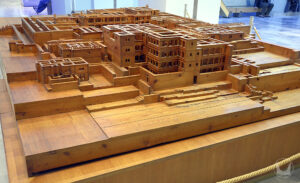
What my visits to Knossos and those other sites gave me was precisely what a novelist most needs and cannot manufacture at a desk: the feeling of a world lived in and remembered. But it was the Archaeological Museum of Heraklion that made everything cohere. I spent over six hours there on each visit, moving slowly through the galleries, absorbing what was on display and understanding, with increasing certainty, how much more remained to discover. It was there that I learned the Minoan warrior wore a helmet fashioned from the tusks of wild boars. It was there that I first saw the clay coffins—the larnakes—in which the dead were laid, to be entombed into the rock. What I found in those galleries altered the course of my writing. The objects that follow are the ones that left the deepest mark.
My journeys to Heraklion have not ended.

Rio de Janeiro, Autumntide of MMXXVI

The Phaistos Disc
Π-Ν1358 · Clay · Intact · Diameter: 15.8–16.5 cm · Phaistos · House 101 · Middle Minoan III, Neopalatial period: 1700–1650 BCE · Gallery V, Case 51
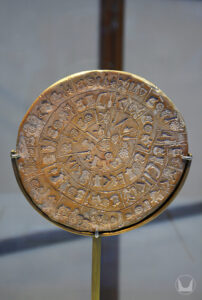 A clay disc no larger than a man’s palm, impressed on both sides with 241 pictographic signs arranged in a spiral. No one, in three and a half thousand years, has conclusively deciphered it. The signs were stamped into the wet clay with miniature seals before firing, making this the earliest known example of something approaching moveable type. Sixty-one groups of signs, separated by incised lines, are thought to represent individual words; certain groups recur at intervals, like a refrain. The leading hypothesis is that the disc is a hymn or incantation. The only certainty is that we do not know. It may be related to Linear A, to Cretan Hieroglyphic, to Linear B—or to none of them. Standing before it in the museum, I felt the particular vertigo of facing a human voice that spoke urgently into its clay three and a half millennia ago and has not yet been heard. That vertigo is useful for a novelist of the Bronze Age. It keeps one honest about the limits of what can be known.
Ivory Bull-Leaper Figurine
O-E3 · Bone (Ivory) · Mended · Length: 28.7 cm · Knossos Palace · Late Minoan II, Neopalatial period: 1600–1500 BCE · Gallery VI, Case 63
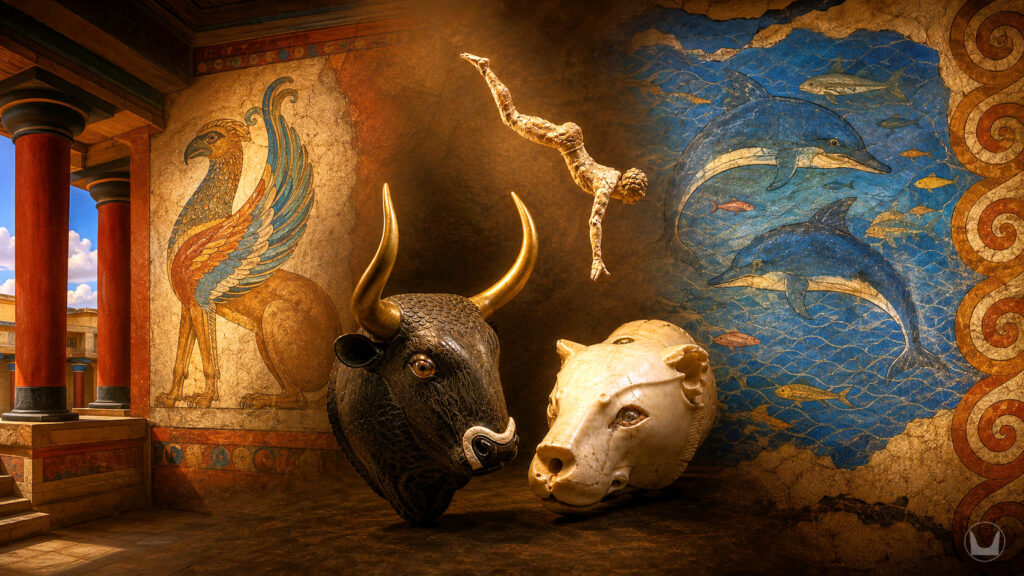
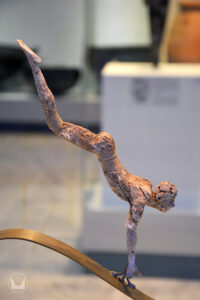 This small ivory figure is one of the most kinetically alive objects I have ever seen. A young athlete, carved in the moment of his leap—body arched, limbs extended, suspended in mid-air over the back of a bull that is no longer there—rendered with such anatomical precision that the leg muscles are individually articulated and the fingernails are present on the hands. He was found with fragments of at least two other figures and a faience bull’s head, the whole composition once depicting the complete arc of the leap. His hair was made of copper gilt wire. Traces of red paint survive on the ivory surface. He may have been suspended on wires above the bull’s back. That detail, suspended in perpetual mid-leap, never landing, seems a precise image of what bull-leaping meant in the Minoan world: not a sport exactly, but a rite of passage between states, a moment held forever at its most dangerous and most beautiful point.
The Snake Goddess Figurines
Y63, Y65 · Faience · Height: 33.8 cm and 29 cm · Knossos Palace · Middle Minoan IIIB – Late Minoan IA, Neopalatial period: 1650–1550 BCE · Gallery VIII, Case 83
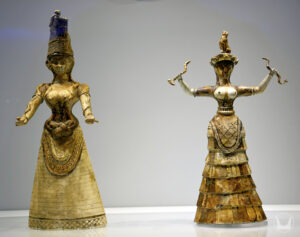
Two faience figures, their separate parts molded and joined with wire, their colors still vivid after thirty-five centuries. The larger holds snakes coiled about her body; the smaller holds snakes in each outstretched hand; a small feline crouches atop her headdress. Whether they are goddesses or priestesses remains a question scholarship has not resolved, and I suspect the Minoans would have found the distinction less important than we do. The snake, in the Minoan world, was a creature of the earth’s depths—chthonic, liminal, connected to whatever lay below the surface of the living world. The feline on the smaller figure’s head announced dominion over the wild. The tight bodice, the flounced skirt, the exposed breasts: this is Minoan formal religious dress, the same dress we see on seals and frescoes across the entire palatial period. These two figures were found carefully deposited in sealed stone cists in the Temple Repositories of Knossos, placed there when the sanctuary was destroyed and preserved against the day it would be rebuilt. Someone thought them worth saving. Three and a half thousand years later, standing before their case in Heraklion, I understood why.
The Ring of Minos
Gold signet ring with cult scene · X-A1700 · Intact · Bezel: 3.55 × 2.45 cm · Knossos, area of the Temple Tomb · Late Minoan II, Final Palatial period: 1450–1400 BCE · Gallery VIII
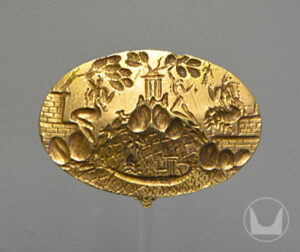 A gold ring whose oval bezel contains, in the tiniest possible compass, an entire theology. On the left, a woman shakes the branch of a tree growing from a built sanctuary, a gesture of ritual invocation. At the center, a man kneels to pull another branch and offers its fruit to a goddess seated on a stepped platform. To her right, a small divine figure descends through the air. Below the terrestrial scene, divided from it by a row of oval rocks, a goddess stands in a boat and rows across a stylized sea, a stepped altar with horns of consecration rising beside her. The goddess appears simultaneously in three registers: descending from the sky, enthroned upon the earth, sailing the sea. The Minoan conception of divinity, compressed into a bezel smaller than a postage stamp: a deity who does not inhabit one realm but moves between all three, whose presence is not fixed but fluid, whose worship is not a matter of approaching a statue but of reaching for a branch, of feeling the living world respond. I have thought about this ring many times while writing. It shaped how I understand the religion of my Minoan characters.
The Prince of Lilies Relief Fresco
T7 · Plaster · Fragmentary, joined from fragments, restored · Height: 230 cm, Width: 145 cm · Knossos Palace · Late Minoan I, Neopalatial period: 1600–1450 BCE · Gallery XIII
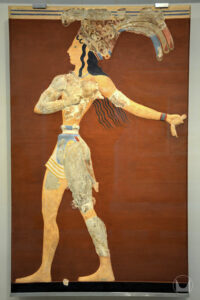 The most famous of all Minoan frescoes and one of the most debated. A life-size male figure moves against a red ground, his body rendered in high relief, wearing a loincloth and belt of vivid color and a crown of extraordinary elaboration: wax-lilies and peacock feathers, constructed with the confidence of someone accustomed to being looked at. Arthur Evans, who excavated Knossos, identified him as the Priest-King, the ruler of the palace, the embodiment of Minoan temporal and sacred authority. Later scholars have proposed other readings—athlete, boxer, figure of command—and some have argued that the magnificent crown belongs not to this figure at all but to a priestess or sphinx from an adjacent fragment. The three pieces of the fresco do not join. The reconstruction is partly Evans‘s interpretation. But standing before it in the gallery, argument falls away. Whatever he is, he moves with absolute assurance through a world where beauty and power are the same thing, and that—regardless of the scholarly dispute—is a true observation about the Minoan world.
Fresco with relief bull
T8 · Plaster · Fragmentary, joined from fragments, restored · Height: 146 cm, Width: 143 cm · Knossos Palace · Middle Minoan IIIB – Late Minoan IA, Neopalatial period: 1650–1550 BCE · Gallery XIII
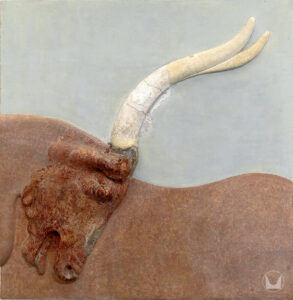 A bull’s head in stucco relief, the animal caught in the moment of desperate flight, head lowered, ears forward, mouth open, tongue visible. The technique is stucco relief rather than flat fresco painting, and what it achieves is something close to the sensation of the animal actually projecting from the wall, lunging toward the viewer. Other fragments from the same composition show parts of two bulls, human figures male and female, olive trees, a rocky landscape: a bull hunt, in full cry, rendered at a scale that must have made the portico wall of the North Entrance to the palace feel like the edge of an actual landscape. The desperate expressiveness of that lowered head—the animal’s complete awareness of its own danger—is not the work of a civilization that regarded the natural world with indifference. The Minoans painted what they saw, and what they saw they saw completely.
The Dolphin Fresco
T10 · Plaster · Fragmentary, joined from fragments, restored · Height: 127 cm, Width: 176 cm · Knossos Palace · Late Minoan I, Neopalatial period: 1600–1450 BCE · Gallery XIII, Case 142
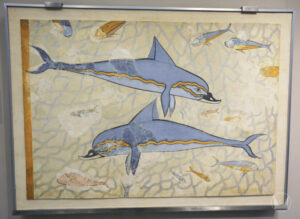
Two dolphins move through painted water among small fish of blue, yellow, and pink, the sea behind them rendered in light blue with a darker net pattern suggesting the iridescent, shifting surface of the Aegean. It was found in the Queen’s Megaron. Evans believed it adorned a wall above an entrance; later analysis suggests it may have decorated a floor on the upper storey, though the uncertainty of its original location has never diminished its power. What strikes me most, each time I stand before it, is the quality of the water. The Minoan painters understood the sea not as a flat backdrop but as a medium—full of light, movement, and life at every depth. The dolphins are not decorative. They are at home. The entire fresco radiates the particular Minoan conviction that the natural world is not hostile to human habitation but continuous with it, that the sea beyond the palace wall and the painted sea above the queen’s door are the same sea, and both are beautiful.
The Bull-Leaping Fresco (Taureador Fresco)
T14 · Plaster · Fragmentary, joined from fragments, restored · Height: 107 cm, Width: 184 cm · Knossos Palace · Late Minoan II, Final Palatial period: 1450–1400 BCE · Gallery VI, Case 60
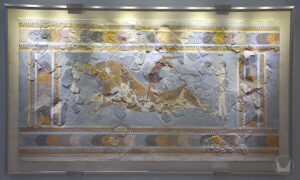
The best preserved of at least four frescoes depicting the same subject, found in the East Wing of the palace. A great bull charges across the painted field; one figure grips its horns; a second is airborne over its back, body fully extended in the leap; a third stands behind, arms raised to receive the landing. Men are rendered in red; women in white. Both participate. The sequence of the leap—approach, grip, vault, land—has been the subject of continuous scholarly debate, with biomechanical studies reaching contradictory conclusions about whether the depicted sequence of movements is physically possible. I find this debate instructive rather than deflating. The Minoans were not depicting the impossible. They were depicting the absolute limit of the possible, the point at which the human body, perfectly trained and perfectly committed, meets the animal at its most dangerous and does not flinch. Bull-leaping was not sport in any sense we would recognize. It was the central ritual image of Knossian authority: mastery of the most powerful creature in the known world, achieved not by weapons but by the body alone.
Griffin Fresco (Relief)
T31 · Plaster · Knossos Palace · Neopalatial period: 1700–1450 BCE · Gallery XIII
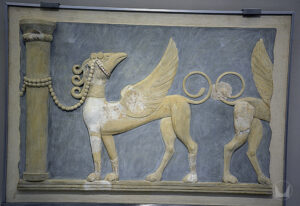
The griffin—eagle’s head, lion’s body, great wings—is one of the most ancient of all composite creatures, arriving in the Aegean from the Near East and finding in the Minoan world a home so congenial that it became one of the defining images of palatial authority. At Knossos, griffins flanked the throne in the Throne Room, rendered in relief fresco on either side of the gypsum seat where the ruler, or perhaps the high priestess, sat in formal ceremony. To be enthroned between griffins was to sit between guardians of the boundary between the human and the divine, between the living and the dead, between the known world and whatever lay beyond it. In my own work, the griffin carries precisely this charge: not a monster, not merely a symbol of power, but a creature that exists at the threshold, that marks the point where one kind of reality ends and another begins.
Boar’s Tusk Helmet with Cheek Guards
O-E175 · Bone (boar’s tusk) · Conserved, modern reconstruction of the helmet using the boar’s tusks found in the excavation · Height: 33 cm, Width: 24 cm · Knossos, Zafer Papoura · Late Minoan II, Final Palatial period: 1450–1400 BCE · Gallery X, Case 105
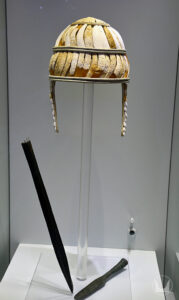 I did not know before I saw this object that the helmets of Bronze Age warriors were made from the tusks of wild boars. The knowledge changed something in how I understood the world I was writing. Each helmet required the tusks of thirty to forty animals, cut into curved plates and stitched in alternating rows onto a leather or cloth base. This example was found in a warrior’s tomb at Zafer Papoura, accompanied by weapons and insignia of rank, and its construction is so delicate—eighty intact tusks, each precisely shaped and placed—that it is now understood to have been ceremonial rather than functional, a statement of status rather than a piece of battlefield armor. Homer describes this exact type of helmet in the Iliad, worn by the Cretan hero Mēriónēs. To stand before the physical object described in a poem composed centuries after the object itself went into the ground is one of the particular pleasures of the literary-archaeological journey. It confirms something important: that the poems remember what the earth preserves.
Stone Bull’s Head Rhyton
Λ1368 · Serpentinite, rock crystal, jasper, shell · Height: 20 cm · Knossos, Little Palace · Late Minoan II, Neopalatial period: 1600–1500 BCE · Gallery VIII, Case 79
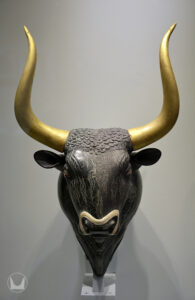 A libation vessel in the form of a bull’s head, carved from dark serpentinite, its eyes inlaid with rock crystal and jasper, its muzzle inlaid with white shell. The right eye retains its crystal lens, which is concave on its inner surface, a detail of extraordinary intentionality, because the concavity magnifies the dark pupil behind it, giving the eye a depth and expressiveness that no flat inlay could achieve. The liquid offering was poured into a hole at the back of the neck and flowed out through the bull’s mouth: the animal as vessel, as conduit between the world of the living and whatever received the libation. The naturalism of the carving is absolute—every surface detail observed, every proportion considered—but the purpose is entirely ritual. This is the Minoan synthesis that I find most fascinating and most difficult to render in prose: a civilisation in which the beautiful and the sacred were not separate categories, in which a cult vessel was also a masterwork, in which the act of making something with consummate skill was itself a form of devotion.
Stone Lioness Head Rhyton
Λ44 · Limestone · Height: 17 cm, Length: 29.5 cm · Knossos Palace · Late Minoan I, Neopalatial period: 1600–1450 BCE · Gallery VIII, Case 87
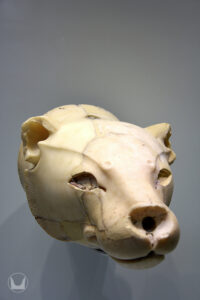 A rhyton in the form of a lioness head, carved from white semi-translucent limestone—the translucency itself a considered choice, allowing light to move through the stone in a way that animates the surface and softens the boundary between the carved object and the space around it. The eyes and muzzle were inlaid; a fragment of red jasper was still preserved at the tip of the nose when it was excavated. Like the bull’s head rhyton, it functioned as a vessel for liquid offerings, the libation poured in at the back of the neck and flowing out through the nose and mouth. It was found stored with other stone vessels in the Room of the Stone Vases in the Central Palace Sanctuary. The lioness, in the Minoan world, carried a weight of sacred meaning that the surviving images only partially explain: guardian, embodiment of divine power, companion of the goddess. In Atalanta of the Wild, my most recent novel, the lioness stands at the center of the story’s deepest mystery. I had been thinking about this rhyton for years before I understood why.
Minoan Larnakes
Painted Clay · Gallery XII
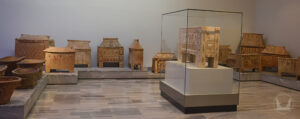
Clay chests, shaped and painted, vessels decorated with the same marine, bird, and floral imagery that adorned the walls of the palaces where the living had moved and breathed. The Minoan dead were placed in them for burial—actually, entombment into the rock of hillsides. When I first saw them, the thought arrived immediately and with complete clarity: If a character in one of my novels dies, I want to write about the body being placed within one of these, for the vigil and the burial. The larnax is not merely a coffin. It is a painted world, a last surrounding of beauty, a final insistence that even in death the Minoan person was not to be separated from the imagery of the living world. In Asterios and the Labyrinth, I wrote it. The scene exists because I stood in Gallery XII and understood, for the first time, what it meant to bury someone in a painted chest.