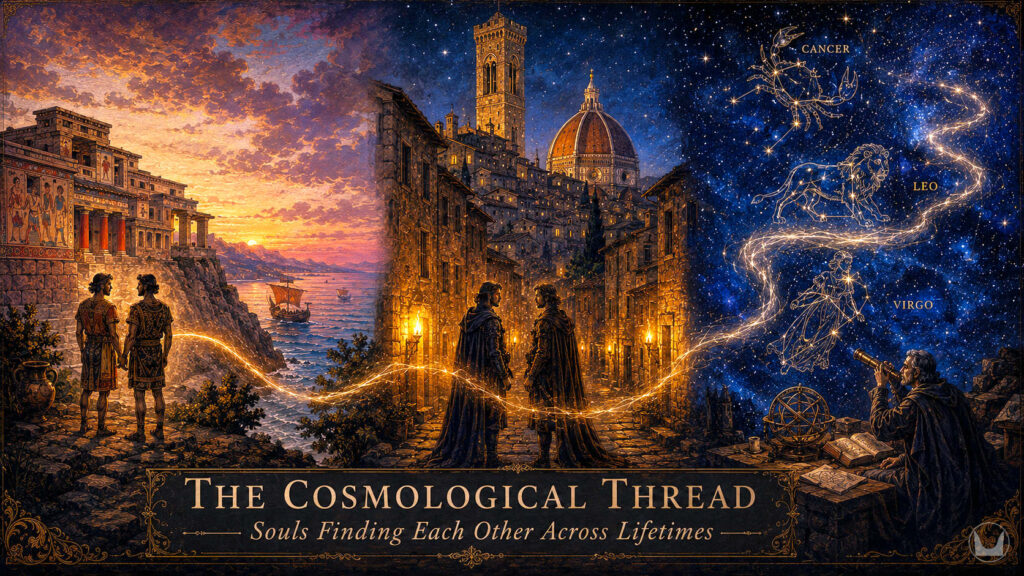
There is a thread that runs through everything I write. It does not announce itself. It does not appear in chapter summaries or back-cover copy. But it is there in every novel, in every narrator’s voice, in every reunion between characters who meet for what the plot calls the first time and recognize each other with an immediacy that mere plot  cannot explain. The thread is this: souls that belong together will find each other. Not once. Again and again, across whatever distance of years or centuries or civilizations the universe chooses to place between them.
I did not choose this theme. It chose me, or rather, it was already in me long before I sat down to write fiction, waiting for the form that would allow it to speak.
The Thread Through Three Novels
In A Tale of Paris & Paris: Echoes of Troy, the bond between Lorenzo and Vittorio carries from its first pages a quality that exceeds friendship—a recognition, an 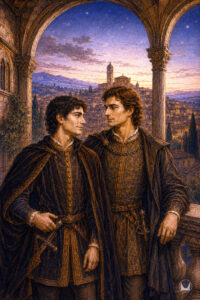 ease, a mutual claim that feels older than either man’s biography can account for. When Erebos enters the story and meets Lorenzo, the same current moves between them: the particular electricity of souls that have, somewhere, somehow, been in each other’s orbit. I have not belabored the point. The novels do not lecture. But the attentive reader will feel it.
In Asterios and the Labyrinth, the connection operates at a deeper structural level. Though I have not stated it within the novel’s pages, I envisioned Asterios and Phaistos from the beginning as previous incarnations of my Renaissance protagonists,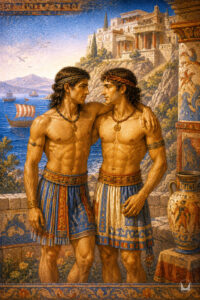 the same souls, two thousand years earlier, loving and committing to each other with the same essential nature, in an entirely different world. The Bronze Age and the Quattrocento are not, in my cosmology, separate eras. They are successive rooms in the same long house.
And in Atalanta of the Wild, the thread becomes the novel’s very architecture. Néos, Atalanta’s closest companion, the half of her heart that is not her, is not simply a Bronze Age character telling a Bronze Age story. I conceived him as a man of letters in the Italian Renaissance of the Quattrocento, a future incarnation of himself, who tells the story 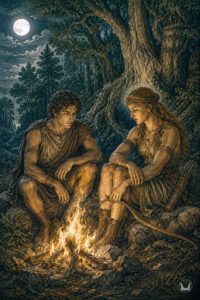 of Atalanta not only from the records of an ancient manuscript available to him but from his own remembrance. He was there; he knows what happened because part of him has always known. Memory, in this cosmology, is not merely personal. It is cosmological. The reunion of bonded souls across successive lifetimes is not a subplot in these novels. It is the argument beneath all three.
A Catholic Boy From Brazil
One might find such a belief unexpected, coming from a Catholic boy from Brazil who grew up in the 1960s and 70s in a conservative household, was forced to attend Mass every Sunday, and came of age within the warm institutional embrace of the Church. My formation was thoroughly Catholic in the most literal sense: my dear aunt was a nun; I joined the youth group at my parish; I studied piano at the Conservatory housed within the Colégio Santa Marcelina, a convent, where my mother presented me to the sisters at one month old. Each and every one of those nuns claimed me as her nephew, and I loved them back with equal fervor. For many years, I was in their prayers. Now that they have moved on, I miss them sorely.
But the Catholic formation and the cosmological belief are not, to my mind, in contradiction. They are answers to different questions. The Church asks: how shall we live? The thread asks: how do the souls we love persist? I have nothing against those who choose to wait in the earth for the trumpet of judgment at the end of days. It is their choice and their comfort, and I respect both. I, on the other hand, intend to follow the people who matter to me—and to whom I matter—wherever the next room of the long house leads.
 Antoine Lavoisier, a man of science rather than of faith, put it with the precision I could not improve upon: “Nothing is lost, nothing is created, everything is transformed.” —Traité Élémentaire de Chimie (1789)
What the Fiction Is For
Until the day when God’s blessing of a creative mind and a healthy body is withdrawn from me, I will write tales that encourage my readers to keep faith with each other, not merely in this life, but beyond it. That is, in the most honest accounting I can offer, what the fiction is for. Not entertainment alone, though I hope to entertain. Not historical scholarship only, though I labor to be accurate. But the transmission of a belief: that the bonds forged between souls are not dissolved by death, that the people we have loved are not simply gone, that the universe is more faithful to its attachments than we, in our grief, are able to believe.
The narrator of my short story Meeting Donatello said it better than I can: “That my voice may enspell you, singing ballads of bygone lives, and grant you the hope to meet with them we held most dear.”
That sentence is the thesis of everything I have written and intend to write. The novels are the argument. The thread is the proof.

Rio de Janeiro, the xxvii day of May, MMXXVI.

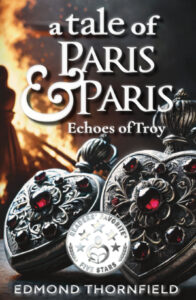
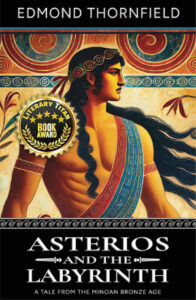

Click any cover to read a preview chapter and learn more.