There is a Latin pun at the heart of medieval Dominican identity so perfect it could only have been God’s own joke—or the devil’s. Domini canes: the Hounds of the Lord. It sounds almost exactly like Dominicanus, the Latin name for a member of the Order of Preachers founded 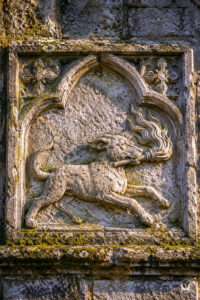 by Saint Dominic in the early thirteenth century. Medieval Catholic folk heard the echo, smiled, and winced. No one wanted such a dog scratching at his door.
The nickname did not arise from malice or mockery. It arose from a legend, and legends, when they are good enough, have a way of becoming doctrine.
The Vision of the Blessed Juana de Aza
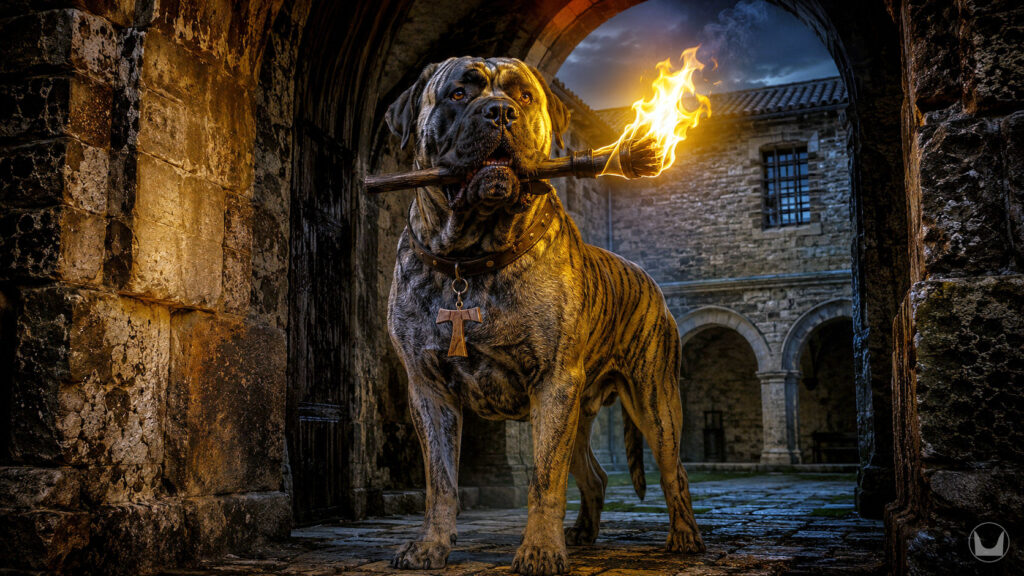
Before Dominic was born, his mother, Juana de Aza, struggled with infertility and made a pilgrimage to the shrine of Saint Dominic of Silos, praying for a child. There she received a dream: she gave birth to a dog that leapt from her womb with a lit torch in its mouth and set the whole world on fire.
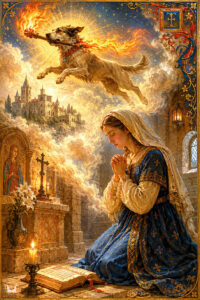 The medieval imagination did not find this disturbing. It found it luminous. The dream was read as a prophetic sign of the son to come, who would carry the flame of the Gospel into every corner of Christendom and scorch out the heresy that threatened to consume it. The dog became the emblem of the Dominican mission: relentless, loyal, burning with holy purpose, impossible to outrun.
The iconography followed naturally. In manuscript illuminations, church carvings, and the decorative programs of Dominican convents across Europe, a dog appears carrying a torch in its mouth, the universal visual shorthand for the Order of Preachers and everything it represented. Zealous preaching. Doctrinal precision. And then the Inquisition.
It is an image that amused medieval people even as it unsettled them. The amusement lay in the wit of it, the elegance of the pun, the pleasing idea that God had announced His hounds in a dream before they were born. The unease came from the other thing—the thing everyone understood but preferred not to name aloud.
The Dog That Decorates Chapter Twelve
In A Tale of Paris & Paris: Echoes of Troy, I allude to the Domini canes tradition through the illustration that decorates the header of Chapter Twelve. But with a deliberate alteration: from the collar of my dog hangs a Tau cross.
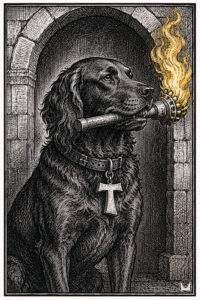 The Tau, the T-shaped cross associated with Saint Francis of Assisi, who adopted it as his personal signature and the emblem of his order, transforms the image entirely. The arrival of a dog bearing this cross in Cortona announces not the black-habited friars of the Order of Preachers but the grey-habited Conventual Franciscans—the Greyfriars—who serve as the novel’s inquisitors.
The adaptation is my small act of historical precision rendered in visual form. The dog who comes sniffing at the doors of my characters wears a Franciscan collar rather than a Dominican one. I have written elsewhere why that choice matters historically. Here I will say only this: I hope the attentive reader pauses at that chapter header, recognizes the Domini canes tradition being invoked, notices the Tau cross, and understands in an instant what would otherwise require several paragraphs of exposition.
This is what decorative devices are for, in the hands of a publisher who takes them seriously.

Rio de Janeiro, the xxix day of May, MMXXVI.

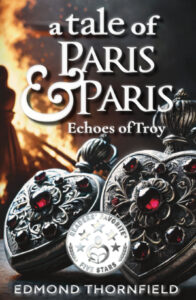
Click the cover to read a preview chapter and learn more.