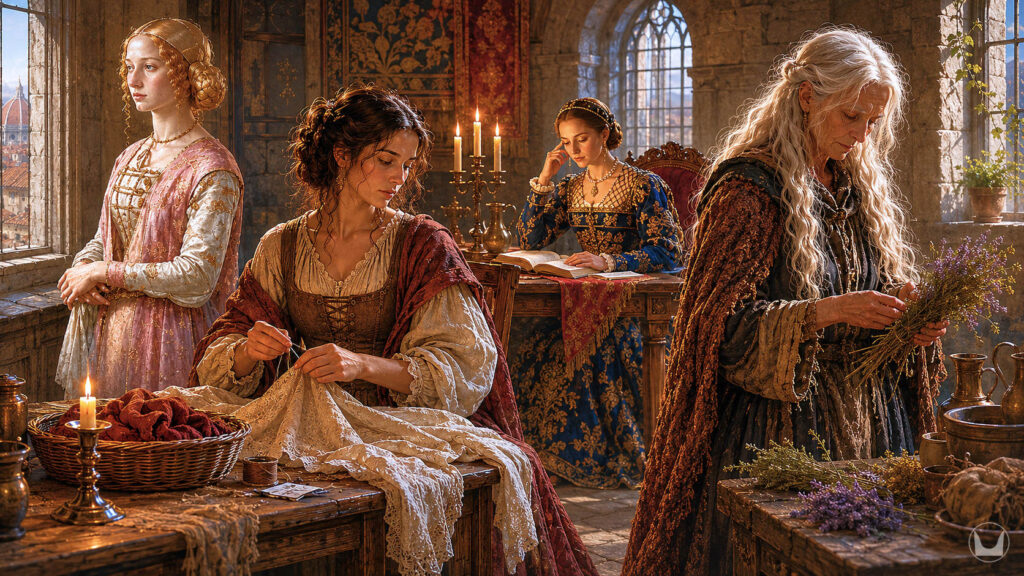
By law, by Church doctrine, and by the unspoken consent of a society, power was a man’s possession in the Florentine Republic of the Quattrocento. A woman passed as property from her father to her husband. Her purpose, as the age defined it, was procreation and domestic service. Non-conformity was frowned upon, and in extreme cases it was punished by conventual confinement or death.
And yet.
Within those constraints, and sometimes in open defiance of them, women exercised power of a different kind: domestic authority, social intelligence, moral courage, the quiet force of someone who has learned to act without appearing to act. A Tale of Paris & Paris: Echoes of Troy is populated by such women. None of them is autonomous; in one way or another, each requires a man’s protection to survive in a world that demands her obedience. Yet none is passive. This essay is about four of them.
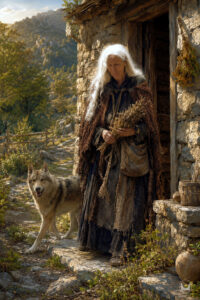 Milena the Ancient: Power Outside the Walls
Milena lives alone in a humble cabin in the Apennine Mountains above Cortona. She is forbidden to enter the citadel. Inquisitors have decreed her capture time and again. The clergy she steers clear of entirely. By every official measure of Quattrocento society, she is a woman without standing—exiled, accused, unwelcome.
And yet she is indispensable.
The home that sheltered her in youth was destroyed by the pestilence of 1437. Her one and only love was killed by papal knights when she was scarcely out of maidenhood. What remained to her was her knowledge: cures for common ailments, potions for the termination of unwanted pregnancies, and an understanding of gifts that the Church would call sorcery and she would call inheritance. Women in need find their way to her cabin. She turns no one away.
It is Milena who teaches Lorenzo to command the gift he has inherited from his mother, so that he may claim his true heritage. Without her influence, the history of Cortona turns out entirely differently. The woman whom official Cortona has exiled from its gates holds the thread upon which the novel’s central plot depends. That is not powerlessness. That is power driven underground, not extinguished.
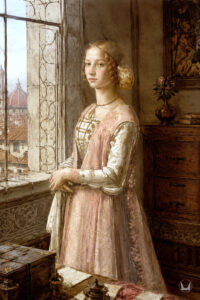 Costanza Briani: Power Deferred
Costanza is the mistress of her house. Her parents perished in the same pestilence of 1437, which took nearly a quarter of Cortona with them. She manages her own affairs with competence and high spirits, presiding over a household that includes her maid Maria Paulina and Signora Cornelia, the lady governess who has cared for the Briani siblings since childhood.
Yet the law requires her younger brother Lino to represent her in all legal matters, including the securing of her own marriage. She cannot act on her own behalf in the matter that concerns her most.
Costanza has loved Lorenzo di Ranieri since childhood, and she intends to marry him. That intention is clear-eyed and determined, not merely romantic. She has no illusions about her situation: her age is advancing, and if Lorenzo does not propose matrimony soon, the pressure upon her will become insurmountable. A nunnery is not a calling for Costanza. It is a threat.
What she exercises is the power of strategic patience: the capacity to hold her position, manage her household, and keep her dignity intact while waiting for circumstances to align. In a society that grants her no formal agency, she preserves her informal authority with every decision she makes inside the space available to her.
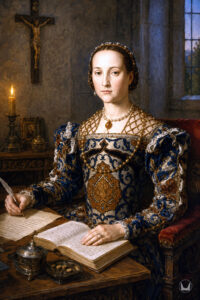 Elena dei Varani: Power at the Highest Cost
Elena is a noblewoman, originally from Castellum Gandulphi in the Papal States, educated and possessed of an intellect that her married life gives her no opportunity to use. She would have dedicated herself to the study of history. She would have traveled to Constantinople and to the ruins of the Roman Forum. Instead she is the wife of Vittorio dei Varani, mother of two sons, and pregnant with a third child she does not want.
She knows what her husband has done. In Arezzo, before their relocation to Cortona, he committed crimes she cannot name aloud—crimes that could ruin the future of her children. She does not denounce him to the authorities, not because she lacks the courage but because she understands what is at stake: to denounce him is to destroy her children’s prospects along with his. She absorbs the knowledge of his crimes into herself and carries it in silence, protecting her sons at the cost of her own conscience.
That is not submission. That is power at a terrible cost. Elena dei Varani makes the calculation that every woman in an impossible marriage has been forced to make, and she does so with full awareness of what it demands of her. She is the character in the novel whose predicament I find most devastating.
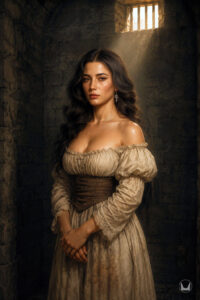 Stella Prinelli: Power in Testimony
Stella Prinelli is my homage to Nathaniel Hawthorne and his Hester Prynne, a character who left a deep impression on my imagination since my twenties. Like Hester, Stella bears the consequences of a transgression that was not hers alone; and like Hester, she refuses to be broken by them.
She is a seamstress of exceeding beauty who came to Cortona not long before the novel’s action begins. Friar Arturo de Dimedalle, the local Greyfriar priest, seduces her. The Greyfriar inquisitors respond by accusing Stella of the corruption of a servant of God and ordering her arrest on suspicion of witchcraft. Friar Arturo receives light penance and is pardoned.
Throughout her trial, Stella maintains her innocence and calls for equal treatment to be given to the man who seduced her. She is not heard. The Greyfriar inquisitors are men of fervent religious conviction, intent on saving her soul from wickedness by all means necessary—even fire. Yet she does not retract. She does not perform the contrition that might have spared her. She testifies to what happened, names the inequality of the judgment bearing down upon her, and stands firm.
That is the power of witness: the refusal to let an injustice pass unnamed, even when naming it changes nothing about the outcome. In Rocco Friuli, one of Lorenzo’s soldiers assigned to the dungeon, she finds unexpected love during the investigation. He restores to her something the institution was intent on stripping away: the knowledge that she is seen, valued, and not alone.
What Writing Them Taught Me
The Quattrocento did not produce passive women. It produced women whose power operated through channels the period was unwilling to recognize. Herbal knowledge passed hand to hand; domestic authority operated without legal title; strategic endurance passed as compliance; and moral testimony, though often quiet, nonetheless found its way into the record.
Writing Milena, Costanza, Elena, and Stella taught me that the most interesting historical question is never what women were forbidden to do. It is what they did anyway, in the space that remained, and at what cost. That is the question A Tale of Paris & Paris: Echoes of Troy attempts to answer—not with argument, but with story.

Rio de Janeiro, the xxx day of May, MMXXVI.

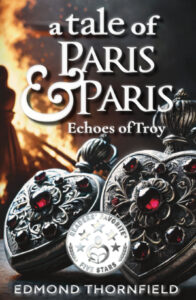
Click the cover to read a preview chapter and learn more.