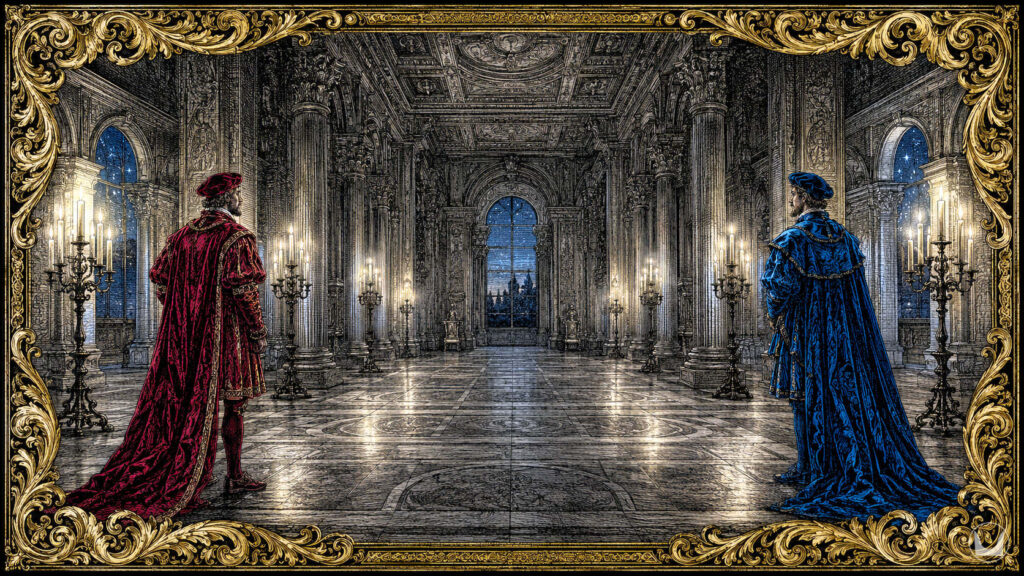
There is a passage in one of my novels where a prince stages his own death at a woman’s feet. He enters the feast hall not as a lord but as a stag—darting, pausing, tossing his head to scent the wind—and when the drum thunders to its crescendo, he falls before her, bares his throat, and lies still. The hall holds its breath. She does not move. The moment hangs like an arrow drawn upon the bowstring.
That is desire, not romance. The distinction matters. I have spent three novels learning to honor it.
 What Desire Is Not
In literary fiction, desire is not the declaration, not the consummation, and not the explanation. It is the charged space between two people who have not yet spoken what they mean, and may never speak it. It is what the body knows before the mind has caught up.
Romance, as a genre mode, moves toward resolution. It wants the declaration, the kiss, the confirmation that what was felt is mutual and permanent. It finds satisfaction in the closing of distance. I do not write in that direction. I write in the direction of the open bowstring, the tension held, the arrow not yet loosed, the space between bodies that is itself the subject.
This is not restraint for its own sake. It is a conviction that the unspoken carries more weight than the spoken, and that the reader’s imagination, properly directed, will feel more than any explicit scene could deliver.
The Body as the Text
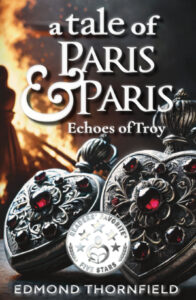
In A Tale of Paris & Paris: Echoes of Troy, Aunt Milena receives Lorenzo in a barn in Castiglione Fiorentino and without ceremony tells him that his love for Vittorio is true and shall never be amiss. The scene is not erotic. It is not meant to be. What it carries is something more intimate than eros: it is the moment when a young man who has lived with the weight of secrecy is told, by a woman who has known love and grief across sixty years, that what he feels is not unnatural but as natural as anything that befalls under the sun.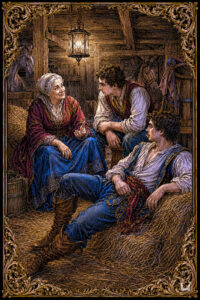
What follows in the barn scene does not describe what Lorenzo and Vittorio do or feel in physical terms. The desire between them has been established not through touch but through context: through the lockets, through Aunt Milena’s knowing gaze, through the word beloved used without apology. By the time the chapter closes with Flora has no other mattress in the house. You both shall sleep in the barn this night—and Lorenzo’s quiet reply, Right well with me—the reader understands everything. Not a word of it was written outright.
The body in my fiction is not described so much as implied by gesture and the charged quality of a glance lingering a moment too long. Lorenzo’s desire for Vittorio lives in the way he wishes the road would never end, in the longing sighs that escape him on horseback, in the simple truth that he wishes it never to end, to keep riding side-by-side with Vittorio, bouncing in the cadence of the hooves of the beasts they love so much. That sentence contains more desire than a page of explicit description could bear because it places the emotion in the rhythm of movement, in the shared world of two people who love the same things.
The Dance That Is Not a Dance
In Asterios and the Labyrinth, the Kemetian princesses Meritamen and Iset arrive at the court of Knossos and perform a dance of betrothal. On its surface, it is a ceremonial event; beneath, it is one of the most charged erotic sequences I have written. Not a single word of overt desire appears in it.
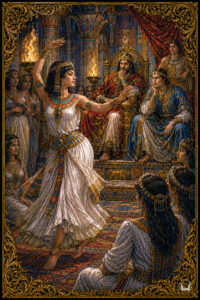 The dance works because it reverses the expected dynamic. It is the women who advance; the king and his beloved are observed, assessed, and claimed. Meritamen does not wait for Asterios to act. She reads him, circles him, deposits her ornaments on the table before him in a series of provocations, and at the end draws him to her lips with one hand pressing on his nape. His response: the shock benumbs his frame. For one of the few times in the novel, he is without agency. The desire in that scene belongs to her. He receives it.
What makes this scene function as desire rather than spectacle is the interiority threaded through it. While the dance unfolds, Asterios watches his beloved Phaistos fall under the spell of Iset’s exotic grace, and what he feels at that sight is not jealousy but heartache: his heart pangs at the thought of his beloved bestowing kisses upon her. In the same moment that a princess claims him before the court, he dreads the alteration of his relationship with Phaistos. The desire and the grief arrive together, truer to experience than either emotion alone.
The scene closes not in the throne room but in the King’s Apartments, where the great doors are closed and a single line does the work: his beloved falls upon the mattress. The reader has been given nothing explicit. The reader has been given everything.
The Willing Hart
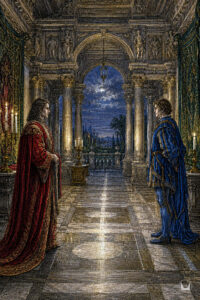
The title of Chapter Fourteen of Atalanta of the Wild names the dynamic precisely: The Willing Hart. Meléagros does not pursue Atalanta. He performs his own willingness to be pursued. He enters the measure as quarry, not hunter, and in doing so, he inverts every expectation that a Bronze Age prince might bring to a hall full of heroes.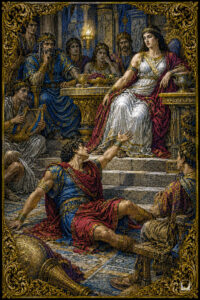
What Atalanta feels during the dance is rendered through restraint: unmoved in body, yet swift of thought. Those five words contain an entire interior drama. The body keeps still; the mind races. The desire is present, but it is held behind the composed mien she reasserts the moment the giggle escapes her. That giggle is the most erotic moment in the sequence because it is involuntary and immediately suppressed. It is the arrow that moves in the bowstring before the hand stills it.
What follows between Atalanta and Meléagros is not passion but conversation. They speak of mountains and forests, of quarries and craft, of cold streams and shared devotion to the same goddess. By the time Atalanta thinks our souls may be twinned, the reader believes her not because desire has been declared but because it has been earned through the quiet accumulation of recognition.
Néos observes this from a careful distance, and his observation adds a second layer of desire to the scene: his own complicated feeling for Atalanta, rendered as protective irony. When he sees her laughing with Meléagros and moves to reclaim her attention with the story of the boar’s lair, the gesture is not jealousy, but it is not nothing. And when he later says he wields my name as a key to conquer your heart, and all of them laugh except Atalanta, the reader glimpses the full triangle: what Meléagros wants, what Néos deflects, what Atalanta refuses to name.
 The Craft of the Unspoken
Across three novels and three very different love stories—a Quattrocento man who loves another man, a Minoan king who loves his companion even as he takes a queen, a Bronze Age huntress whose heart has yet to stir—I have followed the same principle: desire lives in what is withheld.
This is not prudishness, and it is not evasion. It is a conviction about where the weight of a scene lies. The moment before the touch is more charged than the touch. The word not spoken carries more than the declaration. The body kept still while the mind races holds more feeling than the body in motion.
I write for readers who hear what is not said, who understand that the arrow drawn upon the bowstring is, in every sense that matters, already in flight.
I need not loose it for them.
Rio de Janeiro, the xiii day of June, MMXXVI.



Click any cover to read a preview chapter and learn more.