 I knew some of this before I began. Not in depth, and not as a coherent body of knowledge—more as fragments encountered at random, in craft books read out of sequence, in advice absorbed before I had the experience to evaluate it. What the novels themselves taught me was different in kind: not information, but understanding. There is a distance between knowing a principle and having lived through the consequences of ignoring it.
A Tale of Paris & Paris: Echoes of Troy came first, followed by the short story Meeting Donatello, then Asterios and the Labyrinth, and finally Atalanta of the Wild. Each deposited lessons that made the next one more accomplished. Below are the ones that now form the foundation of my creative process.
I. The Appropriate Style Guide
This is not a universal decision. It depends on the market, the language, and the kind of fiction being written. Since I write literary historical fiction in American English, my chosen guide is the Chicago Manual of Style. A writer working for a British readership would reach for New Hart’s Rules and its companion, The New Oxford Style Manual. Beyond English, there are style guides for most major languages. The point is to select one and adhere to it. An inconsistent manuscript is an unprofessional one. No amount of ambition compensates for that.
 II. Point of View and Verb Tense
The options are familiar: first person, limited third, close third, omniscient third, and the rare second person. Each has its logic, its strengths, its costs. Choose one that serves the story and commit to it.
The same discipline applies to verb tense. Most historical fiction is written in the past tense, and most readers expect it. Hilary Mantel wrote in the simple present for the Wolf Hall trilogy, to considerable effect. I favor present-tense narration. I want the scene to unfold in the reader’s mind as if it were happening in the present moment. That is how I experience it while writing: not reconstructed in retrospect, but discovered as it happens.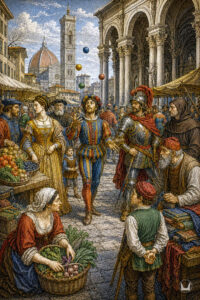
III. POV Characters
My inclination has always been toward multiple points of view. In A Tale of Paris & Paris, I followed it without restraint: twelve characters with point of view, antagonists included. Some died before the final page. Making it cohere was not a simple undertaking. The lesson was not that twelve was wrong—the narrative required them—but that I needed to understand, going in, what I was taking on.
By Asterios and the Labyrinth, I had reduced the count to six. I could breathe. The architecture was easier to hold in mind. And in Atalanta of the Wild, I chose a dual-POV structure: two characters, two voices, the same world in counterpoint. It was the most manageable I had yet attempted.
The novel should have as many points of view as the story requires. The lesson is not that fewer is always better, but that there is a reason it is easier to juggle two balls than twelve.
 IV. The Discovery of the Pantser
Among all the things the novels have taught me, this may be the most fundamental: I am a pantser. I cannot plot a novel in advance beyond a rough outline, perhaps less than twenty percent of what will develop. The rest must be discovered in the writing.
This is a method, not a deficiency. The story knows where it is going; my task is to follow it with attention and trust. When I have tried to impose more structure than the story will accept, the prose has stiffened. When I have let the tale unfold as it wills, it has surprised me. And surprises that catch the author tend to catch the reader too.
What each successive novel gave me is a firmer trust in my voice, in my instincts, in the knowledge that the story will arrive if I follow it where it leads.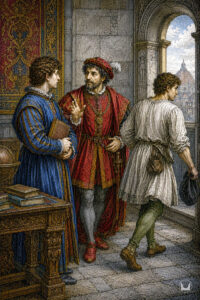
V. Dialogue: Natural, Spare, and Anchored
Four principles govern the dialogue I write now, arrived at through practice rather than theory.
First: dialogue must sound natural for the character and the era. A fifteenth-century Florentine does not speak like a twenty-first-century novelist trying to sound medieval. The voice must be earned through immersion in the period.
Second: not every line of dialogue requires a tag. If the character can be identified by context, presence, or the distinctive quality of the voice, the tag is clutter. Remove it.
Third: action tags serve double duty. They locate the speaker and keep the scene in motion. A character who speaks while doing something is more present than one who only speaks.
Fourth, and governing all the rest: less is more. The dialogue that Asterios demanded, with its dual civilizations and its weight of myth, made me leaner. By the time I reached Atalanta, the tags had reduced themselves almost without effort. The voice had grown confident enough to need less scaffolding.
 VI. The Elimination of Redundancy
Nothing weakens prose faster than the modifier that does work the noun or verb has already done—or must do.
She walked slowly, carefully, nervously across the room and quietly, timidly opened the door. The sentence does not trust itself. He was deeply, profoundly saddened by the terribly tragic news. Nor does that one. It was a very large, very old, very impressive castle on a very steep hill. Four verys and still no castle worth seeing. The modifier in sequence, the adverb of emphasis piled on another adverb of emphasis: these are the marks of prose that has not yet learned to believe in the strength of its nouns and verbs.
The same applies to suddenly. If the writer needs the word to signal that something surprising is coming, the surprise has already been lost. The event itself must do that work, or it is not doing it.
Less is more. In writing as in so much else.
Coda
There is more that the novels have taught me than these pages can hold. The important thing is to keep writing and to understand that what accumulates through the writing is not merely technique but a kind of earned authority: the knowledge of what your voice can do, what your instincts are worth, and how far to trust the story when it pulls you where you had not planned to go.
With heart, perseverance, and time, the magic happens on the page.
Rio de Janeiro, the xii day of June, MMXXVI.

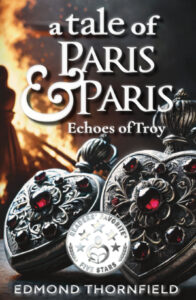
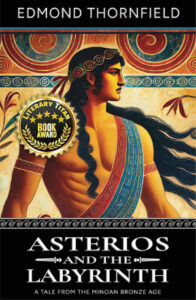

Click any cover to read a preview chapter and learn more.

A note for writers at the beginning of their journey, or for any writer who welcomes an honest and generous voice on the craft: the YouTube channel and website of Diane Callahan—Quotidian Writer—offered me guidance when I was starting out that I continue to draw on. I recommend her without reservation. She can be found at quotidianwriter.com.