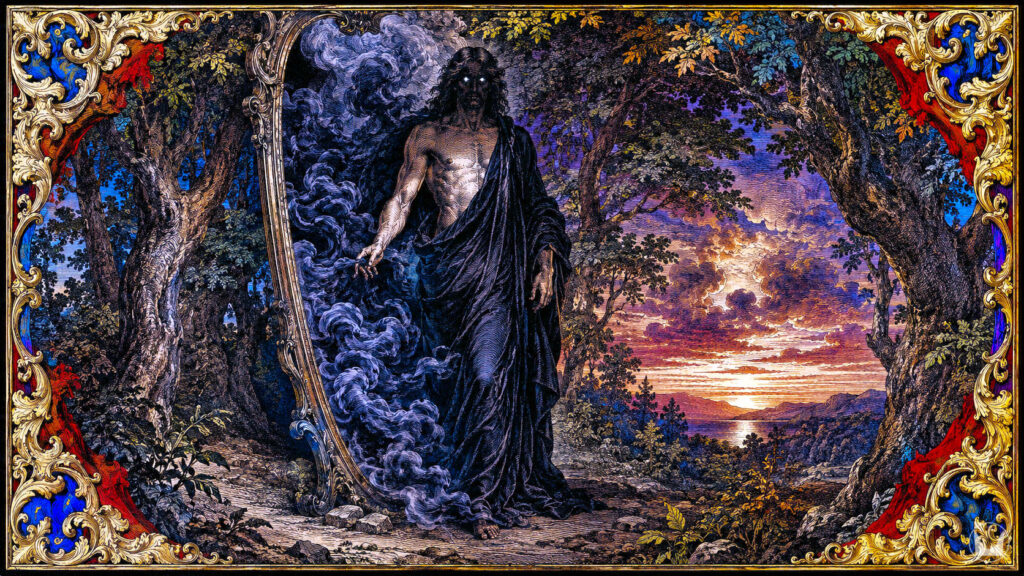
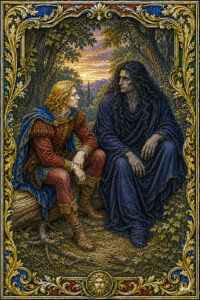
There is a figure who appears in the novel without apology. He steps through a mirror of black smoke at the edge of a glade in November, sits upon a fallen trunk in the waning afternoon light, and speaks of forgotten siblings and a world that has ceased to remember him. He is Erebos—and if the reader is paying close attention, he has been present far longer than his arrival suggests.
This essay is for those readers.
The Oldest of the Old
Before the Olympians, before the Titans, before anything that mythology has named and catalogued, there was a generation of beings so ancient that they are not gods in a conventional sense. They are the stuff from which creation is woven: Chaos, Gaia, Tartaros, Eros, and among them, Erebos and his sister Nyx, Darkness and Night. From their union came Aether, the upper air, and Hemera, the Day. These are not characters from a pantheon. They are the conditions of existence itself.
In the novel’s cosmology, Erebos has endured through all the ages of the world. He has outlasted the Titans, the Olympians, the rise and collapse of civilizations, the Trojan War, and the centuries between. He has not changed. The world has forgotten him. He has, in his own words, forgotten the world.
When Lorenzo summons him in the hazel-glade above Milena’s creek, Erebos comes not as a dread power or a monster. He comes as someone who has been away too long, glad to be remembered.
 The Bloodline and the Bargain
How does a primordial deity find his way into a historical fiction novel set in Cortona in 1450? The answer lies in two threads that the novel braids together.
The first is the mythic one. Cortona‘s legendary founder is Kórythos, and linked to his lineage is Dardanos, son of Zeus and the Pleiad Elektra, ancestor of the royal house of Troy. This is not the novel’s invention; the ancient sources make the connection. A Tale of Paris & Paris honors it. The Ranieri family carries Dardanos in their name—Lorenzo Giuseppe Dardanos di Ranieri—and in Chapter Twenty-One, Aunt Milena corrects Lorenzo’s understanding of his own name, telling him that the true form in sorcery is Lorenzo Giuseppe Dardanos, Luciæ filius: son of Lucia, not son of Ranieri. In this world, descent is reckoned through the mother because only the mother can be known with certainty.
The second thread is the magical one. Lorenzo’s mother Lucia came from an ancient bloodline of witches who received the favor of Erebos and could command him to their will. Lorenzo has inherited this gift, though he has only lately begun to understand it. It was Milena who told him of his family line, Milena who taught him the incantation in Greek, the tongue that connects him to Dardanos and to the world his ancestor knew. The words are transliterated from the Greek and given in full translation within the text: I, Lorenzo Giuseppe Dardanos, son of Lucia, summon Thee, Erebos, my protector and avenger, come forth.
These two threads, the mythic and the magical, are the novel’s hybrid nature on full display. The setting is the Florentine Republic. The politics, the streets, the manners, the people: all historically grounded. But beneath the cobblestones runs a vein of something older, and the Ranieri bloodline sits above it.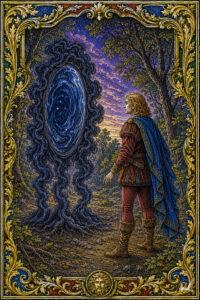
The Conjuration
Chapter Twenty-Six gives us the conjuration, and the scene deserves careful reading.
Lorenzo steps outside the cabin while Vittorio sleeps by the hearth. He stands alone among the hazel-trees. He has not believed any of this. Milena taught him the words; he has committed them to memory; but belief is another matter, and in Lorenzo it has always been a hard-won thing. He recites the incantation nonetheless, with what the text calls profound breath. Then he waits.
Three puffs of ebony smoke, each the size of a plum, rise from the shadows. They merge and spread into what is described as an upright mirror of black fluid, not quite liquid, not yet vapor. From it emerges Erebos. Here the description is exact, and the attentive reader should mark it: His eyes, black as night, glimmer with sparks of white stars.
That phrase is not decoration. It is a signature. Erebos is identified by those eyes—darkness pricked through with light, carrying its own illumination. In a novel that deals in concealment, in love that cannot speak its name, the visual identity of the primordial lord of darkness is itself a paradox: he is the darkness in which stars live.
 A Meeting of Souls
What happens next is one of the novel’s most remarkable scenes.
Lorenzo issues no command. He apologizes for having doubted the conjuration would work and offers Erebos leave to go if he wishes. He says: I seek not to impose demands but to acquaint myself with the soul you are.
Erebos, who has existed since the dawn of time, who has not been called by anyone since Lucia died twelve years before, replies: Not even my children have told me they would know who I am.
They sit together on a fallen trunk. They speak of origins, of time, of Nyx and Aether and Hemera, of a cosmos in which ancient beings drift apart, hindered, as Erebos supposes, by the Fates. Lorenzo pushes back gently: No longer do the Fates have power in this world. Destiny is ours to make. Erebos, who has existed since before destiny was a concept, receives this with merry glee, uncertain whether to take it in earnest.
He tells Lorenzo that Lucia is not gone forever, that she does not abide in Tartaros. You shall encounter her once more.
As the light fails and their time runs short, Lorenzo bids him farewell with warmth and invites him to return whenever he wishes—though he adds with a smile, not when others are present, for they shall flee in terror. Erebos laughs. He says: Gone be the days when I brought dread upon humankind.
Before he steps back through the shadowy gateway, he turns. And the final image Lorenzo gives us is a question: Am I deceived or veritable stars dance in the depths of his eyes?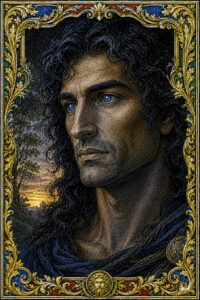
What the Stars Mean
Erebos is the guardian of a bloodline that stretches from Dardanos of Troy to Lucia of Cortona to Lorenzo in the year of Our Lord 1450. He has been there, in the background, before Lorenzo knew to summon him, before Lorenzo knew he could.
The novel presents him with a care that refuses the obvious. He is not sinister. He is not threatening. He is old in a way that nothing else in the novel is old, and he carries that age not as menace but as solitude. The world has forgotten him; he has retreated so far from it that he is uncertain whether his own family still exists in any form he would recognize. And then a young man in an Etrurian glade speaks his name in the old tongue, and sits with him, and wants to know his story.
For the reader who carries that image of the star-flecked eyes forward through the novel, Erebos becomes visible in places he does not announce himself. The darkness in a corner. The shadow at the edge of a scene. The novel’s climax will make certain things clear, though that is not this essay’s territory. What this essay says is simpler: look for the stars in the dark. When you find them, you have found him.
He has been there all along.
Rio de Janeiro, the xiii day of June, MMXXVI.

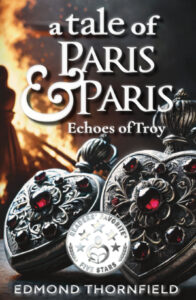
Click the cover to read a preview chapter and learn more.