Why Does AI Narrative Follow the Same Architecture Regardless of the Story It Claims to Tell?
This is Essay 12 of 22 in the series Why Choose 100% Human Authors, addressed to readers who want to understand what a human author does that a machine cannot and why that difference matters to the experience of literary fiction.

 The Costume and the Architecture Beneath It
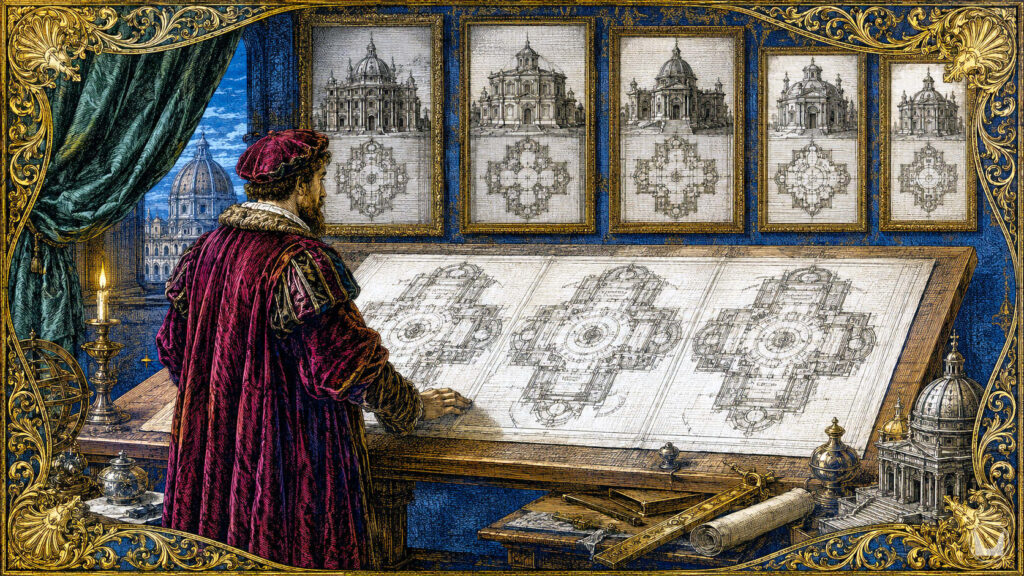
A language model (LLM) given a prompt for a historical novel set in fifteenth-century Venice will produce something that, on its surface, looks like a narrative set in fifteenth-century Venice. The canals will be present; so will the merchant families. There will be a young protagonist, a dangerous secret, a betrayal at the midpoint, a reversal of fortune in the third act, and a resolution in which something is lost and something is gained and the protagonist emerges transformed. Change the setting to Bronze Age Mycenae and the same architecture appears beneath different costume. Shift it to Georgian London and the costume changes again. The architecture does not.
This is the formulaic plot—not a story shaped by what its characters, circumstances, and world require, but a template populated with period-appropriate furniture.
The Beat Sheet and Its Tyranny
Narrative theory has given writers tools for understanding how stories work. The inciting incident, the midpoint reversal, the dark night of the soul, the climax, and the resolution are useful formal descriptions of patterns that appear across them. A language model does not use them as analytical descriptions. It uses them as a production schedule.
The result is a novel in which reversals arrive on cue. The protagonist’s first significant failure falls where a beat-sheet would place it. The moment of apparent victory before the final crisis arrives at the expected interval. The character who will betray the protagonist is introduced early enough to be planted and late enough not to be obvious because the model has learned that such figures appear then.
Consider a brief invented example. A story opens with a young woman who has inherited her father’s trading house under suspicious circumstances. She suspects her father was murdered. She investigates. At the midpoint, she discovers evidence that appears to confirm her suspicion. Then it is revealed to be false, planted to mislead her. She is at her lowest. She recovers, finds the true culprit, and confronts them. Justice is achieved at some cost.
 The story is competent. It moves. But every element arrives as convention dictates it should arrive. No moment surprises when it is required rather than allowed by the template. Somewhere around the midpoint, a seasoned reader will feel that they know more or less how many pages remain and what they contain.
The Character Arc That Resolves on Cue
The formulaic plot is not only a structural problem. It produces stock characters: in a template-driven narrative, characters exist to fulfil their assigned functions. The rival exists to be redeemed or destroyed. The love interest exists to be won, then endangered, then secured. Each arc completes under architectural pressure, not because it arises from the character’s nature.
A human author who has lived with a character long enough to know them will sometimes discover that the character refuses the expected arc. The rival does not redeem himself; he becomes less important as the novel finds its shape. The love interest is neither won nor lost but remains unresolved, reflecting the protagonist’s inner conflict.
These are not failures of plotting. They are what happens when a writer follows the logic of their work rather than the logic of the form. A language model cannot access that: it knows form, not work.
Originality and Its Source
The tropes that appear in AI-generated prose are not there due to poor choices made by the model. They are there because it has made the most probable choices, the ones that appear most often in the training data and resolve narrative tension in the most familiar way.
Originality in fiction does not come from rejecting familiar elements. It comes from following a vision to conclusions that could not have been predicted from the premise. The story that surprises does so when something in its writer’s imagination or understanding leads it to a place the template did not anticipate. This may be uncomfortable territory and ask more of the reader than the form allows.
An LLM cannot go to a place it does not know exists. It knows the destinations that have already been reached and finds the most efficient route to one of them. The reader arrives without having been anywhere new.
 What a Human Author Does
A writer familiar with a story knows the difference between a plot point that arrives from necessity and one that appears when it is time. The second kind produces a faint unease that something has been placed rather than grown. The correction can be difficult: such elements are load-bearing and removing them requires rebuilding what depended on them.
This is work that cannot be delegated to a template. It requires the writer to ask at every turn of the narrative: do the characters in this situation bring this about, or does it happen because this is where such things happen in stories like this one? The first question produces fiction. The second produces product.
The reader does not finish a novel shaped by the first question and think: that went as expected. They think: I did not know it would end there. They may not have wanted that outcome. That uncertainty is not a failure of the novel. It is the mark of a story that has been somewhere.

Rio de Janeiro, the xxix day of June, MMXXVI.