
Why Does AI Prose Produce Protagonists Who Excel at Everything and Convince Us of Nothing?
This is Essay 13 of 22 in the series Why Choose 100% Human Authors, addressed to readers who want to understand what a human author does that a machine cannot and why that difference matters to the experience of literary fiction.

The Problem with Perfection
There is a particular kind of protagonist that appears with frequency in AI-generated fiction. They are capable. They are perceptive. The people around them recognize their qualities, often remarking on them directly. When they face a problem, they find a solution; when they face opposition, they overcome it. They are, by every measurable standard, admirable. They are also, in every way that matters to a reader, nobody.
This is the competent nobody: the protagonist assembled from the qualities a protagonist is expected to possess, present as a list of attributes rather than as a person. They do not convince because they do not cost anything. A character who cannot fail in any way that matters has nothing at stake, and a character with nothing at stake gives the reader nothing to fear on their behalf.
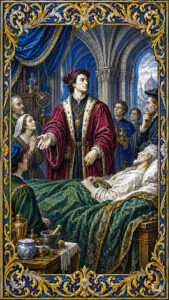 What Competence Without Flaw Looks Like
Consider the following example. A young physician in a Renaissance city is summoned to treat a nobleman whose illness baffles the older doctors. He makes the correct diagnosis where others have failed. The nobleman’s family, at first skeptical of his youth, comes to trust him within a scene. His methods are questioned by a senior physician; he refutes the challenge and the older man withdraws. By the end of the chapter he has saved the patient, earned the family’s gratitude, and demonstrated that his instincts, learning, and composure are beyond reproach.
Nothing in this is implausible. A skilled physician might do all of these things. The problem is not that he succeeds but that he succeeds without interior cost, without a moment in which his confidence falters and the waver is real rather than performed. He is a function wearing a Renaissance doctor’s robes.
Now introduce a different version of the same character. He makes the right diagnosis by a method he cannot justify: an intuition built on pattern recognition he has not yet learned to name. The correctness troubles him more than an error would. He refutes the senior physician, but the challenge reveals a gap in his formal training that he has been avoiding. The patient recovers. He sits with the family’s gratitude and feels it does not quite fit, for he came close to having nothing to offer. This version of the character has the same outcome, yet he is a different person: one the reader can inhabit because he contains the friction of being human.
 The Admiration of the Surrounding Cast
AI prose compounds the problem of the competent protagonist through the behavior of the characters around them. In a template-driven narrative, the protagonist’s qualities are frequently confirmed by the cast. These remarks serve an expository function: they tell the reader what to think about the protagonist instead of trusting the reader to form their own conclusion from evidence.
This is an unnatural way for people to behave. They show their regard through small actions, through the attention they bring to what the admired person says. They also withhold regard, misread character, admire for the wrong reasons, and fail to recognize quality when it is before them. A cast of characters who perceive the protagonist in a consistent manner and respond in accordance reflects the protagonist rather than existing independent of it.
The surrounding cast in literary fiction should function not as an audience assembled to receive the protagonist but as a world the latter must navigate. Some will see them clearly and dislike what they see. Some will love them for reasons that have more to do with their needs than with the protagonist’s nature. This friction is not incidental: it is what distinguishes the protagonist’s movement from a procession.
 The Absence of Failure
A language model understands failure as a narrative device. It knows that protagonists encounter setbacks; it includes them at the intervals the beat sheet requires. What it cannot produce is loss that costs them something irrecoverable. The setback in AI narrative is always reversible: it teaches, it clears the way for the eventual success. It is not the kind of failure that leaves a mark.
Genuine failure in literary fiction is not always so. A character may make a decision whose consequences cannot be undone. The character learns to work around it, or fails to, or succeeds in ways that make the flaw bittersweet. The resulting mark is part of what the character carries into the final pages, and the reader carries it too.
By then, an AI-generated protagonist who has failed and recovered is the same person they were at the beginning, enlarged by experience but not altered by it. A human author’s protagonist who has failed may arrive at the ending diminished in some way that the narrative does not apologize for. That diminishment is not a flaw but evidence that the story has been taken in earnest.
 What a Human Author Does
A writer who knows their protagonist knows the flaw not as a narrative device but as a condition. It is not something the character will overcome by the final act; it is something the character lives with, works around, is occasionally undone by, and sometimes turns into the thing that saves them. The flaw and the strength are often the same quality in different circumstances: the stubbornness that destroys one relationship and holds another together, the perceptiveness that isolates and protects.
This cannot be assigned from outside. It must be discovered through the process of living with a character until they become unpredictable, until they do things the writer did not plan. A language model cannot discover a character. It constructs one from the available components supplied by its training and deploys them. The result is always recognizable though never quite real.
The reader knows the difference, even if unable to name it. Under the satisfaction of the resolved plot, they finish the novel with the competent nobody and feel that they have watched someone perform rather than accompanied someone live. And accompanying someone through failure and human limitation is what literary fiction is for.

Rio de Janeiro, the xxix day of June, MMXXVI.