What the Mythological Tradition Preserves and What the Novelist Discovers Beneath It.

There is a kind of silence in ancient sources that is not absence but compression. The authors who mention Atalanta—Hesiod in fragments, Pindar, Apollodorus, Diodorus Siculus, Pausanias, Ovid, Hyginus—do not bother to explain her. They assume their audience knows who she is. The episodes they record are the canonical ones: an infant exposed on a mountain, suckled by a she-bear, raised among hunters, consecrated to Artemis, first to draw blood at the Calydonian Boar Hunt, victor in the footrace that could not be won, transformed at the last into a lioness. None of them describes her life before all this.
 That omission is frustrating. Yet if studied with care, it becomes evidence.
I. The Sources and Their Limits
Hesiod first names Atalanta. Pindar alludes to her. Apollodorus catalogs her. Pausanias visits the sites associated with her and reports what locals still believed. Ovid gives her two set pieces in the Metamorphoses: the hunt and the race. Hyginus summarizes both with a brevity that suggests the story needed no embellishment.
Not one of them is writing a biography. They are writing poetry, mythology, local history, antiquarian collection. They assume a reader who already knows the essential Atalanta and requires only the selected episodes. The childhood occupies a few lines; the long years of training in the mountains receive none at all.
But myths do not invent motivations at random. And when the same details recur across centuries, genres, and literary purposes, those details look less like invention and more like memory. Stripped of the supernatural, what remains is a coherent human life.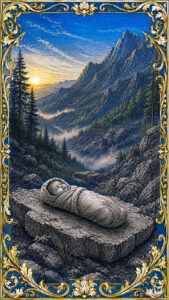
II. The Abandoned Child
Almost every ancient account begins here: a father who wanted a son rather than a daughter, whose newborn child was left to die on Mount Parthenion in Arcadia.
Scholars sometimes treat this episode as part of the machinery of myth. The exposed child appears often enough in Greek and Roman tradition (Oedipus, Perseus, Romulus and Remus) that it can seem a stock motif. But motifs endure because they carry meaning. A king who exposes a daughter because she is not a son is acting within a specific social logic, not from cruelty alone. That logic rests upon succession, warfare, inheritance, and dynastic legitimacy, all dependent upon male heirs. It is far more Mycenaean than Classical. In Bronze Age palace societies, a wanax needed warriors and administrators; daughters, however beloved, could not inherit the spear.
The exposure does double duty. It explains why Atalanta grows up outside the palace, and it preserves the memory of what drove her there: not accident, not adventure, but a father’s decision that she was born the wrong sex.
 III. The She-Bear
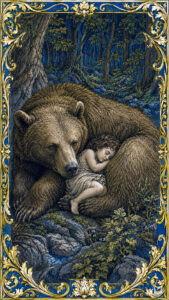
The nursing bear is dismissed by many readers as pure fairy tale. That is a mistake.
Artemis inherited the mantle of the Bronze Age Potnia Theron, the Mistress of Wild Things, and her bear cult left traces that survive into the third century BCE. At Brauron, the sanctuary on the Attic coast, young girls serving the goddess were called arktoi: little bears. The bear was not just a wild beast. It was Artemis‘s animal into which her favor could be made visible. When Callisto became one, it was both punishment and proximity to the divine.
What this suggests is that the Atalanta account may retain something older than the legendary nursing: a memory of girls raised within a sanctuary of Artemis or her precursor, where the bear was not metaphor but title. An infant abandoned near such a sanctuary and raised by women whose ritual designation involved bears would become a child nursed by a bear. Later generations, compressing the story, convert symbol into narrative.
This pattern recurs throughout Greek myth. The extraordinary is often the residue of a practical reality that time and distance have made unintelligible.
 IV. The Hunters Who Found Her
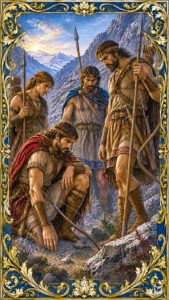
When Atalanta passes from the she-bear to human hands, she goes not to priests, nobles, or shepherds. She goes to hunters.
That distinction matters.
Hunters in antiquity occupied a distinct social position. Living on the margins, they moved through mountains that political authority seldom penetrated. They understood animals with an intimacy that farmers and palace administrators did not. Daily work carried them across boundaries between tame and wild, between civilization and the places beyond it. And in certain traditions, hunting was a religious act: the sacrifice of wild animals belonging to the Mistress of Wild Things required her consent, expressed through the skill and outcome of the hunt.
In my historical novel Atalanta of the Wild, I chose to make the hunters who found her also priests of Potnia Theron. That choice has a basis in the sources. The overlap between hunting and religious service is not an invention; it is a logical inference from how the ancient world organized its relationship with the wilderness.
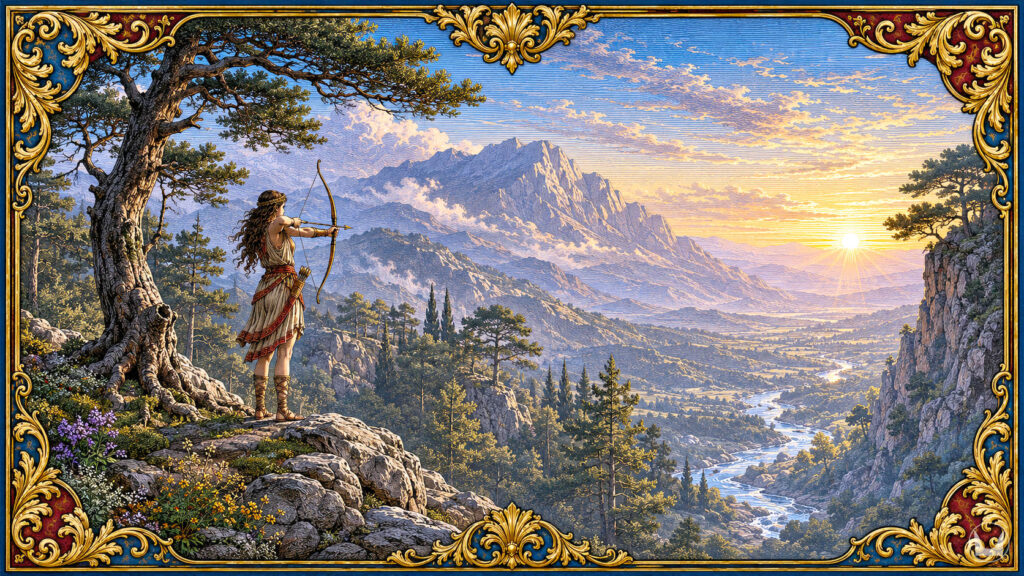
What this means for Atalanta‘s education is that she does not learn what a princess learns. She learns tracking and weather signs, silence and endurance, archery and spear-throwing, the reading of terrain, and the behavior of animals under stress. She learns the patience to follow a deer for hours without alarming it, and the decisiveness to loose the arrow at the right instant. Long before her legend begins, she stands apart from other women of her class—and from most men.
 V. Why She Rejects Marriage
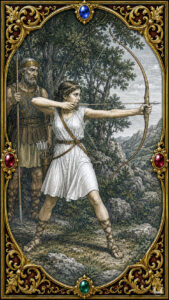
The literary record offers a convenient explanation: an oracle warned her that marriage would be her destruction. She consecrated herself to Artemis and refused all suitors.
That account has always struck me as too tidy. Oracles in myth often function not as causes but as reframings, prophecies that explain a course of action that originated in earlier, more human circumstances. The oracle gives cosmic significance to her decision. But there is a simpler sequence beneath it.
Consider the shape of her life. A child abandoned because she was female. Raised outside every structure that defined women’s existence. No experience of domestic life. No frame of reference for what a wife was expected to do or be. Freedom of movement. Competence evaluated on its own terms. Respect earned by ability rather than birth, beauty, or marital connection.
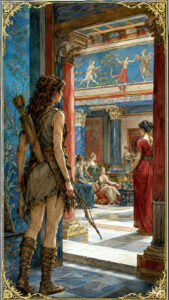
Returning to palace life after that would not have felt like a homecoming. It would have felt like a cage. Marriage, in the Bronze Age context, did not mean romance. It meant the transfer of a woman from one man’s household to another’s, with obligations of fidelity, reproduction, domestic management, and political alliance. For a woman who had spent twenty years making her own decisions in the mountains, the proposition was not only unappealing but also unintelligible.
The myth transforms psychological truth into prophecy. The oracle says what Atalanta already knows.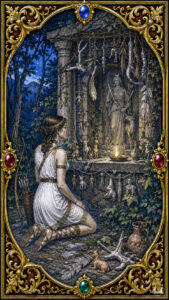
VI. Artemis and the Life She Lived
There is something worth pausing on in Atalanta‘s devotion to Potnia Theron. The goddess favors women who exist outside ordinary female roles: hunters, mountain dwellers, independent maidens, women who resist the political arrangement of marriage. Callisto, Britomartis, and all the hunting companions of the goddess’s retinue are women who live at angles to the social world.
Artemis does not simply protect women of this kind. She mirrors them.
Atalanta‘s devotion to Artemis is more than piety. In the goddess, she sees herself elevated to the divine order. Her autonomy becomes sacred, and her refusal of domesticity a religious obligation. Artemis gives theological language to a life Atalanta had been living before she had words for it.
 VII. The Calydonian Boar Hunt: When Men First Recognized Her
Notice where the literary tradition concentrates its attention. Not the childhood. Not the training. The Hunt.
When King Oeneus of Calydon offended Artemis and the goddess sent a monstrous boar to devastate his kingdom, he summoned the greatest heroes of Greece. They came from across the heroic world: Meleager, Castor and Pollux, Theseus, Jason, Nestor, Admetus, Peleus, Ancaeus, and the only woman among them, Atalanta.
Every surviving account agrees that she draws first blood.
The literary sources dwell on this moment because it is the first moment Atalanta enters male history. Before it, she belongs to the forest, to the world that does not record itself. The Calydonian Boar Hunt is the day she becomes visible to the heroic tradition, the day her story begins.
But from her perspective, her greatness did not start here. She had drawn first blood on dangerous animals before. What was new was the audience.
The men remember the day they first saw Atalanta. She recalls it as another hunt. That gap between her inner experience and the myth that forms around her is where the novelist lives.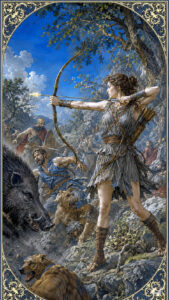
VIII. What Archaeology Contributes
Writing about Atalanta today carries one advantage unavailable to Ovid: archaeology has since reconstructed the world she might have inhabited.
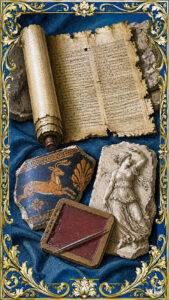
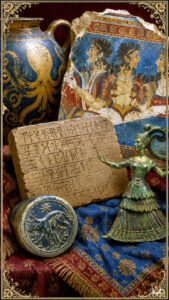
Linear B tablets from the archives at Pylos, Knossos, and Mycenae identify women as textile supervisors, religious officials, landholders, and artisans. They appear as workers attached to palaces but also as individuals with their own property and personnel. The administrative tablets do not describe a world in which women were confined to domestic invisibility.
Minoan art goes further. The Akrotiri frescoes, the Knossos palace paintings, and the sealstones from across Crete and the Aegean depict women officiating at rituals, dominating compositions in which men are peripheral, and leaping bulls alongside men. The world that produced the legend of Atalanta may have regarded exceptional women as unusual, but not as category violations.
This matters for the novelist. Atalanta‘s competence, however astonishing to the Archaic Greek mind, would not have been unimaginable in the Mycenaean world. The shock of her is, in part, the product of later centuries—from Athens and Rome, from a world that had narrowed the space available to women. In the Bronze Age, her territory may have been less remarkable than her legend later required.
 IX. What the Myth Retains
Beneath the bear, the oracle, and the golden apples, several very old memories seem to survive.
The technical confidence of her hunting is the first. The tradition describes her technique with a precision that does not feel invented. She behaves like someone who has hunted for years, with the knowledge that comes from long practice: how to move through terrain, how to track, when to loose the arrow. This reads not as a poet imagining what hunting looks like, but as an inheritance of expertise.
Her association with Artemis may preserve another trace: female rites involving wilderness and temporary separation from society. Many ancient cultures practiced initiation through a period of living outside the boundaries of normal life, in forests and mountains, often among animals. What begins as ritual experience may, in Atalanta‘s case, have become permanent.
The heroes of the Calydonian Boar Hunt and the Argonaut expedition belong to the Mycenaean heroic cycle. They are Jason‘s companions, Telamon, Pirithous, Theseus, the generation before Troy. Nothing in Atalanta‘s story requires Classical Greece. Several things fit the Bronze Age better: the exposed royal infant, the sanctuary upbringing, the relationship between hunting and religious service, the relative freedom of an aristocratic woman operating outside palace structures.
In Atalanta of the Wild, I weave several of the Argonauts, Herakles in their midst, into the narrative as her comrades. That choice is not embellishment. It is an attempt to restore her to the world where the myth formed.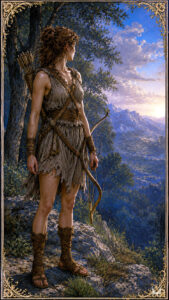
X. The Silhouette of a Bronze Age Woman
Strip away the miracles, and one possible life emerges.
A royal infant is abandoned on a mountain because she is not the son her father wanted. She survives because hunters who are servants of Potnia Theron find her. As she grows, there is no expectation that her sex should limit her competence. She learns to stalk deer before she learns courtly speech, and to read weather, animals, rivers, and mountains. She comes to know the wild as her home and the palace as foreign ground.
Only years later does she discover that she was born to nobility. Coming to court is like arriving in a place where everyone speaks a language she understands but has never made her own. The demands of marriage and dynastic obligation feel restrictive and wrong to her.
When the Calydonian Boar Hunt summons the greatest warriors, she does not join it in search of recognition. Hunting dangerous animals is what she has always done.
This is the most compelling Atalanta: not a woman striving to become extraordinary, but one who has never thought herself anything else. The world that recorded her legend cannot explain a woman who inhabits the heroic ideal with the same ease as any man. The myths add bears and oracles and divine favor and golden apples—and in my novel, I preserve them too—yet beneath those additions there remains the silhouette of a Bronze Age woman shaped by mountains rather than by any palace’s idea of what she ought to be.
That silhouette is faint. It is also consistent across the scattered traditions. And it provides the novelist with more than enough: the outline of a human being, from which a life can be rebuilt.

Rio de Janeiro, the xv day of July, MMXXVI.

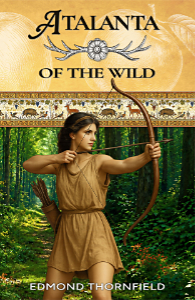
Click the cover to read a preview chapter and learn more.