Writing Divine Presence in Bronze Age Fiction as Lived Reality Rather Than Abstraction.

Mythological fiction has a problem that most writers fail to solve: the gods are either too large or too small. Made too large, they do not inhabit the story; they furnish it. Artemis stands for chastity, Aphrodite for desire, Athena for wisdom, Zeus for patriarchal authority. Made too small, they are mortals with powers, subject to the same psychological language as every other character in the novel.
Yet the novelist writing about the Bronze Age need not choose either extreme. The gods can be written as the people of that world understand them, concrete beings possessed of personality without being reduced to human terms. In this framework, the divine is not a metaphor for something more real. It is the most real thing there is.
 This essay is an account of how I approached this problem in my historical novel Atalanta of the Wild, and what my treatment of Potnia Theron suggests about the question of writing divine presence as lived experience, not as a literary construct.
I. The Theological Problem
Any novelist working with the ancient past must decide whether the divine exists within the story’s reality or only within the characters’ understanding of it.
The first choice carries great risk. A writer who places the gods on the page as present beings must make them convincing—not as fantasy creatures, but as entities who feel vast and strange. The second choice is safer but dishonest. A Bronze Age Greek did not regard the gods as psychological projections. Artemis was not a symbol of the hunting life. She was the Mistress of Wild Things. She moved through the world, and it responded to her. To remove that dimension from the fiction in the name of psychological realism is to misrepresent the consciousness of the people being portrayed.
I chose the first option. In Atalanta of the Wild, Potnia Theron is present. She appears in chapters One, Six, Sixteen, Nineteen, and elsewhere. She has a voice, a laugh, a history of relationships, and responsibilities that extend beyond the protagonist’s story. In Chapter Thirty, another goddess, Athána Alēa, speaks through her priestess, revealing the fate of Atalanta and Hippomenes.
 II. The First Appearance: After the Centaurs
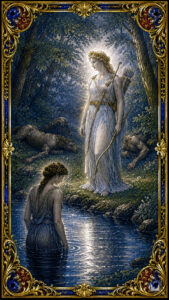
The first time the reader meets Potnia Theron in my novel, she arrives without announcement, as a presence that the natural world registers before any human figure sees her. Atalanta has just killed two centaurs who assaulted her at a stream; the danger has passed, and she has re-entered the water. And then:
Unheeded glide the moments till the dappled light falling about her grows silvern-bright, and the breeze brings with it the perfume of jasmine bloom. Amid the brook’s soft babble ring the melodious notes of a nightingale close by. Her mistresse comes to her.
On the grassy brink, steeped in silver radiaunce though day yet lingers, stands Ártemis, bow across her shoulder, quiver slung upon her back, her gaze unmoved as the moon.
The goddess is announced not by spectacle but by a change in the quality of light and air. Here the supernatural has a smell and a sound. It does not interrupt the visible world—it arrives through it, as though nature itself is one of its modes.
From the outset, Potnia Theron is a person. She has a manner: composed and aware. When she looks at the dead centaurs, she does not pronounce judgment. She laughs.
“Here lie the bodies of centaures. Is this your doing?” Thrice a merry giggle rises from her lips.
A goddess who laughs possesses the presence of a character. This laughter persists across every subsequent encounter and defines her as a being who enjoys existence.
 III. The Society of the Divine
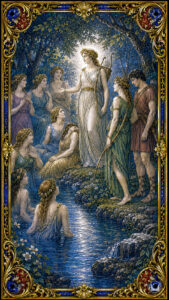
In Chapter Six of the novel, Atalanta brings her brother Periklos to meet Potnia Theron and the nymphs at the sacred stream. What this scene achieves is the creation of a social texture around the divine, with its own hierarchies and affections, in which the bond between the goddess and her nymphs is as well defined as her connection to Atalanta.
Before Artemis arrives, Atalanta describes her to Periklos in terms that a lesser novel would leave as exposition:
“Vanity and malice find no lodging in her heart. She brings comfort, shelter, and adventure. O so many blessings! She lets you reach for the moon.”
The novel does not let this remain description. When the goddess arrives, her behavior confirms every claim:
“Khaírete, my cherished ones!” says the goddesse, resting her eyes upon them. “How fares your day hitherto? Has your board been filled? … O Tála, how gladsome is your presence!” A shining smile adorns her countenance.
She greets each nymph as an individual. She notices Atalanta with what can only be called personal delight. With Periklos, she first tests him: “Am I not yours likewise?” Having received his sincere if fumbling reply, she relaxes into humor:
“She shall not mind if I take a few warriors from her.” Her mirthful laughter spills, and her nymphs echo her delight.
The ease with which she shifts register—sovereign deity to affectionate elder, formal greeting to easy joke—is what makes her feel alive rather than constructed.
 IV. Authority Without Menace
One of the failures of divine characterization in fiction is the tendency to treat power as menace. The gods become threatening figures, liable to punish at any moment. This is not without basis in the ancient sources (Homer‘s Olympians are often terrible), but it reduces the full range of religious experience they reflect.
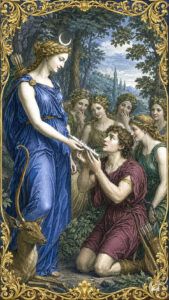
The Potnia Theron of Atalanta of the Wild is powerful. Before her, Periklos lowers his eyes, kneels, and chooses his words with care. The nymphs attend her at once. And yet she never threatens. Her authority manifests as the sense that one is in the presence of a reality beyond the human, whose regard is a gift rather than a danger.
The flute she gives to Periklos captures this balance.
“This is no common flute, dear lad. Whether you learn to sound it matters not. No difference shall it make. Should peril ever draw nigh whiles you roam in my domain, breathe but a single note upon this swan-flute. I, my nymphs, or whichever of my servants be nighest shall deliver you from harm.”
She bestows her protection upon a mortal boy she has met for the first time, yet the manner of giving is maternal. The contrast between the gift’s magnitude and the simplicity of its giving is a sign of divinity the scene contains.
V. The Goddess Has Other Business
Also in Chapter Six, an important craft decision happens when the feast is interrupted:
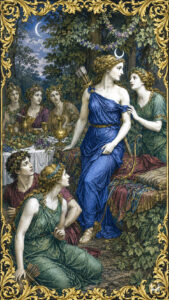
“Pardon the intrusioun,” says Merisa, smiling toward her yet speaking unto their mistresse. “Arethusa beseeches you for a word. An overbold river-god has given her chase of late, and she may not shake him. She fears she shall not be quit of him without your aid.”
The goddesse uprises, wagging her head. “Shall they never learn?”
And she leaves.
The novel does not follow her or explain what unfolds between Arethusa and the pursuer. That thread belongs to another myth. The reader glimpses an unseen world beyond Atalanta‘s experience, where the goddess has responsibilities of her own.
This is the novelist’s most underused tool in writing the divine. A god who exists only in relation to the protagonist is not convincing. One who has other things to attend to beyond the page is. That continuity is what distinguishes a divine presence from a divine function.
 VI. Wisdom Without Theology
The test of any character who offers wisdom is whether it sounds earned rather than supplied. The reader can often sense its origin: genuine experience or the author’s desire to make a point.
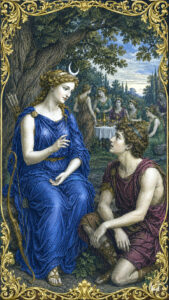
Potnia Theron passes this test when Periklos describes his oath to protect Atalanta from forced marriage. The goddess does not celebrate or endorse his vow. She says:
“None would have a cherished one delivered unto wretchednesse. Yet oft the will of men and gods trespasses upon a soul’s freedom, leaving but ruin and sorrow in its wake. Hold you fast unto your pledge.”
She includes her kind among the trespassers upon mortal freedom. Her words reveal that even divine will, however benevolent, can become oppressive. The line carries the weight of experience, which is the only kind of wisdom an immortal can possess.
No further speech follows. She gives Periklos the counsel he needs and moves on.
VII. Artemis as Witness: The Death of Meleager
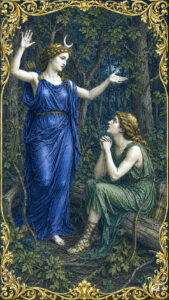 Potnia Theron‘s most demanding appearance in Atalanta of the Wild comes in Chapter Nineteen, when she must tell Atalanta that Meleager is dead. This scene requires her to carry grief without losing divinity.
The goddess relates the tale as an account received through her priestesses: the story of Queen Althaea and the burning brand.
Is my mistresse held in a trance? Her motions keep a dancer’s measure, and her countenance mirrors that of the Queen.
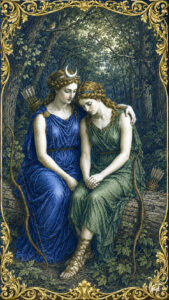 Artemis‘s body performs the Queen‘s grief even as her voice recounts it. This is the fullest embodiment the novel grants her—and it works because it is unexpected. She is not observing Althaea‘s suffering from a distance. She is entering it.
The narration culminates in Meleager‘s last words, which the goddess delivers with a weight that leaves nothing to be said:
“In his final moments, groaning sore, he called his aged sire to mind, his brothers, his beloved sisters, the companion of his couch, and perchaunce his mother. His last utterance was this: ‘Keep faith with me no more, my truest love. I release you.'”
Nought further speaks Ártemis. The two abide there, huddled one against the other, whilst her heart sinks ever deeper into the abyss.
 VIII. Athána Alēa: The Goddess at the Edge of the Story
From the novel’s opening chapters, Athána Alēa, the patron goddess of Tegea, Atalanta‘s birthplace, has been a presence without a body. Yet she governs the world of Tegea from within its institutions: its sanctuary, its priesthood, its daily rites, its political life. Atalanta‘s father invokes her protection. Her sanctuary is where the family brings its most important offerings. She is everywhere in the novel without ever being seen.
This is as demanding a characterization as Potnia Theron‘s direct appearances. A goddess who is never present in person but whose influence shapes every decision must be made credible by the behavior of the mortals who serve her. By the time Chapter Thirty arrives, the reader knows Athána Alēa not from any scene she has inhabited but from the lives ordered around her.
When she speaks at last, it is through her high priestess.
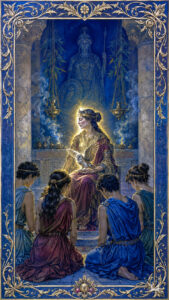
Two priestesses cast pine resin and rosmaros upon the hearth; she pours libacioun of oil of olive upon the warm stones and sits afore the goddesse’s image. Her chanting in the old tongue rings about them, at times fervent, at times still, till a golden shining enwraps her form and a little owl flies through the smoke-hole to perch upon her lap.
The ritual preparation is not decoration: the herbs, the oil, the ancient words, the silence between the fervent and the still—all of it creates the condition under which the boundary between the priestess and the divine grows thin. The goddess continues:
“We be pressed by a season of woe. The guiltless endure unjust punishment dealt by the gods.”
She speaks as a being who laments what has come to pass. She names Aphrodite‘s guilt and explains Zeus‘s decree, acknowledging that she is constrained by his authority.
“Nought, alas, I say with heavinesse.”
And as the manifestation begins to waver:
The radiaunce about the priestesse flickers, and her body undulates. Mayhap the goddesse’s time in our midst waxes nigh to its close.
Néos asks his question before she departs. She answers it—the lions range upon the eastern slopes of Helikon. The presence withdraws:
When they rise, gone are the shining and the little owl; ’tis the high priestesse who once more beholds them.
What this chapter achieves with Athána Alēa is a portrait of how the divine was encountered in the ancient world: not by sudden epiphany but in the sustained relationship between a goddess and those who keep her rites. The priestess is someone who has spent a lifetime in preparation for such communion. The goddess who speaks through her is not performing a function; she is sorrowful, doing what she can within the limits imposed upon her.
 IX. What the Novel Argues
The approach taken in Atalanta of the Wild rests on a conviction that underlies its treatment of the divine: that Bronze Age religious consciousness was not a cruder version of later philosophy but a complete and coherent way of inhabiting existence, in which the sacred was woven into daily experience rather than held apart as an object of intellectual inquiry.
The narrative embodies this in two goddesses with distinct expressions. Potnia Theron arrives in person with jasmine, nightingale song, and a brightness that belongs to neither day nor moonlight. She is the Mistress of Wild Things, and the wild is her immediate domain. Her personal appearances are not interruptions of the natural order. They are the natural order revealed.
Athána Alēa operates otherwise: in daily rituals, in the inheritance of a city’s religious traditions over generations. She already pervades every stone of her temple, every decision her city makes. When she speaks in Chapter Thirty, the golden light, the chanting in the ancient tongue, and the little owl are the culmination of a relationship between a goddess and her people begun on the first page she was named.
Together, the two goddesses define the novel’s theological argument that the divine in the ancient world manifested in a full range of modes, from the direct epiphany in the forest to the mediated presence of civic religion. Both are real. Neither is a symbol.
The reader who reaches the final pages of Atalanta of the Wild has spent time within a culture where the gods are encountered in both modes. It is an attempt at historical truth, a reconstruction of the consciousness of people for whom the divine was an intrinsic part of life.
This is how to write a god.
Rio de Janeiro, the xvii day of July, MMXXVI.


Click the cover to read a preview chapter and learn more.