I first became aware of Cortona as a teenager, poring over the history of the Etruscans, those singular people who were neighbors of the ancient Romans. Their art held me fast from the start. I remember dreaming of their magnificent bronze casting of the Chimera and of the 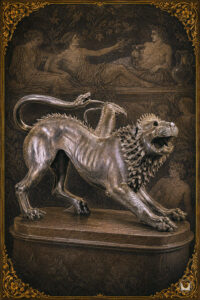 feasting scenes painted on the walls of their tombs: figures reclining in celebration, reaching toward pleasures that death had only suspended. What struck me then was how their world rhymed with that of the Archaic Greeks—two peoples on different shores whom the archaeologists confirm were in steady, fruitful contact with each other. Cortona had been on my list for decades before I ever set foot there.
When Under the Tuscan Sun arrived in 2003, my heart stirred again. Frances Mayes‘s tale of beginning again in Tuscany reached me at the right moment: I too was living through a divorce, weighing the possibility of a life very different from the one I had known in Los Angeles, somewhere that might feed the part of me I had been neglecting. I did not yet know I would become a novelist, but I had been fighting that knowledge since I was a young man. The film gave me ladybugs. To this day, whenever one lands near me, I smile.
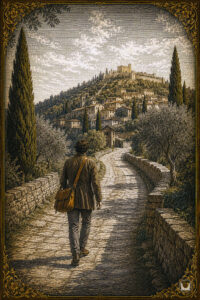 Then I went to Cortona.
My first visit was on the twenty-second of April, 2019. Easter Monday. I rose early in Florence and took the train from Santa Maria Novella, alighting at Camucia an hour and a half later. Anyone who knows Italy in holiday season will understand what I found: the town effectively shut, no taxi at the stand, no bus in sight. A kind woman in a coffee bar on Camucia‘s main street took pity on me and rang an acquaintance of hers, a taxi driver willing to make the run up the hill. I had no idea how I would get back down. I went anyway.
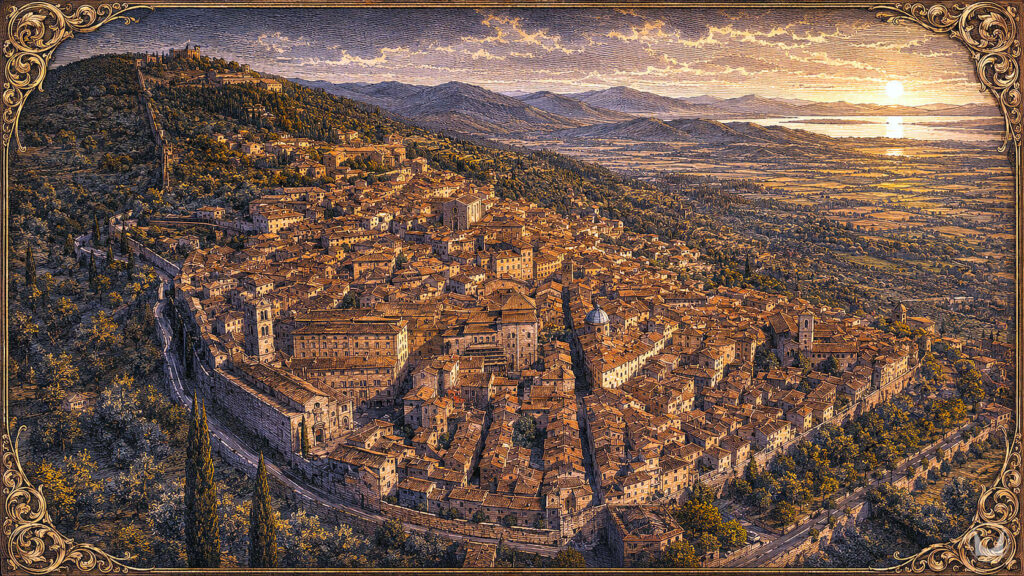
The view from the belvedere before Via Nazionale stopped me in my tracks. Lake Trasimeno lay in the distance, pewter and still. Something drew me aside—not curiosity but compulsion—toward the stretch of medieval wall to the right of the main street. I had to touch it. When my hand met the stone, a certainty settled in me that I cannot name rationally. It felt like coming home.
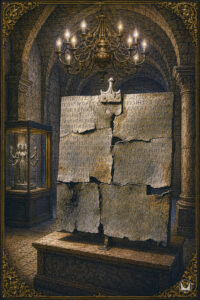 I made my way to Piazza della Repubblica, took an espresso, and turned the corner into the Museo dell’Accademia Etrusca e della Città di Cortona (MAEC). Two hours passed without my noticing. The Tabula cortonensis held me at length, that great bronze tablet inscribed in a language we can only partially read; the Etruscan chandelier with its parade of figures, its lamps poised like offerings; and in a case in the middle of an exhibit room, a statuette of Hekate. Small, worn, hers. It is always a good omen when Hekate appears without her retinue.
Lunch was pici al ragù di cinghiale—the thick, hand-rolled pasta with wild boar sauce for which the town is known. Cantucci dunked in golden vin santo followed. I cannot tell you which I enjoyed more.
I walked off the meal through the streets above the piazza and came upon the Church of San Francesco and its cloister. When I approached the high altar, the hairs on my arms rose. I did not linger. I needed air and to keep moving, so I kept climbing until the street delivered me to Porta Montanina and a spectacular view of mountains and valley.
 Coming back down to Piazza della Repubblica, I passed under the arch of Via Ghibellina. I had the whole street to myself. Halfway along, the light dimmed, though the sky above was clear, and a man’s voice spoke to me. There was no man. What followed I can only describe as a cascade of images, arriving faster than thought, more vivid than memory. I felt the ground shift beneath me. I turned and walked back to the piazza. I needed to leave.
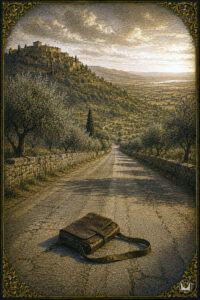
No taxi waited at the belvedere. I knew it was not far to Camucia, and the road ran downhill. I began to walk. The voice followed me. “Forsake me not,” it said. I stumbled on nothing visible and went down hard onto the asphalt. Twisted ankle. Scraped leather on my courier bag (which I carry to this day). Walking hurt more than jogging, so I jogged the rest of the way to the station at a slow pace, boarded the train, and returned to Florence.
That night I recorded the day in my journal.
 Cortona never left my thoughts. I returned in October and spent five days walking the town, taking measurements, documenting stones, arches, bells tolling, and the quality of afternoon light on the Palazzo Comunale. Leaving hurt. I went back again in January. Three years later I began writing A Tale of Paris & Paris: Echoes of Troy.
The Prologue of that novel speaks for itself. Everything I have described above lives in it—the pull of old stone, the voices that do not wait for permission, the sense of a life remembered rather than imagined. Cortona gave me my characters. La Piazza, Via Ghibellina, the Convent of San Francesco, the long view over Lake Trasimeno: these are not settings I invented. They are places that claimed me. I only followed.
Rio de Janeiro, the xxxi day of May, MMXXVI.

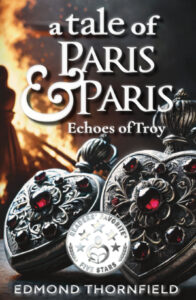
Click the cover to read a preview chapter and learn more.