People sometimes tell me that archaic English is unnecessary. That it creates distance. That modern readers want transparency, immediacy, a prose that gets out of the way of the story. I understand the argument. I disagree with it not on grounds of taste, but of accuracy.
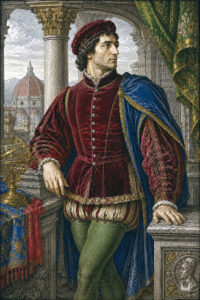 When you set a novel in the fifteenth century, you are not writing about people who thought in modern categories, dressed in modern clothing, or expressed their inner lives in modern idiom. You are writing about people for whom the word pants did not exist, for whom okay had no meaning, for whom the question how are you doing? would have produced bewilderment. To give them a contemporary voice is not to make them accessible. It is to make them a farce in period costume.
The point is not to be archaic. It is to be appropriate.
The Words That Have Not Left Us
The first principle I follow is this: if an archaic word has not vanished from living English, it earns its place on the page by deepening immersion rather than blocking it.
Consider braies, the loose linen undergarment worn by men in the medieval and early modern periods. A character in a fifteenth-century Florentine novel does not wear underwear, briefs, or boxers. He wears braies. The word exists; any reader who does not already know it will understand it within a line or two of context, and having understood it, possesses something they did not before: a word proper to that time.
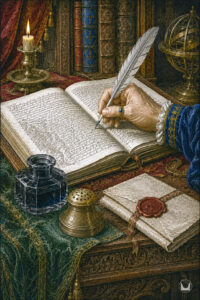 The same principle governs doublet, hose, tresses, locks, visage, countenance. These are not obscure relics requiring scholarly annotation. They are the natural vocabulary of the world being recreated. Crimson is not a stylistic flourish substituting for red: crimson is a specific shade, a dye, a trade good with a history. Verdant is not a fancy word for green: it carries a moisture, a lushness that green no longer conveys.
Then there is breast, which in earlier centuries referred to the chest of either sex, while chest itself denoted a coffer or box. A character who presses his hand to his breast inhabits a different body of language than one who touches his chest. The distinction is not pedantry. It is precision.
The Verb That Walks
Modern prose is impoverished in its verbs. Not because the verbs have disappeared, but because we have stopped reaching for them.
Take the act of walking. Contemporary fiction walks, runs, and goes. Yet the language offers saunter, stride, trudge, traipse, tread, shuffle, amble, promenade, wander, march, trot. Each of these is a different walk. Each tells you something about the character’s state of mind, the terrain underfoot, the urgency or absence of it. A man who trudges through a market is not the same man who saunters through one. The verb does the work that a paragraph of description would otherwise attempt.
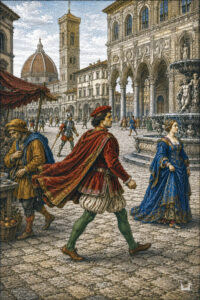 The same abundance applies to sound: resound, echo, ring, resonate, reverberate are not synonyms. Each carries its own texture, duration, and force. To reach for the specific verb rather than the general one is not affectation. It is craft.
The Connective Tissue of Thought
Modern prose has contracted its vocabulary of transition and qualification to a handful of workhorses. However does almost everything now; but does the rest. Occasionally yet is permitted in.
Centuries ago, a writer’s toolkit was richer: natheless, howbeit, withal, notwithstanding, nevertheless, albeit, for all that, howsoever. These are not interchangeable. Natheless carries a formal weight; howbeit a slight concessive dignity; yet a conversational ease. The choice among them is a rhythmic and tonal decision as much as a logical one.
The same contraction has flattened the vocabulary of happiness. Modern prose reaches for happy and, when it is feeling expansive, joyful. Yet the gradations available are far more numerous: glad, merry, gleeful, felicitous, delighted, blithe, gay. Each locates the emotion at a different pitch and temperature. Gleeful has an edge that happy does not. Blithe has a grace that joyful does not. Gay, in its older sense, carries a lightness almost physical, a quality of air rather than weight. The novelist who has access to all of these writes a more precise emotional score than one who works with only the modern staples.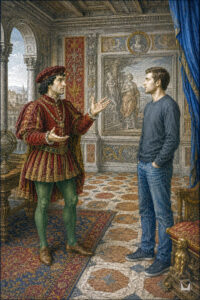
The Anachronism as Farce
There is a failure mode in historical fiction that no amount of research prevents if the writer does not take language seriously: the anachronism of consciousness.
A character in a novel set in 1470 who says okay, snap out of it, or right on has not just used the wrong word. He has revealed that the novelist does not believe in the world he seeks to recreate. The modern idiom punctures the illusion not because it is unfamiliar but because it is too familiar. It reminds the reader that there is a contemporary author behind the prose, reaching across the centuries not to illuminate the past but to domesticate it.
This extends beyond vocabulary to the entire texture of thought. People in the fifteenth century dressed differently, ate differently, understood the body and the soul and the social order differently. They did not have microwave ovens or cellular telephones; they did have a rich inner life, urgent priorities—the survival of the family, shelter, food, freedom, faith—that are continuous with ours. The novelist’s task is to uphold both truths: human continuity and historical difference. The language is the primary instrument for doing so. Get the language wrong and the novel becomes a costume drama; get it right and the reader  crosses into another time.
The Defense
I am aware that the archaic prose I write is not for everyone. I write for readers who hear the cadence of Atalanta‘s I weep of bliss and feel something that I’m crying with happiness cannot give them. I write for readers who understand, without being told, that tarry and break your fast with me is the invitation of a fifteenth-century gentleman and not a modern affectation. I write for readers who find in natheless and peradventure not obstacles but gifts: words passed from hand to hand across six centuries, still capable of doing work that nothing in contemporary English quite replicates.
The archaic register is not a costume any more than a surgeon’s precision is an affectation. It is the instrument appropriate to the task. For readers who delight in historical authenticity, it is music. I write for them.
Rio de Janeiro, the xii day of June, MMXXVI.

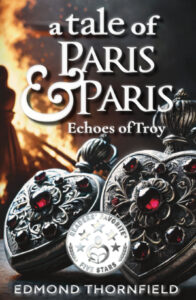
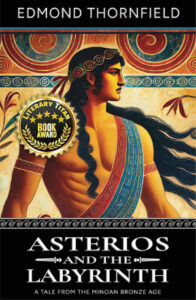

Click any cover to read a preview chapter and learn more.