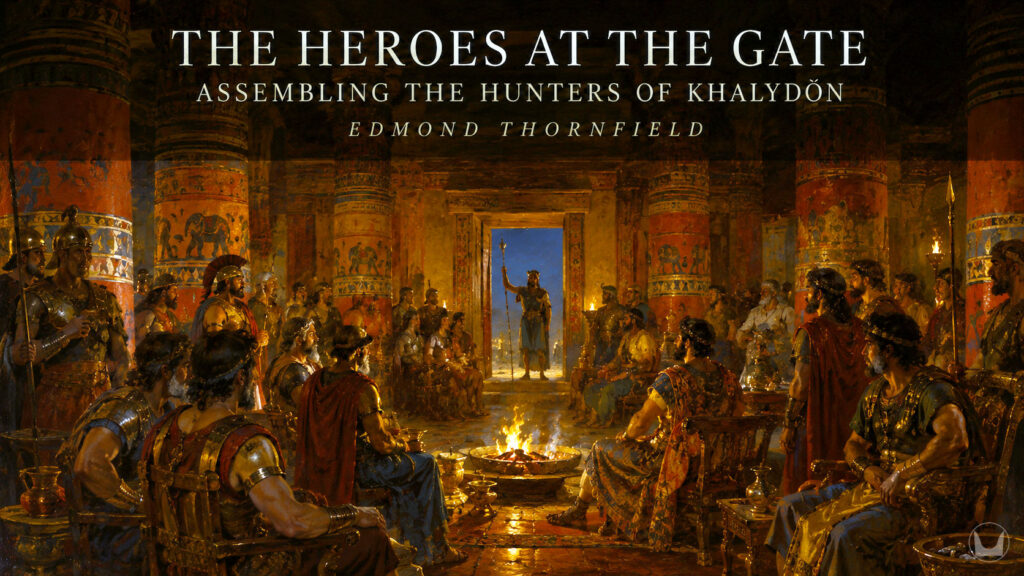
In the world of Atalanta of the Wild, worthy men do not simply walk into a king’s megaron. They are announced. A court herald strikes his staff upon the stone floor, and the name, lineage, and fame of the arriving hero ring out across 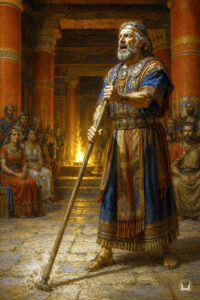 the hall before the man himself has taken three steps into the firelight. This was, I believe, the ceremonial reality of Mycenaean palatial culture, a world in which identity was inseparable from genealogy, in which a man’s father’s name and his city’s name were as much a part of him as his own, and in which the proper acknowledgment of that identity was a matter of both courtesy and social order.
When I came to write the chapters devoted to the gathering of heroes at Khalydōn, I needed to know exactly who was in that hall. Not approximately, not impressionistically, but specifically: who they were, whose sons they were, where they came from, and what they were already famous for. No single ancient text gives a complete or consistent account.
What follows is the result of that research, a working annotated roster of the participants in the Calydonian Boar Hunt as I assembled them from Book VIII of 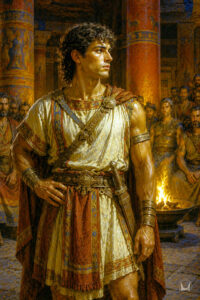 Ovid‘s Metamorphoses, Apollodorus’s Bibliotheca (1.8.2–3), Hyginus’s Fabulae 30, and several supplementary sources. I offer it here not as a scholarly catalogue but as a novelist’s document: the kind of working knowledge that must lie behind the page even when it does not appear upon it.
The Central Figure
Meléagros—son of King Oinēos of Khalydōn, in Aitōlía—is the hunt’s organizer and its tragic center. He recruits the heroes, presides over the gathering, and delivers the killing blow to the boar after Atalántē draws first blood. He also ignites, through his passion for Atalántē, the quarrel over the spoils that will ultimately cost him his life. In my novel he is present from the moment the hunters arrive, his desire for Atalántē woven through every scene he shares with her.
 The Only Woman
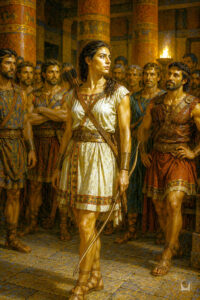
Atalántē—daughter of King Iásios of Tegéa, in Arkadía—needs no introduction to readers of this blog. She is the hunt’s most distinguished participant. She is the only woman admitted to the company, she wounds the boar before any man does, and she is awarded the spoils by Meléagros over the furious objections of his uncles. In Ovid‘s telling she is described with extraordinary vividness—her belted chiton, her ebony quiver, her face simultaneously maidenly and boyish. She is, quite simply, the best hunter in the field.
Kástōr and Polydeúkes—twin sons of King Tyndáreōs of Lakedaímōn—are among 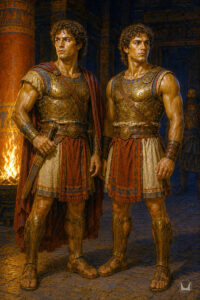 the most prominent figures in the hall. Both are Argonauts; both are heroes of established fame before the hunt begins. Kástōr is the horseman, Polydeúkes the boxer, and together they represent the ideal of twin heroic complementarity. In my novel they are among the figures whose camaraderie I drew upon most directly in writing the fellowship of the hunt.
The Mightiest Son of Zeus
Hēraklēs—son of Amphitryon, King of Tirȳns, though I situate him in Mykênai—joins the hunt as the greatest hero of his generation, already famous for the Nemean Lion and the Lernaean Hydra. He is also an Argonaut. Plutarch remarks that the male lovers of Hēraklēs were too many to number, naming Admetōs and Iólāos 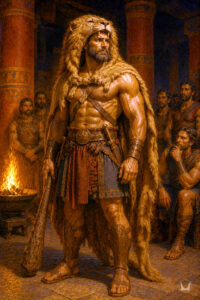 among the most notable, a detail that informs the emotional texture of the scenes in my novel where these three figures share the stage. Hēraklēs‘s physical presence dominates any room he enters; writing him required constant attention to the effect his scale and reputation have on those around him.
The Argonauts Among the Hunters
Several of the hunt’s participants are also veterans of the Argo‘s voyage, and their shared history creates undercurrents of loyalty, rivalry, and unfinished business in any scene where they gather:
Iásōn—son of King Aísōn of Iolkhōs—the leader of the Argonauts, joins the hunt. His presence in any heroic assembly carries the weight of the Golden Fleece.
Iólāos — son of Iphiklēs of Tirȳns, nephew and charioteer of Hēraklēs—is where he always is: beside his uncle. The bond between them is one of the most complex in Greek mythology.
Laértēs—son of Arkeísios, King of Kephallēnía and Ithákā, father of the yet-unborn Odyssēos—joins the hunt. His presence at Khalydōn places him in a generation of heroes whose sons will fight at Troy.
Néstōr—Messēnían prince, son of King Neleús of Pýlos—is the young man who will one day be the garrulous elder of the Iliad. At Khalydōn he is still in his heroic prime.
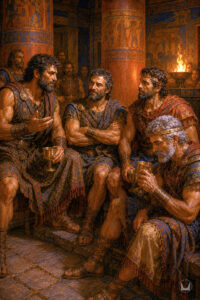 Pēleús—son of Αἰaκόs, King of Αἴgῑna, father of the yet-unborn Akhilleús—joins the hunt. Like Laértēs, his presence here carries the shadow of the next generation’s war.
Telamōn—brother of Pēleús—is included among the hunters. The two brothers together represent the house of Αἰaκόs at its fullest strength.
Admetōs—son of King Phéres of Pheraí, in Aiōlía, the Untameable—joins the hunt. Ancient sources record that Apollo was fired with love for Admetōs and became his servant by choice, not compulsion, a detail that gives this prince a particular quality of divine favor. In my novel his relationship with Hēraklēs carries its own carefully handled freight.
Akástōs—son of Pelías, who sent Iásōn on the quest for the Golden Fleece, later King of Iolkhōs—is famed for his javelin and joins the hunt. His story after the Argonauts‘ return is among the darker threads of the mythological tradition: Medea manipulated his sisters into killing Pelías, and Akástōs drove Iásōn and Medea from Iolkhōs in consequence.
Amphiáraōs—son of Oíklēs, from Árgolis—is both hero and seer, favored by Zeus and Apollo, who granted him his oracular gift. His presence at heroic gatherings always carries a prophetic undercurrent.
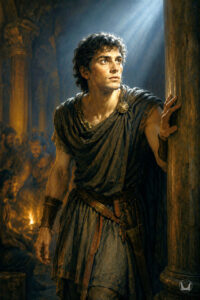 Mópsos—son of Ampyx of Titarōn, in Aiōlía—threw the first spear of the hunt, a detail Ovid records specifically. He too is an Argonaut.
Idas and Lynkeús—Messēnían princes, sons of Apharēos—join the hunt together. Lynkeús is said to possess sight so keen he could see through walls, trees, and the ground itself, and to see clearly in total darkness. His brother Idas is swift and fierce. The two are inseparable. Their later history is one of the mythology’s great tragedies: they will murder Kástōr over the daughters of Leúkippōs, and Polydeúkes will kill Lynkeús in turn.
The Others in the Hall
Thēseōs—son of King Αἰgeύs of Athēna—appears in some versions of the hunt. I include him. His best friend Peiríthous, son of Ixíōn, King of the Lapiths, comes with him, as he always does.
Ekhiōn, Klytíōs, and Eurytōs—three sons of Actōr, from Alope in Aitōlía—join the hunt: Ekhiōn unbeaten at running, Klytíōs of established valor, Eurytōs widely honored and energetic in action.
Ankáiōs—son of King Lykôrgos of Arkadía—and Hyleús—son of Lykaōn, hero of Attikē—are killed by the boar during the hunt. Their deaths establish the animal’s lethal power before the final confrontation.
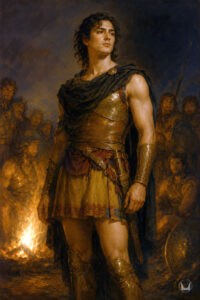 Kaineús—a Lapith hero, son of King Elatōs of Gyrtōn, in Aiōlía—joins the hunt with a history unlike any other participant’s. He was born Kainís, a girl, daughter of a Lapith king, but after Poseidōn lay with her, she was transformed at her own request into an invulnerable man. His presence in the hunt requires no special handling in the narrative; he is simply one of the heroes. But the novelist who knows his history cannot help but hear the resonance.
Lēlex—the gray-haired chieftain of Nárykos, of the Lokroì Opoúntioi—joins the chase. His age amid the company of young heroes gives him a particular gravity.
Enaisēmos, son of Hippokōōn of Amyklaē, cousin of the Dioscuri, joins the hunt. Hippasos of Oikhalíā, son of King Eurytōs, and Hippothoús of Phokís, son of Kerkyon, are also among the company. Leúkippōs, Messēnían prince, whose daughters will one day be abducted by Kástōr and Polydeúkes, joins the hunt with the epithet warlike. Panopeús—renowned as a skilled hunter, son of King Phokos, Prince of Αἴgῑna—and Phoínikos—son of King Amýntor of Eleon, whose name means defender—complete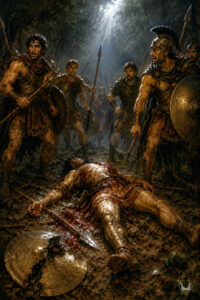 the company’s middle rank. Phyleús, Ēlean prince, son of King Augeías, is sent by Ēlis. Hippálmos, son of Ítōnos of Aiōlía, and Pelágon, son of Āsōpos of Paionía, both survived the boar’s first attack, a detail Ovid records.
What This Roster Made Possible
A herald cannot announce a hero he does not know. Before I could write a single line of ceremonial announcement in King Oinēos‘s megaron, I needed this document not as material to display but as knowledge to draw upon. When Néos, Atalántē‘s confidant, the novel’s second POV character, watches the heroes arrive, his observations are grounded in actual genealogy and actual fame. When Atalántē moves among men she recognizes, that recognition rests on a real mythological record. When the hunt unfolds and specific heroes do specific things, those things are anchored in what Ovid, Apollodorus, and Hyginus actually record.
 The research disappears into the novel. That is exactly what it is supposed to do. A reader of Atalanta of the Wild need not know that Lynkeús could see through solid ground, or that Kaineús was once a woman, or that Admetōs was beloved of Apollo, in order to feel the texture of a hall full of extraordinary men. But the novelist must know it. The knowledge is the foundation, and the foundation must hold even when no one sees it.
That, in the end, is what scholarly research means in the service of fiction: not a display of learning but a discipline of honesty. The heroes of Khalydōn were real to the people who told their stories for a thousand years. They deserve to be real in the novel too.
Rio de Janeiro, the xxv day of May, MMXXVI.

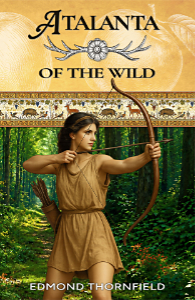
Click the cover to read a preview chapter and learn more.