There are readers, and there are novelist-readers. The two experiences are not the same. A reader surrenders to the story; a novelist-reader surrenders and watches himself surrendering, noting every mechanism that eases or impedes the fall. I cannot pick up another author’s book without half my mind standing apart, pencil in hand—not exactly to judge, but to see. What is working and why? What is failing and at what moment? The novelist reads the way a watchmaker examines another man’s clock: admiration is genuine, but it never silences the professional eye.
 What follows is my list of concerns, the things I pursue through every page of another writer’s prose. And, God forbid, through my own.
The Management of Point of View
Point of view is a structural commitment, and it demands the same fidelity as any other contract between author and reader. Whichever narrative mode a writer elects, I expect it to hold not merely as a default setting, but as a governing discipline sustained from first page to last.
First person, when prolonged across the length of a novel, I find increasingly tiresome. The relentless intimacy becomes claustrophobic; every observation filtered through a single consciousness that cannot be wrong, cannot be unself-aware, cannot simply recede and let the world breathe. Second person I have yet to encounter in long-form prose. To my mind, limited or close third person remains the ideal instrument for literary historical fiction: flexible and transparent enough for immersion, disciplined enough to hold a shape.
What I cannot abide—and what earns an immediate DNF—is the narrator who wanders. Head-hopping is not creative liberty; it is a failure of nerve, an unwillingness to commit to a single perspective and do the imaginative work required by that constraint. The moment a narrator slips from one consciousness to another without justification, the story evaporates. We are no longer inside the world. We are watching the author fumble.
 The Adverb as Confession
Nothing exposes an underpowered verb like the adverb enlisted to compensate for it.
He walked slowly. She spoke quietly. He closed the door firmly. These constructions are not merely inelegant; they are confessions. They tell the reader that the writer reached first for the expected verb and then, sensing its inadequacy, tried to patch the wound with an adverb rather than go back and find the right word. He walked slowly when what was meant was he shuffled, he dragged himself, he moved as though the floor resisted him.
The dialogue tag is the most embarrassing theatre for this failure. “I hate you,” she said angrily is a line so self-defeating that it almost achieves a kind of comedy: the adverb tells us what the dialogue has already shown, or rather, should have shown. If the line does not carry the anger, no adverb will save it. If it does, the adverb is noise.
I include in this indictment the filler adverbs—actually, really, just—whose primary function appears to be diluting the sentence in which they appear. Unless they are part of a character’s voice, used strictly in dialogue, they are the verbal equivalent of clearing one’s throat before every statement. A guaranteed DNF.
 The Filter and the Tell
He saw the door open. She felt the cold. He thought that something was wrong.
Filtering, the habit of routing every perception through a character’s act of perceiving, places an invisible pane of glass between the reader and the scene. We are told that the character sees, feels, thinks. We are not allowed to see, feel, or think alongside them. The effect is a curious double distance: we observe the character observing, which is precisely the wrong direction.
Literary fiction does not traffic in reports. It traffics in experience. The door opens; the cold arrives; the wrongness settles in the room. All do so without the narrator stopping to announce that the character has noticed. Showing is not a creative writing workshop cliché. It is the technical discipline of keeping the reader inside the moment rather than above it.
 Dialogue and Its Tags
Not every line of dialogue requires a he said or she said. Context, when properly constructed, identifies the speaker without signage. Attribution tags are infrastructure. They should be nearly invisible, present where needed and absent where the exchange can carry itself.
The writer who attaches a tag to every spoken line has either lost faith in the clarity of the scene or never thought to question the habit. The writer who ignores tags, producing exchanges of such syntactic sameness that no speaker can be distinguished, has taken silence for elegance.
The balance is not difficult to achieve, but it requires the author to read the dialogue aloud, to ask, at every line, whether the reader knows who is speaking. If yes, the tag is furniture; if no, it is a wall.
 The Information Dump
For a reader of my disposition—and I am an anxious reader—the information dump is exasperating beyond most other failures.
The impulse behind it is understandable: the author has done the research, is proud of it, and wants the reader to have it. The problem is that this is the author’s desire, not the reader’s. The reader wants the story. Information not threaded through character, action, or consequence is not history. It is a lecture delivered to a captive audience that may flee at any moment.
All historical context should arrive the way light arrives through a window: present, necessary, and never mistaken for the window.
Syntactical Monotony
The writer must vary syntactical constructions. Period.
A page on which every sentence opens with subject-verb-object, whose rhythms flatten into the same stressed intervals, is not merely dull to read. It is an unintentional declaration that the author has not read the page aloud. No ear that is truly listening permits such monotony.  Syntax is music, and music requires variation: long and short, subordinate and declarative, the periodic sentence coiled and released against the fragment that stops the ear cold.
I read prose for its rhythm as much as its meaning. When the rhythm disappears, the meaning grows harder to trust.
The Simile Gone Wrong
The simile is among the most dangerous instruments in the novelist’s kit. When it lands, it illuminates with a flash, and the reader suddenly sees. When it misfires, it does so in ways that range from the unfortunate to the hilarious.
As cold as ice. The clichéd simile says only that the writer reached for the nearest image rather than the truest one. But the failures grow stranger as ambition rises without the craft to sustain it. Her voice was as sharp as a sunrise—a mixed metaphor that, in its confusion of the visual and the auditory, says nothing coherent about either. The general stood as fragile as a mountain—an inapt reversal that produces not paradox but incoherence. Her thoughts scattered like triangular music—the forced simile 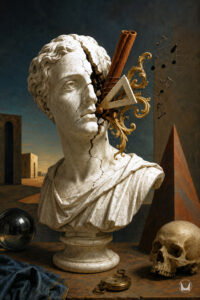 that reaches for the unusual and arrives at the unimaginable. His anger spread through him like a thing spreading—the empty simile, which is to say no simile at all, merely the grammar of one. And a memorable: The moon hung above the city like a forgotten equation of cinnamon—a line so untethered from sensation, logic, or effect that it achieves its own perverse majesty.
Her eyes shone like the architecture of destiny. This is not poetry. This is decoration mistaking itself for meaning.
A simile must clarify. It must bring the known to bear upon the unknown and produce understanding. The moment it calls attention to the unusual image, it has failed because the reader is no longer in the scene. He is admiring the author. The author should not be visible.
A Final Word
These are my concerns as a novelist-reader and as a novelist-writer. I hold my own prose to the same account. The standards one applies in external judgment are meaningless if one does not apply them to oneself first.
Especially now, when the volume of published work grows louder by the day, much of it AI-generated slop, no author who cares about the work can afford to let his guard down. Our good books are being buried. The only honest response is to ensure that what we offer is not merely competent but necessary.
The novelist’s eye must not rest.
Rio de Janeiro, the iv day of June, MMXXVI