A stylized, black-and-white vector image of the Minoan horns of consecration is the logo of ETHORN Publishing, the imprint under which I publish my historical fiction. It is also used in a more elaborate form as the topmost illustration of the colophon pages of my novels. The symbol has been part of my literary vision since my teenage years. It is not a logo I chose because it looked striking. It is a statement of 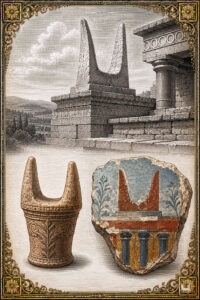 identity I expect to earn over time.
My hope is that the more readers learn about my work, the more inevitable the choice will seem. When they encounter my essays, my Bronze Age fiction, my fascination with the survival of ancient religious memory, and then discover that my publishing imprint is marked by the horns of consecration, I want them to think: of course it is.
The remarkable thing about the symbol is that we know it was important. We do not know what it meant.
What Are the Horns of Consecration?
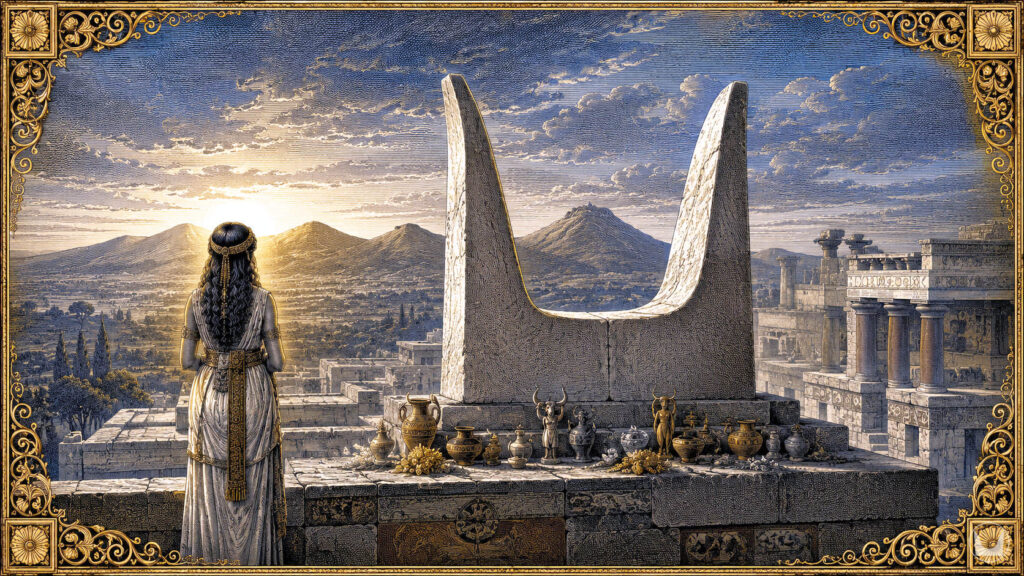
The term was coined by Arthur Evans, the excavator of Knossos. The symbol appears throughout Minoan Crete: on palace rooftops, in shrines, on altars, in miniature votive models, carved from stone, made in terracotta, and depicted in frescoes. It is represented as a pair of upward-curving projections. The immediate visual suggestion is a bull’s horns, though the interpretation is not as simple as it first appears. The symbol is so widespread across Minoan material culture that it must have been one of the civilization’s principal sacred signs. Yet no surviving Minoan text explains it. That silence is part of its power.
 The Bull and the Sacred
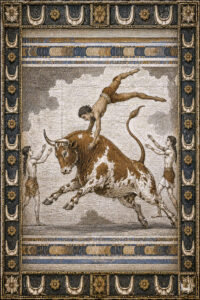
The most direct interpretation is that the symbol represents a bull’s horns, and the bull in Minoan culture carries enormous weight: bull-leaping frescoes, bull-headed rhyta used in ritual libation, bull sacrifice scenes, the mythic traditions that later coalesced around the figure of the Minotaur. The animal permeates Minoan religious iconography in a way that suggests something well beyond the agricultural. The bull appears to have embodied vitality, power, fertility, and sacred authority simultaneously.
If the horns are indeed stylized bull horns, they may have functioned as a visual shorthand for divine presence—not unlike the cross in Christianity or the crescent in Islam, though without the doctrinal specificity those symbols carry. One possibility is that the horns marked the places where the sacred entered the human world, thresholds between the everyday and the divine.
The Horizon Theory
There is a second interpretation that has fascinated me more than the zoological one. Some scholars have observed that the shape of the horns resembles a pair of mountains separated by a valley, a silhouette that could as easily be a sacred landscape as a pair of horns. In many ancient religions, mountains were understood as the points of contact between heaven and earth, the place where the divine descended and the human ascended. Viewed through this lens, the horns may represent the horizon itself, a sacred gateway, the meeting place of earth and sky.
Whether or not this was the original intention, the interpretation resonates with how the symbol appears architecturally: marking thresholds, boundaries, elevated sacred spaces, the edges of rooftops against the sky. For a novelist whose imagination is drawn to liminal places—the borderlands where myth and history overlap, where one world ends and another has not yet begun—that symbolism feels almost irresistible.
A Symbol of Presence Rather Than Identity
What strikes me most, reading the scholarship on Minoan religion, is that the horns may not have represented a specific deity at all. Many ancient Mediterranean religions possessed symbols that indicated sacredness itself rather than pointing to any particular god. The horns may have functioned as a declaration. This place belongs to the divine. Full stop.
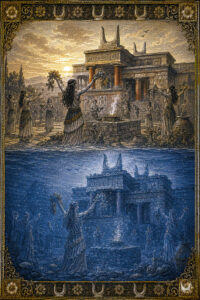 That ambiguity explains why they appear across such different contexts. A shrine to one deity could bear them. A palace could bear them. A peak sanctuary open to the sky could bear them. The symbol transcended individual cults, which means it must have operated at a level above cult, as a marker of sanctity rather than of any specific sacred identity.
Survival into Greek Myth
There is a poetic possibility—not something that can be proven, but too persistent to ignore—that echoes of the horns survived into later Greek mythology. The Minoan world vanished. Its written language vanished. Its religious structures vanished. Yet certain images endured: the sacred bull, the labyrinth, the king of Crete, the creature with bovine features at the center of a maze, the recurring association between divine power and horned imagery. Like much of Greek mythology, these may preserve memories transformed beyond recognition, not continuity of doctrine but of memory.
My essays return to this phenomenon time and again. It is one of the central arguments of my fiction, that ancient religious memory does not die. It goes underground. It resurfaces in stories.
Why It Works as a Literary Emblem
What makes the horns of consecration an effective publisher’s mark is that they communicate several things at once. They are ancient, distinctive, geometric, recognizable, and rich in symbolic resonance. Yet they are open to interpretation rather than closed by doctrine. Most logos tell the viewer precisely what they mean. The horns do not. They invite curiosity instead of satisfying it.
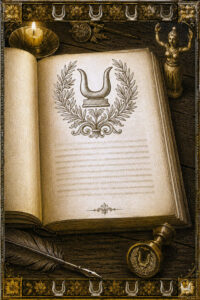 For a writer whose work dwells at the meeting place of myth, history, religion, and imagination, that quality of ambiguity is not a weakness. It is the point.
And there is one final aspect that seems especially fitting. The horns of consecration are not a symbol of conquest, kingship, or empire. They are not a sword, a crown, or a fortress. They are a sacred sign whose meaning has outlasted its explanation—a symbol of sanctity that survived the civilization that created it, carrying its importance intact through three thousand years of silence.
The persistence of ancient memory lies at the heart of my fiction. I could not have chosen a more appropriate standard under which to publish.
Rio de Janeiro, the iv day of June, MMXXVI.

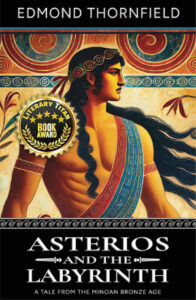
Click the cover to read a preview chapter and learn more.