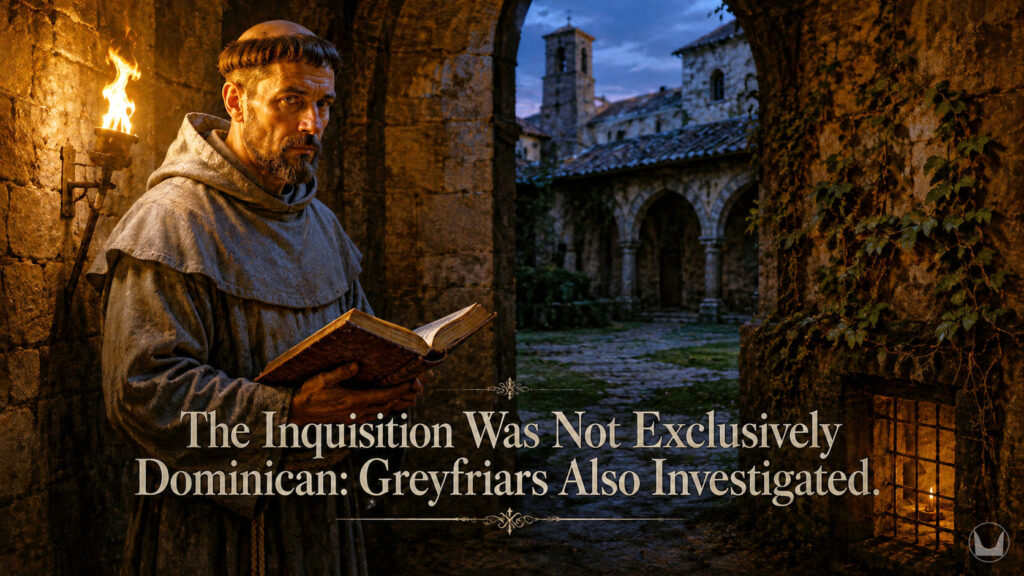
There are scenes in A Tale of Paris & Paris: Echoes of Troy that unsettle readers who arrive with their assumptions intact. The inquisitors who descend upon Cortona in 1450 are not the black-and-white Dominicans of legend, the Domini canes, the Hounds of God, the scholastic terrors immortalized in every gothic retelling of the medieval Church‘s enforcement arm. They are Greyfriars. Conventual Franciscans. Brothers, however degenerate, of the saint who preached to the sparrows.
 The choice is deliberate, and it is historically defensible. But it requires explanation, because the popular imagination has so thoroughly welded the Inquisition to the Dominicans that at first glance any deviation reads as anachronism or dramatic license. It is neither.
The Dominican Monopoly That Was Never Quite a Monopoly
The association of the medieval Inquisition with the Order of Preachers is not fiction. From the thirteenth century onward, the papacy entrusted the Dominicans with the machinery of anti-heresy investigation. Their training in scholastic theology, canon law, and formal disputation made them the obvious instrument. When Gregory IX issued the papal inquisition into permanent form in the 1230s, the Dominicans friars, already embedded in university culture and practiced in structured argument, became its principal agents.
Yet institutional primacy is not the same as exclusive jurisdiction. The Inquisition in the Italian Peninsula was never a monolithic machine of the kind imagined by later centuries. It was a patchwork: papal legates, episcopal courts, civic magistracies, mendicant orders, and local noble factions all interacting, competing, and cooperating depending on the city, the decade, and the particular heresy or scandal under investigation. In one Tuscan hill town, a Dominicans might dominate proceedings; in the next, a Franciscan preacher might be the principal face of orthodoxy.
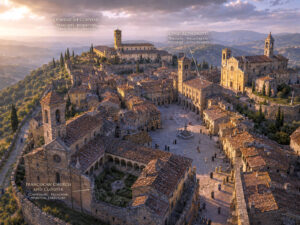 The Order of Friars Minor Conventual—the Conventuals, as distinct from the reform-minded Observants who would eventually dominate the order—were precisely the branch of Franciscanism most integrated into civic and ecclesiastical administration. Urban, institutional, comfortable with property and governance in ways that would have scandalized their founder, the Conventuals maintained close ties with episcopal structures across central Italy. Because of this proximity to power, they were sometimes appointed into inquisitorial commissions as inquisitores hereticae pravitatis (“inquisitors of heretical depravity”), as theological examiners or penitential preachers attached to judicial proceedings. Papal and episcopal records of the Trecento and Quattrocento document these appointments, if less numerous than Dominican ones.
 The Particular Heresies That Drew Franciscan Attention
Franciscan involvement in inquisitorial activity was not random. Certain forms of heterodoxy fell within their sphere, owing both to their pastoral reach into popular devotion and to the fact that some of those heresies had erupted from within the order itself.
The Fraticelli—radical Spiritual Franciscans who refused to accept the papacy’s ruling on Franciscan poverty and drifted into schism—were pursued by inquisitors who may have included members of the very order they had split from. The papacy regarded these apocalyptic dissidents as dangerous, and sometimes Franciscan officials participated in their suppression. The order thus appeared on both sides of inquisitorial history: investigators and investigated, judges and defendants, defenders of orthodoxy and its most flamboyant violators.
Beyond internal Franciscan strife, mendicant friars of the minor orders would combat the remnants of Cathar and Patarine influence, the Waldensians, unauthorized visionary cults, prophetic movements, and by the fifteenth century, the spreading anxiety around popular magic, superstitious practice, and what contemporaries called demonic pacts. It was precisely in this last domain, the contested territory between devotion and sorcery, that Franciscan preachers helped shape the intellectual climate that would feed the early modern witch trials. The fully developed witch panic belongs more properly to the late fifteenth and sixteenth centuries; but its preconditions were assembled in part by Franciscan preaching in the decades before.
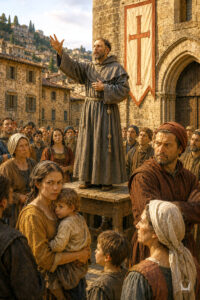
In cities where Franciscan spirituality ran deep—Assisi, Perugia, Siena, and much of Tuscany—these friars exercised enormous moral authority among ordinary people. That authority was not merely devotional; it was practical, legal, and coercive.
 The Confiscation Economy
One motive requires no theological justification: money.
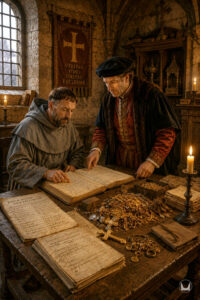
The bona hereticorum (the goods of heretics) were the financial engine that kept inquisitorial proceedings self-sustaining and politically attractive. Upon conviction, the property of the condemned was forfeit. The division of these assets varied by jurisdiction and era, yet the pattern was consistent: the presiding religious order retained the majority; a portion flowed to local civic authorities; the machinery that supported the tribunal—guards, scribes, carpenters, smiths, cooks, legal counsel—was paid from the proceeds.
This was not a peripheral consideration. It was structural. The Inquisition created employment. It stimulated the local economy in the most literal sense: artisans built the cells, the platforms, the furniture of confession and judgment; professionals staffed the proceedings; local authorities who might otherwise have resisted ecclesiastical overreach found themselves financially incentivized to cooperate. A friar who brought a successful prosecution to conclusion was not merely a defender of orthodoxy. He was also an economic actor, and the order behind him knew it.
The Greyfriars of a prosperous Tuscan city, however far removed in spirit from their founder’s embrace of holy poverty, were entirely capable of understanding this arithmetic. Their Conventual branch had long made peace with institutional wealth. An inquisitorial commission was, among other things, a revenue stream.
 Not the Black-Clad Caricature
The Franciscan inquisitor of central Italy in the Quattrocento was not the figure of later gothic imagination, robed in black, possessed of procedural sadism, a figure of institutional menace. He was something more unsettling because he was more human.
He was a learned but austere mendicant, deeply embedded in the civic and devotional life of his city. He preached in the piazza. He heard confessions. He advised the magistrates. He was known by name to the families whose children he catechized. When he began to investigate rumors of heresy, illicit prophecy, or demonic pact, he did so in the genuine belief that he was a physician of souls, protecting a Christian community from spiritual corruption that, left untreated, would metastasize and destroy.
That conviction did not make him less dangerous. It made him more so. The inquisitor who believes himself a healer is far harder to resist than one who knows himself a tyrant.
The Novelist’s Choice and Its Consequences
When I placed Greyfriars at the head of the inquisitorial commission that descends on Cortona in A Tale of Paris & Paris: Echoes of Troy, I was not reaching for the sensational. I was reaching for the accurate and, more importantly, the morally complex.
The Dominicans carry too much theatrical baggage. Readers arrive pre-loaded with responses: the black habit, the scholastic precision, the Domini canes etymology that has been performed in historical fiction for generations. A Dominicans inquisitor in a Renaissance novel risks becoming a stock figure before he opens his mouth.
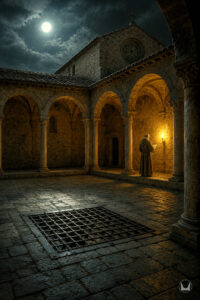 A Greyfriar inquisitor arrives without that armor of received meaning. He comes from the order of Francis, the most beloved saint in Christendom, the Poverello who wept for lepers and sang to the sun. Yet here he is, with his dungeon and his instruments and his ledger of confiscated estates. The cognitive dissonance is historical. The horror is in the gap between the founder’s vision and what the institution became.
In Cortona of 1450, the friars of San Francesco, the very church built by the disgraced Brother Elias, provide the novel’s principal seat of ecclesiastical power and menace. The dungeons beneath their cloister are real in the sense that such spaces existed. The friars who inhabit them are fictional—Domenico, Nardo, Paolo as embodiments of institutional corruption; Vincenzo and Miniato as the order’s residual conscience—but they are drawn from the historical reality of what the Conventual Franciscans had become by the mid-fifteenth century: a wealthy, politically integrated, morally compromised institution that had not merely forgotten Francis‘s “Praised be You, my Lord” but had learned to profit from its forgetting. In truth, “Praised be You, my arse.”
This is not a Dominican story. It is a Franciscan one. And it is the one the novel required.

Rio de Janeiro, the xxviii day of May, MMXXVI.

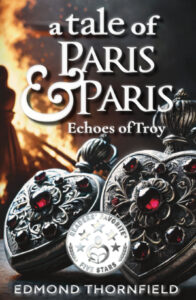
Click the cover to read a preview chapter and learn more.
If this intersection of medieval ecclesiastical history, Renaissance civic life, and literary fiction interests you, the novel is where history becomes flesh.