I. Introduction
The religion of the Late Bronze Age Aegean was not Olympian religion in an earlier form. It was something older and stranger: more local, more animistic, more deeply rooted in the agricultural rhythms of the land and the intimate realities of the household. The defined personalities we know from Homer, of gods with genealogies, grievances, and governing portfolios, had not yet solidified. What existed were presences: powers felt in the olive grove, in the chamber where a woman labored, in the mountain passes, and in the serpent coiled in the thicket.
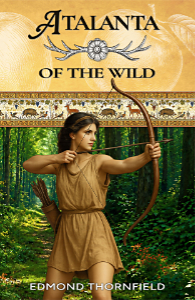
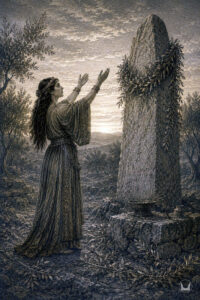 My novels set in the Late Bronze Age—Asterios and the Labyrinth in Minoan Knossos, Atalanta of the Wild in Mycenaean Arcadia—take considerable care to honor this distinction. In Atalanta I speak of Athána Alēa, a local protective and agricultural manifestation of the later goddess Athena, worshipped in Arcadia long before the Olympian codification. I speak of Enyálios, the regional war-power that the Archaic Greeks would eventually rename Ares. I speak of Hermās of the Road, invoked with libations before any journey, centuries before Hermes acquired his winged sandals and messenger’s rod. In Asterios, I give a place to Pipituna, goddess of the olive and her harvest, and to Potnia, simply The Lady, The Mistress, the great mother-nature-fertility figure whose name required no further elaboration. The sun-god I call The Bright One, The Radiant One, The Bringer of Light, because Hyperion was only barely beginning to be used as an epithet; it was not yet a name.
What follows are five divinities who were largely forgotten by the time Homer sang, or else absorbed into their Olympian successors until only scholars, peering at inscriptions and potsherds, have recovered their outlines.
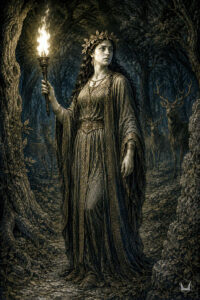 II. Despoina, The Hidden Mistress
Of all Arcadian divinities, Despoina may be the most intriguing. Her name means simply The Mistress, and in Classical times her true name was considered so sacred it was revealed only to initiates. Scholars have long suspected that she preserves a very ancient, possibly pre-Greek goddess who was later partially absorbed into the identities of Kore and Artemis.
Her sphere appears to have encompassed wild nature, fertility, animal life, initiation, and the transition from maidenhood to adulthood. She was worshipped in Arcadia alongside Demeter and a mysterious male figure who has left almost no trace in the record. In a Late Bronze Age setting, she would not yet be a mystery figure. She would simply be there, in the forest clearings and at the threshold of the rites of passage, known by the names that suited the moment: The Hidden One, She of the Wild Places, The Lady of Arcadia.
For my work, Despoina fits beside Atalanta. She feels like the shadow standing behind both Kore and Artemis, older than either, less domesticated, preserving something that the later Olympian system, with its genealogies and its patriarchal orderings, had set aside.
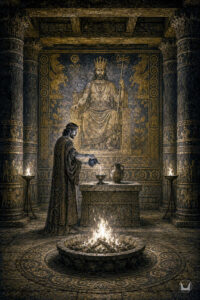 III. The Wanax God: The Lord
The Linear B tablets from Mycenae, Pylos, and Knossos employ the term wanax— king, lord—with notable frequency. Most occurrences refer to palace rulers; a number of scholars, however, have proposed that a divine Wanax also existed as a guarantor of sacred authority and social order.
By the Archaic period this deity seems to have vanished so completely that not even a shadow of his cult name survived. His functions were redistributed, chiefly to Zeus, who absorbed the role of divine king.
What he might have been called in the Bronze Age admits of some speculation: The Lord Above; The High King; The Heavenly Wanax; He Who Sits in the Hall of Gold. He is the sort of divinity one would expect to find honored in a Mycenaean palace: present in the ritual, essential to the legitimacy of the king, and utterly absent from Homer.
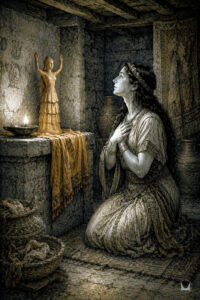 IV. Eileithyia Before Olympus Claimed Her
The goddess known as Eileithyia is attested in the Linear B tablets, which place her among the most ancient of all recoverable Greek divinities. In Crete she appears to have been of great importance. Her domain was childbirth, labor pain, motherhood, and the protection of infants, not cosmic administration but the immediate and practical business of survival.
Unlike the Olympian tendency toward grand mythological narratives, Eileithyia belongs to village life. A Mycenaean woman would not invoke a complicated genealogy. She would say: Lady of Birth, open the gate. That prayer is older than the Olympians and truer to the Bronze Age.
What is notable about Eileithyia is not that she disappeared, but that she survived as a minor functionary within Hera‘s mythology rather than remaining the autonomous power she once was.
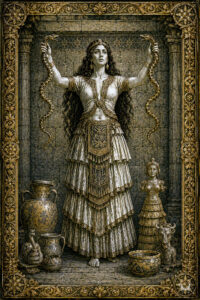 V.
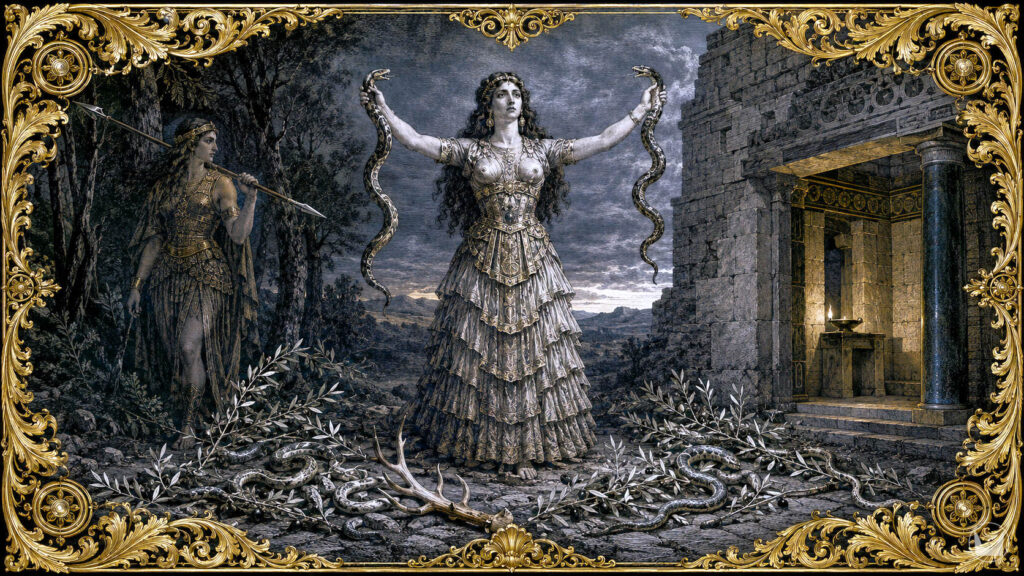
V. Here we reach the most famous and the most frustrating of the pre-Olympian divinities: the goddess of the famous Knossian figurines, whose actual name we do not know. The faïence images from the palace storerooms—a woman holding serpents aloft with composed authority—almost certainly represent a major Minoan divinity, though whether they depict a goddess, a priestess, or both is a question scholars continue to debate.
Her sphere appears to have included household protection, fertility, regeneration, the earth, and the chthonic powers below it. Echoes of her have been traced in later Athena, Artemis, Demeter, Rhea, and Persephone, which is to say that she was so fundamental that the Greeks could not absorb her whole and had to distribute her among several successors.
For fiction she works best under the names her worshippers would have used: Lady of Serpents; She of the Coiled Ones; Keeper of the Hidden House. A Minoan priestess of 1450 BCE would have understood her as something deeper and more primordial than any deity the later Greeks would recognize.
In Asterios and the Labyrinth, she inhabits the same world as Pipituna. The Minoans appear to have centered much of their religious life on powerful female divinities associated with nature, fertility, animals, and the earth. The later Olympian system, by contrast, grew more patriarchal and more concerned with lineage. A priestess from Knossos, transported to Athens in the fifth century BCE, would have recognized almost nothing.
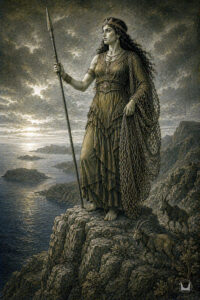 VI. Diktynna, Mistress of the Mountain
The Cretan goddess Diktynna was associated with mountains, hunting, wild animals, and fishing nets. The Greeks later identified her with Artemis, but this identification may conceal a far older and distinctly Cretan figure whose identity was simply too inconvenient to preserve whole.
For a Bronze Age Cretan, she would be The Lady of the Mountain, The Mistress of Nets, The Huntress of Crete: herself, sufficient, without recourse to any imported Olympian equivalent.
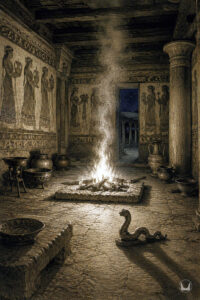 VII. Closing
What strikes me most, in years of research into these older religious worlds, is not the strangeness of these vanished divinities but their coherence. They governed the things that mattered to the people who worshipped them: the birth that might kill the mother, the harvest that might fail, the perils ever near, the girl standing at the threshold between childhood and womanhood. They were not abstractions. They were pressures felt in the body and in the season.
For all their magnificence, the Olympians brought something else with them: distance, hierarchy, the clean narrative of genealogy. They became the gods of poetry and philosophy. But the older divinities were the gods of need; in the Bronze Age, need was never far away.
Writing fiction set in this world means learning to hear those older powers beneath the later mythology. They speak in ancient epithets and in names preserved only within the mysteries.
Rio de Janeiro, the vii day of June, MMXXVI.

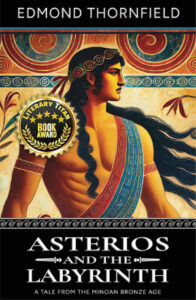
Click any cover to read a preview chapter and learn more.