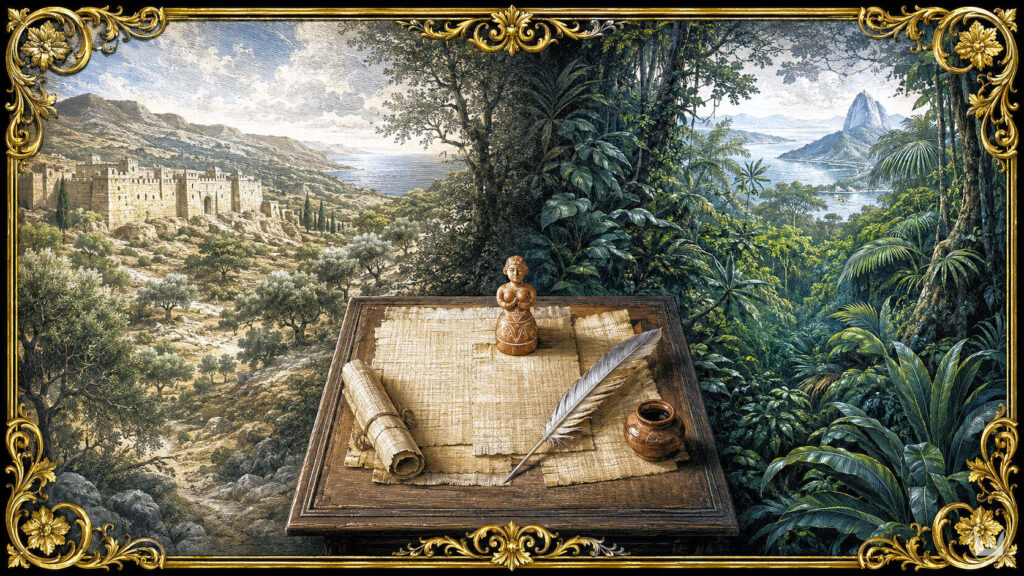
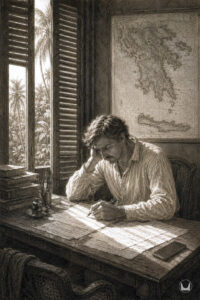
I can offer no other explanation: I close my eyes and travel. The ancient Mediterranean worlds of the tales I write lie some 9,600 kilometers from my writing desk in Rio de Janeiro, and yet, in the solitude of the working hours—the cell phone on mute, the tropical city going about  its business beyond the window—I manage to arrive in Tegea, in Nafplio, in the palace corridors of Knossos. The distance is considerable. Nevertheless, I make it.
Rio is the “Marvelous City“. The Tijuca National Park, the largest urban rainforest in the world, begins where the neighborhoods end and climbs the granite peaks in a wall of green. It is not a landscape that invites thoughts of the Bronze Age Aegean. There are no acorn-laden oaken boughs here, no pines high in the mountains, no olive trees in the valleys and on the rolling hills. There are no snow-melt streams to cross in the Spring. The light, the humidity, the very quality of the air belong to another world entirely, a world magnificent in its own right but not the world I write.
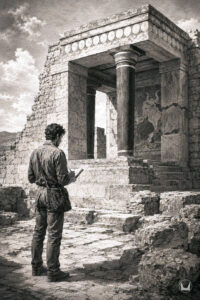 And so I close my eyes and go.
I make regular journeys to Crete and the Peloponnese. Those journeys are indispensable. Call me restricted of imagination if you will, but I find it impossible to invent certain things: the particular smell of a place, the scent of rain falling upon dry earth, the taste of road-dust lifted by the wind, the way the light moves through the leaves as the season turns. I have taken notes, photographs, and measurements at Knossos, at Zakros, at the Peloponnesian sites, in the hill towns of Arcadia. I have stood in the places where my characters stand. That embodied knowledge cannot be replicated at a desk in Rio, and I do not attempt to replicate it. I wait, and I go, and I bring back what no remote research can supply.
 There are also the archaeological museums: the rooms of Linear B tablets, the Minoan frescoes, the grave gold of Mycenae, the modest household objects that reveal more than any royal treasure about how people lived. I count myself fortunate to work in an age when historians and archaeologists have recovered so much of the Minoan and Mycenaean Bronze Age. Without their patient labor, writers of historical fiction set in this period would be navigating in near darkness. As I am fond of saying, we would again be living in the Dark Ages.
The contradiction of my working life is that I sit in one of the most extraordinary cities on earth and attempt to see another world. Rio presses upon the senses without apology. The Bronze Age Aegean demands quieter attention. The two coexist ill at ease. Solitude is a professional necessity. The cell phone stays on mute. The door stays closed. The tropical afternoon does what it will.
 In that disciplined silence, somehow the distance collapses.
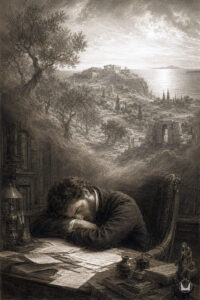
I will close with this: even in the waking hours, the effort requires an act of sustained imagination that research alone cannot supply. Research supplies the bones; imagination moves them. But there is a third element that escapes them both, and it visits without invitation in the hours when the desk is abandoned.
I live in Rio de Janeiro and write of distant lands from times long past. Yet I go farther at night in my dreams.
Rio de Janeiro, the viii day of June, MMXXVI.

Click any cover to read a preview chapter and learn more.