I. The Bell That Tolled in the Wrong Tower
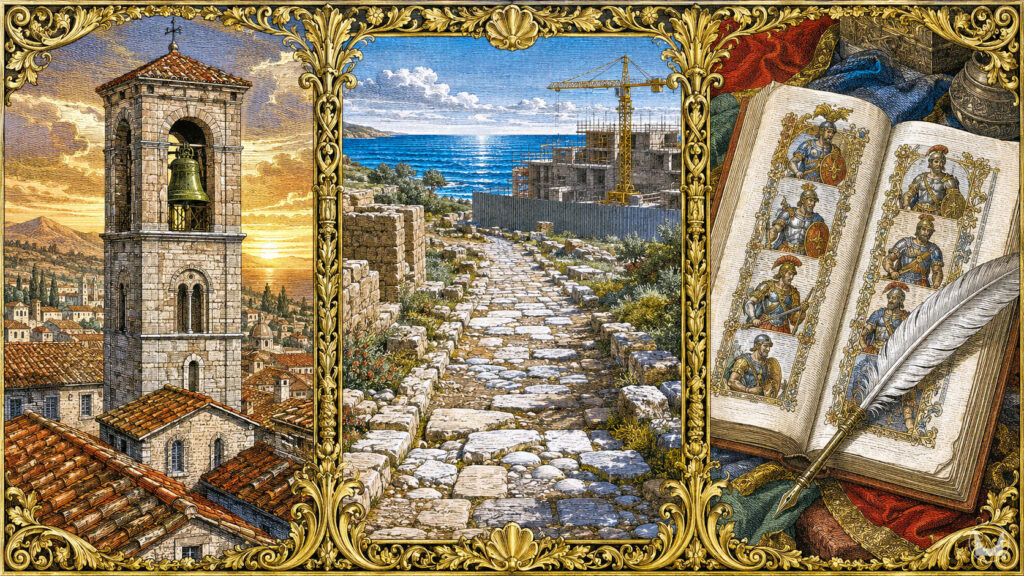
Throughout the writing of A Tale of Paris & Paris: Echoes of Troy, I needed bells. Not as atmosphere—as infrastructure. Cortona in 1450 AD ran on bells the way a modern city runs on clocks: they called the faithful to Mass, to Vespers, to the Compline; they marked the hours; they governed the rhythms of commerce and curfew and prayer. I had grown up with bells. They pealed through my childhood in the interior of Brazil, in the 1960s and 1970s, announcing the same round of obligations they had announced in Tuscany five centuries earlier. The concept was not foreign to me. The specific bell was another matter.
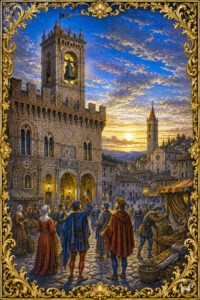 I had been to Cortona three times. I knew the town’s topography with the intimacy of someone who has walked its streets in the late-afternoon light. And yet, because I had not sought out this one piece of information, it took me days of research to decide which bell to assign to which moment in the novel.
The Church of Santa Maria Assunta had a modest tower and tolled its bells, but I wanted one near the Palazzo del Capitano del Popolo, at the town’s main piazza, which was central to most of the novel’s settings. The Greyfriars‘ Convent of San Francesco, to the east, had another campanile with two bronze bells: one from 1250 AD, added by Friar Elias of Cortona—a figure of extraordinary historical weight, the organizer of Saint Francis‘s burial and a builder of the order’s influence across central Italy—and a second from 1267. They were rung day and night to communicate with the parish.
But the real question was this: did the Palazzo del Capitano del Popolo use its single bell to toll the civic hour in 1450 AD?
It did. By then, the tracking of secular merchant time, the counting of equal twenty-four civic hours, had been assumed by town councils to regulate market hours, curfews, and labor. This was the Florentine Republic, not the domain of a Pope-King. The civic bell was the instrument of civic authority. The research, when I completed it, was unambiguous and satisfying.
Unfortunately, it came to me after publication. I had already assigned the bell to Santa Maria Assunta. History, it seems, has a sense of timing. I will correct those passages when the novel reaches its second edition. Also, the correct bell will ring in the second book of the Chronicles of Cortona. Lorenzo cannot remain in Erebos forever.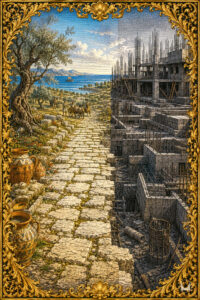
II. The Road That Disappeared
Many scenes of Asterios and the Labyrinth take place on the Royal Road between Knossos and the port of Amnisos. In Minoan times, this was a journey of a little more than an hour on foot from the palace’s North Gate. By chariot or horseback, it was a quick passage.
I walked the section of the road nearest the archaeological site of Knossos. It ended without warning. The modern suburbs of Heraklion had been built on top of it: new buildings, new streets, new roads laid over the ancient ones, the Minoan surface buried under concrete, asphalt, and ordinary life. And when I visited Amnisos, I found a touristy beach with nothing to tell me what a Bronze Age harbor had looked like from the landward side.
I described the road as best I could, drawing on what I had walked, what archaeology has recovered, and what the landscape still suggests. But the gaps were real, and I spent many days hunting for information that was either fragmentary, contested, or absent from the available record.
I made the same mistake I had made at Cortona: I did not seek out a local historian at the archaeological museum, did not obtain a contact, did not position myself to verify details from someone who had spent years studying this corner of Crete. I tried reaching the museums by email while I was writing—several emails, to both Heraklion’s Archaeological Museum and Cortona’s MAEC. None ever replied.
 I am patient. Someday I will be standing in front of those institutions in person, and we will have a reckoning. I look forward to it.
III. The Catalogue of Heroes
Not every rabbit hole ends in a wall or a swamp. Some open into something wonderful, and the assembly of the Calydonian Boar Hunt‘s catalogue of heroes was one of those.
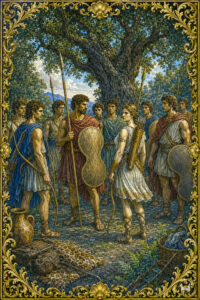
The Calydonian Boar Hunt is one of the great set-pieces of Greek mythology: a king’s failure to honor Artemis, a goddess’s retribution in the form of a monstrous boar sent to devastate the land of Calydon, and a gathering of heroes from across the Greek world to bring it down. The guest list, so to speak, is remarkable, not only as a roster of famous names but as a statement about the interconnectedness of the heroic generation, the web of loyalties and lineages that underpins the whole edifice of Bronze Age legend.
I could not have written those chapters of Atalanta of the Wild without knowing who was there.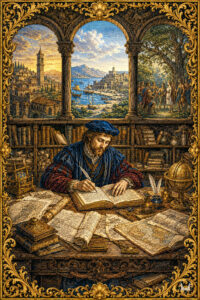
The task was enjoyable, but it was not a three-hour diversion. It took days to locate and cross-reference the most plausible list from the ancient sources: primarily Book VIII of Ovid‘s Metamorphoses, which gives the most literary and dramatically developed account, supplemented by Apollodorus’s Bibliotheca (1.8.2–3), Hyginus’s Fabulae 30, and several auxiliary sources. The ancient accounts are not in agreement. Different traditions include different heroes, promote different figures, and reflect the local mythologies of different city-states that wanted a claim on the hunt’s prestige. Making sense of it, adjudicating between versions, and determining who belonged in the hunt took genuine research.
The result was an essay of its own: Part II | The Heroes at the Gate: Assembling the Hunters of Khalydōn, which those interested may read by following the link provided. The catalogue did not just support the chapters—it shaped them. Knowing who was in the field, and why each was there, changed the way scenes were written.
 IV. What the Rabbit Hole Teaches
There is a version of historical research that is pragmatic: you need a fact, you find the fact, you move on. But it is not the version I recognize from the inside of a novel.
In my experience, what happens is that you enter a rabbit hole in search of one thing and emerge with three. The bell tower research taught me something about the Florentine Republic‘s relationship to secular time that fed into how I understand the political texture of Cortona in 1450. The Royal Road research, however frustrating, taught me the particular quality of absence, the way a landscape that has been built over still whispers its older shape to someone willing to look. That quality entered the prose. The catalogue of heroes taught me that mythology is not a unified tradition but a contested archive, and that the novelist’s job is to make a responsible editorial decision and commit to it.
Some rabbit holes lead to dead ends. Others take you to swamps. I enter them for the ones that tunnel into Wonderland.
Rio de Janeiro, the xvi day of June, MMXXVI.

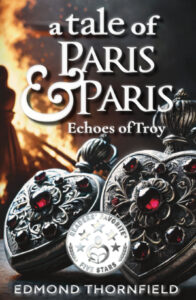
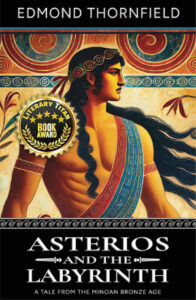
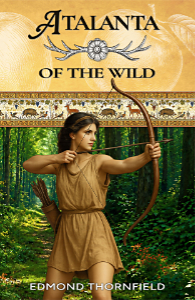
Click any cover to read a preview chapter and learn more.