 The Pressure That Broke
By Chapter Eighteen of Asterios and the Labyrinth, I had been sustaining a level of emotional intensity that left even me—its author—in need of air. The novel had given romance, court intrigue, mythic sorceresses, Bronze Age siege warfare, and personal violation. Every scene carried weight. The narrative engine had been running at full throttle for eighteen chapters, and I could feel it beginning to overheat.
Then it came to me. Not as a plan—I am a confirmed pantser, at most twenty percent plotter—but as a revelation, the kind that arrives unbidden while you are not thinking about the book. A song title. Girls Just Want to Have Fun. In my archaic register, that became Ladies Chase Mirth. And the moment the phrase landed, I knew who would be doing the chasing.
 The Perfect Company for Dark Mischief
Greek mythology offers no shortage of dangerous women. But for the particular kind of chapter I needed—irreverent, comic in a dark vein, and morally untroubled—the choice was obvious before I made it.
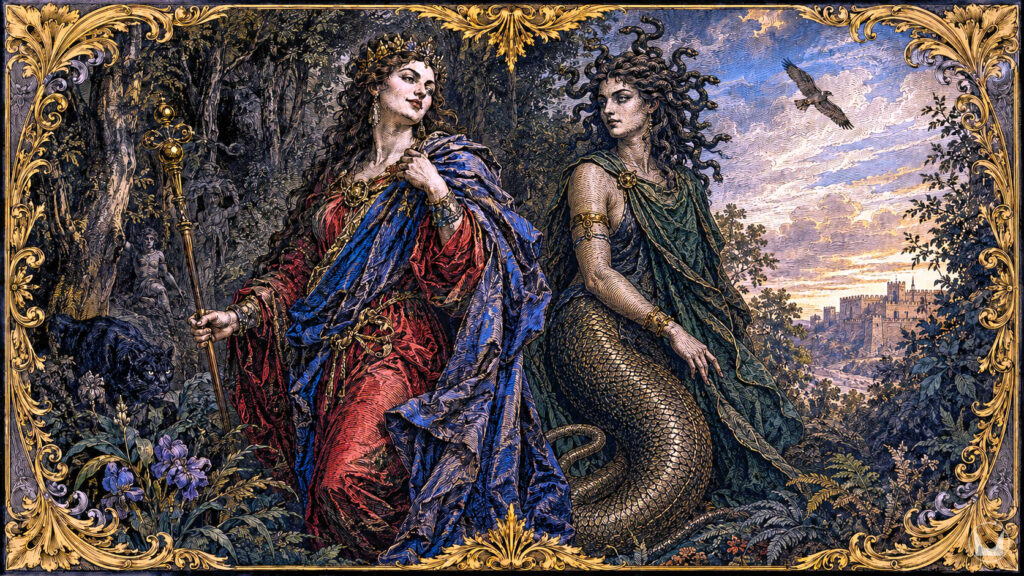
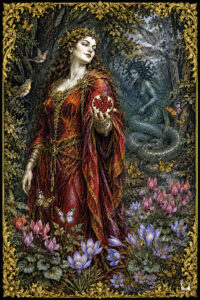
Kírke, whom the world knows as Circe, is the most accomplished enchantress in the Greek mythological canon. Daughter of Helios and the Oceanid Perseis, she figures in the Odyssey as the sorceress who turns Odysseus‘s men to swine on the island of Aeaea. In Asterios and the Labyrinth, she is Pasiphaë‘s sister and Asterios’s aunt, an immortal of staggering power who moves through the world on her own terms. She had appeared in earlier chapters, observed, advised, and intervened. But she had not yet had her own game to play.
Her companion in Chapter Nineteen is Echidna, who in the classical tradition is among the oldest and most terrible of all mythic beings. She is the Mother of All Monsters. From her lineage descend Cerberus, the Hydra, the Chimera, the Sphinx, the Nemean Lion. Half-woman, half-serpent, she dwells in a cave in Tartaros, immortal and ever-hungry. In my novel she is Kírke‘s friend from youth, their friendship already well established. When Kírke goes to visit her in the Kydonian forest, bringing a pomegranate enchanted to grant Echidna human legs for an afternoon, it feels less like a plot event and more like a reunion long overdue.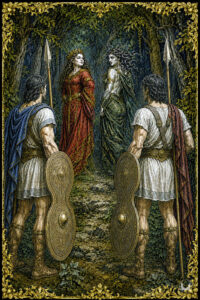
Two of a Kind: Amoral, Not Evil
This is where I need to be precise because the distinction matters for how the chapter works.
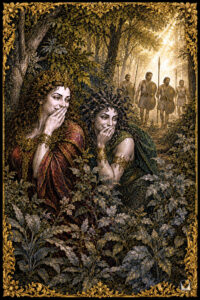
Kírke and Echidna are not evil in the way a villain is evil. They have no ideology of cruelty, no desire to cause suffering for its own sake. What they have instead is an absence of the moral framework that governs human behavior. The warriors who fall to them in Chapter Nineteen are not innocent men cut down unjustly—they are prey, as a rabbit is prey to a hawk. Kírke is hungry for diversion after weeks of palace life; Echidna is always hungry. Between them, there is only appetite.
This amorality is far more unsettling than conventional villainy and far more interesting to write. A villain who wishes to do harm can be judged and condemned within the story’s ethical framework. But Kírke and Echidna operate outside that framework. They are older than its rules. The reader who laughs at their masquerade as helpless maidens and the merry chase through the forest laughs with beings for whom human life carries the gravity of sport. That discomfort is the chapter’s engine.
Nor are they without loyalty. Everything they do in the forest serves the cause of King Asterios, Kírke‘s nephew. The Kydonian warriors are the enemy. The chapter is both entertainment and warfare, executed with the cheerful efficiency of women who see no contradiction between the two.
 The Chapter That Gave Itself
I will not tell you what happens in Chapter Nineteen. Not all of it. But I will say that it unfolded with a freedom I seldom experience in the writing of a novel. There was no resistance, no scene that refused to open, no dialogue that needed to be coaxed. The chapter came out already knowing what it was.
Looking back, I understand why. Kírke and Echidna have no internal conflict to resolve. They are not troubled. They want what they want. They take it, and they laugh. Writing them required me to set aside the weight that had accumulated over eighteen chapters—the moral seriousness, the historical fidelity, the architecture of cause and consequence—and simply play. It was the closest I have come to pure authorial pleasure.
I also needed the chapter to do something structural: to plant the seed of Kírke and Echidna‘s participation in the novel’s climax. Their afternoon in the Kydonian wood is not merely an interlude. It establishes what they are capable of, how they work together, and what loyalty means to beings who do not share human morality. The reader who pays attention will remember Chapter Nineteen when the time comes.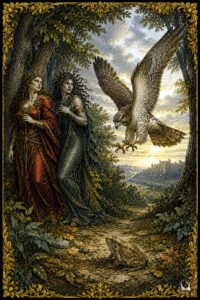
A Vision at the Edge of the Wood
The chapter ends with a sequence that came to me not from planning but from a vision.
After Kírke and Echidna‘s chase has ended, Kírke transforms one of the young warriors into a toad. She then kisses him and whispers the terms of his disenchantment in his ear. He stands transfigured. What happens next, before either woman can react, takes everyone by surprise—and to laughter.
It arrived with the scene, exact and inevitable, the way certain ideas do when you have been writing long enough to stop managing them. It is the mythology’s logic bleeding through into the story. The world of Kírke and Echidna is one in which enchantments have unintended consequences. A moment of unexpected mercy can be undone by the casual cruelty of nature.
The warrior’s fate I shall leave for the reader to discover.
Rio de Janeiro, the xvi day of June, MMXXVI.

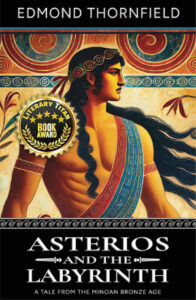
Click the cover to read a preview chapter and learn more.