Laughter does not interrupt a story. It belongs inside it, the way a breath belongs inside a sentence.
I learned this not in a craft manual but in the pages of men who lived with the stench of open sewers and the fear of plague and somehow wrote the funniest prose in the Western canon. Giovanni Boccaccio and Geoffrey Chaucer, both children of the fourteenth century, understood something that many contemporary writers of serious fiction have forgotten: the body is not an embarrassment to the soul, and laughter in the middle of catastrophe is not a concession—it is an act of witness.
I write literary historical fiction. My novels live in Minoan Knossos, in Mycenaean Arcadia, in Renaissance Cortona. The drama is often grave: death, exile, divine punishment, inquisition, abuse of power. Into that gravity, I have learned to place laughter, not to soften the weight but to make the reader capable of bearing it.
 I. The Reader Needs to Breathe
After a while, a novel that sustains unbroken tension becomes a book the reader sets down. Not because the drama has failed but because the body refuses to stay wound tight for long. You can demand sustained attention but cannot demand sustained anxiety. The reader needs a place to exhale.
Comic relief is that place. It is not a chapter that steps outside the story to be amusing; it is comedy that arises from within the same circumstances that produce the drama. The ideal comic moment gives the reader a breath, and it advances character, plot, theme, or all three.
Boccaccio knew this. The Decameron contains stories of seduction, betrayal, cruelty, death, and also foolish priests caught in their own hypocrisy, women who outmaneuver lecherous husbands with perfect comic timing, and monks whose bodies betray their vows in the most public ways imaginable. The laughter does not cancel the seriousness. The seriousness makes the laughter feel earned.
Chaucer understood the same rhythm. The Canterbury Tales holds grief and comedy in the same breath, sometimes in the same line. The Miller’s Tale and The Knight’s Tale sit beside each other not by accident. One tells of noble suffering and courtly love; the other is a farce involving a misdirected kiss, a hot iron, and a man hanging from the ceiling in a tub. The dignity of the one makes the indignity of the other funnier, and the laughter of the other makes the dignity of the one more bearable.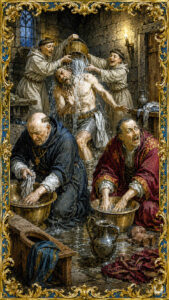
II. The Body as the Great Equalizer
A fact of medieval literature that modern writers working in this period must reckon with is that if your narrative contains no reference to bodily functions, you are not writing a realistic period piece. You are writing a courtly romance, a bureaucratic treatise, or a modern fantasy dressed in period costume.
Boccaccio and Chaucer did not flinch from the body. They wrote about it with the directness of people for whom the body was not yet a private embarrassment. In the fourteenth century, what became unspeakable by the Victorian age—flatulence, vomiting, diarrhea, the unruly urgency of the flesh—was part of the texture of life. More offensive to a medieval ear was blasphemy: By God’s nails, By God’s blood. These were the curses that shocked. Excrement did not.
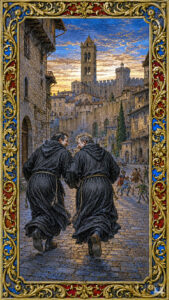 Excrement served a literary purpose that I have come to value in my own work. It is the great equalizer. It does not spare the powerful. It does not respect rank or piety or the authority of office. The Inquisitor, the Convent Guardian, the Captain of the Pope’s Army, all are subject to the same urgent necessity, all are equally undignified when their bodies declare independence from their ambitions. Medieval audiences understood this; it lands with the same force today.
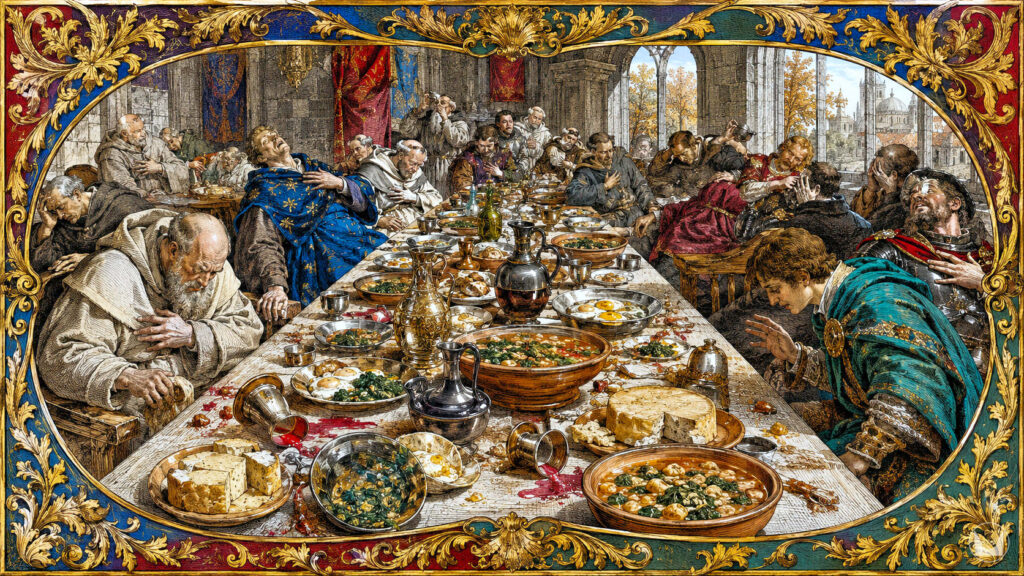
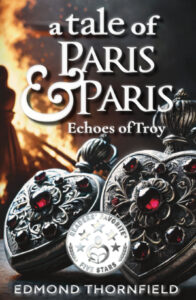
In Chapter Thirteen of A Tale of Paris & Paris: Echoes of Troy, the kitchen master Friar Vincenzo and the novice Gianmaria slip castor oil and a basket of bad eggs into the convent’s noontime meal. The targets are the inquisitors, the Guardian, and other wicked friars. The knights of the Pope’s Army are an incidental bonus. What follows is administered with the composure of a man who tries not to laugh while emptying chamber pots at midnight. He guides the Guardian away from his own mess. He holds a bucket under Friar Tommaso. He returns each vessel cleansed with natural agility.
The comedy here is not at the expense of the narrative’s serious concerns. The Inquisition is real, the threat is real, the abuse of the convent orphans is real. But for one chapter, the grand machinery of Church authority is reduced to its most basic function, and the reader, who has been holding a great deal of tension, is allowed to laugh.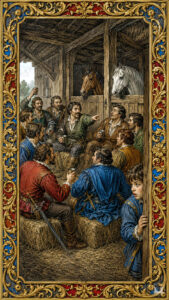
III. Comedy That Belongs to the Story
When I consider whether a comic moment earns its place, the distinction I find most useful is whether the laughter arises from the same materials as the drama. If I have to introduce new characters or a new setting to be funny, the comedy is a detour. If the comedy comes from the same characters, the same situation, the same conflict, then it is not relief from the story. It is the story seen from a different angle.
In Chapter Fifteen of A Tale of Paris & Paris, Lorenzo meets with his ten commanders in a stable to organize the defense of Cortona against the Pope’s knights. It is a scene of military gravity: these men are preparing, if necessary, to kill. And then one of the commanders, Claudio de Gradi, renowned archer, not renowned for quickness of wit, pauses the proceedings to ask whether Greyfriar means fritto grigio. Fried grey things.
The rambunctious merriment that follows is not a rupture in the scene. It confirms that these men are friends, that their solidarity runs deeper than their mission, and that they trust each other in a way that allows for absurdity. The comedy is doing narrative work. It shows us who these people are to one another.
Chaucer‘s best comic moments operate the same way. The foolish husband in the tub, the lecherous abbot caught in his own trap—these are not jokes appended to stories. They are the logical conclusion of the stories’ premises, delivered with perfect timing. The comedy earns its effect because it belongs to the world in which it occurs.
 IV. What the Craft Requires
Writing comic relief in serious historical fiction requires the writer to resist two opposing temptations.
The first is to suppress the comedy out of a misguided respect for the gravity of the subject. This produces prose that is historically accurate, serious, and exhausting to read. The medieval world was not solemn. Its people were not solemn. They laughed at their priests, at their bodies, at their own pretensions. A narrative that refuses them this is not true to their world.
The second temptation is to let the comedy dilute the drama, to use laughter as a way of stepping back from the difficulty of the material. This produces prose that entertains without consequence. The trick that Boccaccio and Chaucer mastered is to let comedy and gravity occupy the same space without either surrendering to the other.
The inquisitors lie sick in their cells. The knights of the Pope’s Army stand naked in the washroom. The Inquisition will soon be back on its feet. The orphans are still in danger, and Gianmaria’s double life grows more precarious with every chapter. The laughter does not solve the problem; it restores the reader’s capacity to face it.
Boccaccio and Chaucer taught me that. Not that serious fiction needs relief. But that serious fiction, written in full view of life, generates its own laughter.

Rio de Janeiro, the xxiv day of June, MMXXVI


Click any cover to read a preview chapter and learn more.