I have said this before and will say it again: I am not a writer who builds worlds from nothing. Pure imagination is not enough for me. Without a foundation of something real beneath my feet, my creativity has nowhere to stand. And because my purpose is to carry a reader into another time and place, I must first go there myself.
This is where the travels come in: the archaeological museums and the sites, walked on foot, in the heat or the wind or the rain, with my senses doing the work no photograph or documentary can do.
The Belvedere at Mycenae
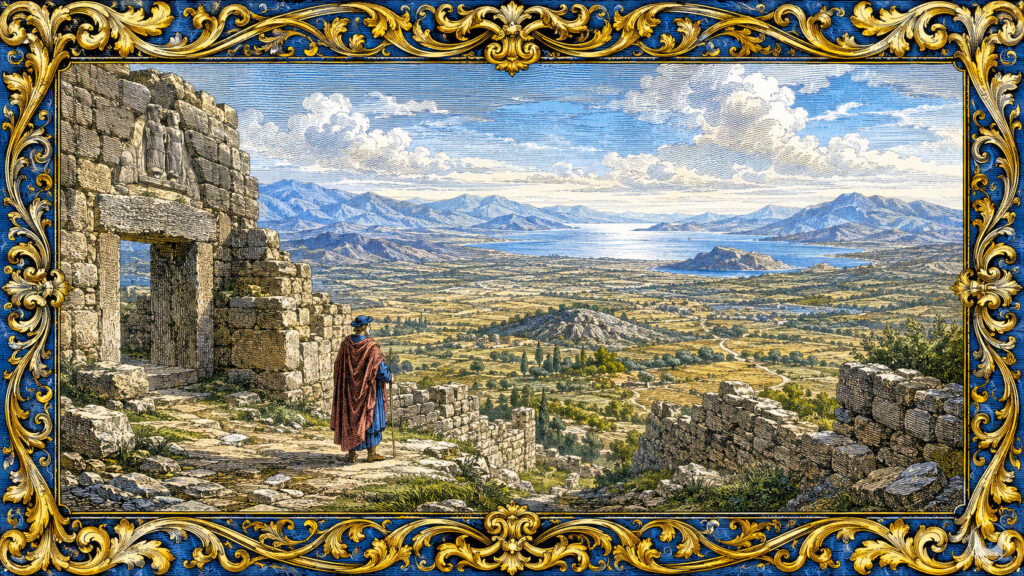
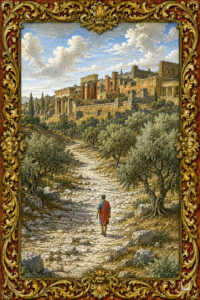
Years before I knew I would write Atalanta of the Wild, I stood at the small belvedere outside the museum at Mycenae and looked out. The Argolic Gulf. The Argolid plains. The mountains of Arcadia in the west, and to the north, Nemea.
I remember the thought arriving before I had finished looking: The Mycenaeans could see all of this. The hearth-fires of Argos, of Tiryns, of Lerna, at night. Ships approaching from the sea, friend or enemy, with no way to know which until they were close. Everything exposed. Everything within sight of everything else.
It made me shiver—not from the wind, but from understanding how those people had lived, surrounded on every side by neighbors who might be allies this season and enemies the next, with no walls high enough and no distance great enough to grant real safety. I thought further, Someday I must go to Nemea, where Herakles slew the lion.
 A few years later, I did. [You may read about that visit here.]
The Dry Riverbed Beyond the East Gate
The same thing happened at Knossos.
I had read about Crete my whole life. I had seen the photographs, the films, the reconstructions. I thought I knew what I would feel when I arrived. I did not. Standing among the ruins, no book had prepared me for the sheer weight of meaning that the place pressed upon me.
At one point I walked down to the dry waterbed of the Kairatos River, beyond the East Gate. There was nothing remarkable about this. I stood there, in a riverbed that had not held water in some time, looking at the palace ruins from below rather than from within them.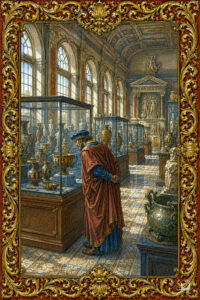
That day, I did not know that I would write Asterios and the Labyrinth. Yet that riverbed inspired some of the most romantic moments between the two protagonists. It became one of the defining locations in their story.
What the Museums Hold
The archaeological sites are one half of the work. The museums are the other.
What no single person could discover in one lifetime, generations of historians, geographers, and archaeologists have uncovered, and continue to uncover, for all of us. The museums of Athens, Rome, Naples, Heraklion, and Paestum exist because someone decided that the objects inside them could not survive where they were found. They were brought in, catalogued, preserved, and put on display so that people like me could come and look.
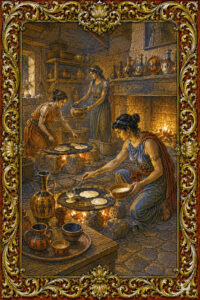 And because they did this, I can write a character pouring wine into a cup that is not shaped like a wine glass. I have seen the actual cup. I can write the women of a Bronze Age kitchen ladling barley-cake batter onto ceramic griddles set across the hearthstones, because I have seen the griddles. These are not details I invented and hoped were close enough. They are details I copied from objects that existed, that someone dug out of the ground, that someone else decided were worth keeping.
Cortona gave me the same gift, though closer to home and from a different century. Had I not done my own archaeology there, walking the streets, looking at what remains of the fifteenth century beneath and around the present-day town, I could not have built the immersive world of A Tale of Paris & Paris: Echoes of Troy. The research does not stop being necessary just because the century is closer to our own.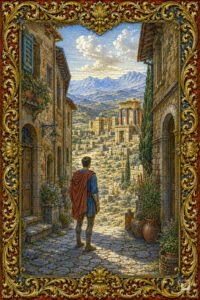
Taken to the Places of My Dreams
I am a writer of literary historical fiction. There is no shortcut around this: if I do not do the archaeological work that a story demands, I cannot build the world the story needs.
This is not a complaint in the least. Because my work requires travel, I have been to the places I dreamed of seeing since I was young. The hilltop fortress at Mycenae. The Palace of Knossos. The streets of Cortona. Each gave me something I did not know I needed until I was standing there, and each became part of a book I did not yet know I would write.
I would not have it any other way.
Rio de Janeiro, the xiv day of June, MMXXVI.

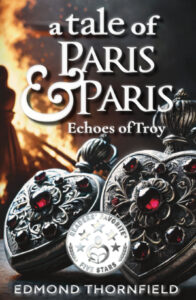
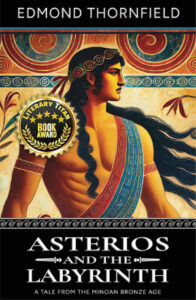
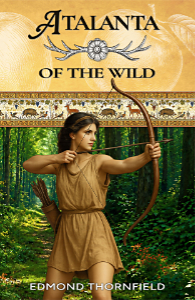
Click any cover to read a preview chapter and learn more.