 I. A Word Most Readers Have Never Encountered
Ask a hundred readers what a colophon is and perhaps three will know. Ask those three whether they have seen one in a novel published in the last decade, and the number will shrink further. In most readers’ minds, the colophon, that brief inscription at the end of a book recording the facts of its making, belongs to an era of illuminated manuscripts and hand-operated presses, to a world in which the book itself was an object of such labor and rarity that its maker felt compelled to sign the work at its conclusion.
 That world has not vanished. It has become uncommon enough to merit notice.
I am an independent author. I write, edit, typeset, design, illustrate, and publish my novels under my own imprint, ETHORN Publishing. Every element of my books—from the typeface chosen for the body text to the drop caps that open each chapter, from the illustrations wrought through a confluence of draftsmanship and engraving practice to the cover art on the front board—passes through my own hands. When a reader opens one of my novels, he is holding not only a story but a made object: something conceived and executed by a single artist from first word to final page. The colophon is where I say so.
 II. What a Colophon Is and What It Was
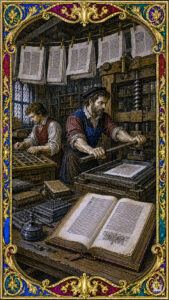
The word derives from the Greek kolophōn, meaning a summit, a finishing stroke. In the manuscript tradition, the colophon was the scribe’s signature at the end of his labor: the date of completion, the name of the workshop, sometimes a brief prayer of thanks or a plea for the reader’s charity toward any errors. When Gutenberg’s press transformed the production of books in the fifteenth century, the colophon migrated into the new medium and acquired additional information such as the name of the printer, the city, the typefaces employed, the paper stock, the number of copies struck. It was a declaration of craft pride.
By the twentieth century, trade publishing had largely abandoned the custom. Books became commodities; the machinery of their making became invisible. The colophon survived in fine press editions (the Kelmscott Press, the Ashendene Press, the Limited Editions Club), where it remained a statement of values. The making of a book was an art, so the reader deserved to know what hands had shaped the object he held.
I share that conviction. The colophon is a claim, not a formality.
 III. The ETHORN Colophon: A Document of Craft
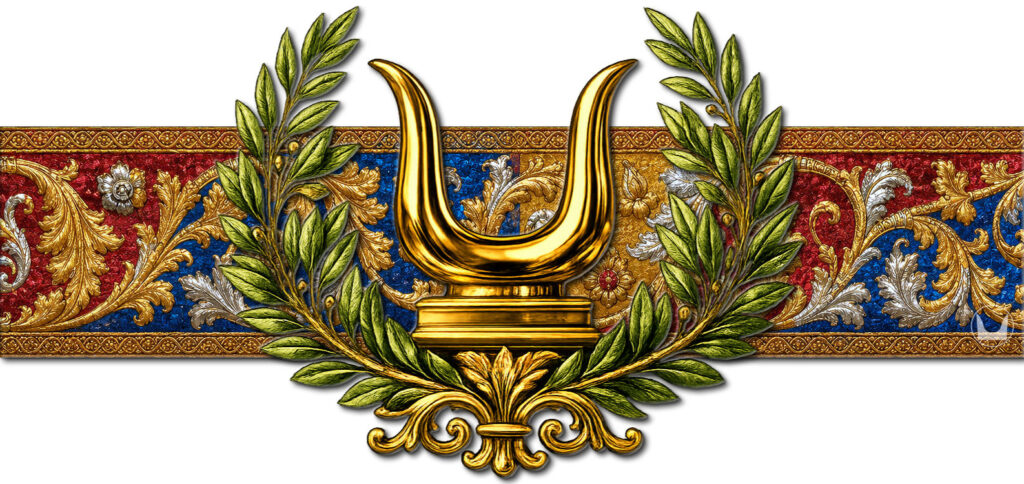
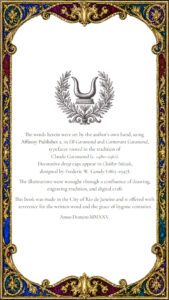
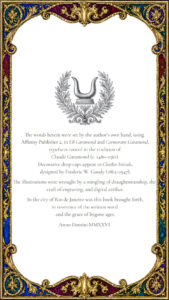
My colophon occupies the final page of each novel. At its crown sits the ETHORN Publishing logo: a stylized image of the Minoan horns of consecration, framed within a laurel wreath. Below the image, set in EB Garamond and Cormorant Garamond, typefaces rooted in the tradition of Claude Garamond, the colophon declares the tools of its making.
It notes that the words were set by the author’s own hand, using Affinity Publisher 2. It acknowledges the decorative drop caps, cut in Cloister Initials by Frederic W. Goudy. It records that the illustrations were wrought through a mingling of draftsmanship, the craft of engraving, and digital artifice. And it closes with a statement of place and intention: In the city of Rio de Janeiro was this book brought forth, in reverence of the written word and the grace of bygone ages.
Each of these details is deliberate. The colophon does not just inform; it immerses. A reader who reaches that final page has spent hours inside a world I constructed. The colophon is the moment I step from behind the curtain, not to break the illusion but to confirm that the spell was intentional.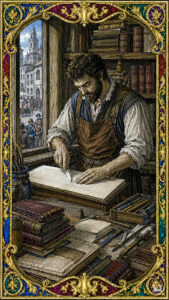
IV. Why an Independent Author Needs One
At its core, the justification for the colophon is an argument for distinction.
Traditional publishing renders its machinery invisible. The reader is given the story; the apparatus that produced it—editors, typesetters, designers, printers—recedes behind the author’s name and the publisher’s logo on the spine. This is a reasonable presentation for an industry built on volume, but it is not the only arrangement possible.
When a reader picks up one of my novels, he is not picking up a product assembled by committee and refined by market research. He is picking up a book made by one person, in one city, according to one set of convictions about what a novel should be and what a book should look like. The colophon makes that visible. It tells the reader: these choices were made. The typeface was chosen. The illustrations were drawn. The words were set by hand. Someone cared.
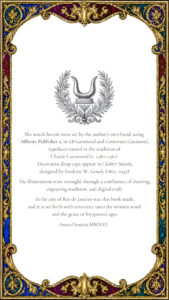 In an era when a novel can be generated, formatted, and published within hours, this matters. The colophon is a declaration that the object the reader holds took time, required skill, and was made with intention. It is the independent publisher’s equivalent of the craftsman’s mark.
There is a further reason I confess without embarrassment: I want the reader to remember ETHORN Publishing. When he sees the horns of consecration on the spine of another volume, on the website, on a literary review, I want recognition to arrive before analysis. The colophon is the final impression a reader carries away from the book. I have invested considerable thought in ensuring that impression is the right one.
V. The Horns of Consecration: A Symbol That Earns Its Place
The ETHORN Publishing logo is not decorative. The Minoan horns of consecration appear throughout the archaeological record of Bronze Age Crete and the Aegean world. They were important, though their precise significance remains unknown. That combination of confirmed importance and unresolved meaning draws me to them.
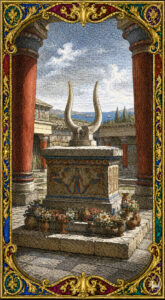 I have written historical fiction set in Knossos. I have written of Arcadian myth. Across my work, I am attuned to the survival of ancient religious memory, to the ways in which the sacred persists. The horns of consecration are an emblem of that continuity, a symbol whose meaning was once charged with living belief and which now survives in stone and fresco.
When a reader completes one of my novels and turns to the colophon page, the horns of consecration look back at him. He may not know what they meant to the Minoans. Neither do I. But they mean something here, at the end of this book, in Anno Domini MMXXVI. They mean that this work belongs to a tradition longer than any single author’s career, and that the author who made it knows it.
The colophon not only closes a book. It opens a conversation between the reader and everything that made the book possible—the centuries of craft, the particular intelligence of a single maker, and the stubborn conviction that the written word deserves to be set down with reverence.
Rio de Janeiro, the xxii day of June, MMXXVI.

A Note: the design of colophons for authors and independent publishers who wish to carry this tradition into their own work is a service I offer with enthusiasm. If it is something you have considered, I invite you to visit the Services page at ethornauthor.com.