—and why the instinct to keep it was correct.
I am a relentless copyeditor. Nothing survives my revision passes by accident: not a clause, not a comma, not an adverb that has wandered in without earning its place. And yet, across three different novels, passages have arrived in single drafts and remained untouched through every pass that followed. I want to talk about why that happens and why I trust it.
The Barn Scene
The first example surprised me more than the other two because in ordinary life I am not a funny man. Far from it. But Chapter Fifteen of A Tale of Paris & Paris: Echoes of Troy required a moment of relief, a covert meeting of soldiers plotting to manage the inquisitors descending on Cortona, and into that tense scene arrived a passage about a ruined convent privy and a chain reaction of breaking wind among the assembled commanders. The whole exchange landed in its final shape on the first pass and has not needed correction since.
The speaker confirms it by nodding. “My source witnessed his presence. A foul mess has overtaken the convent’s privies despite novices pouring pail after pail to cleanse them—and drenching the knights. No fresh breeches in sight!”
“I wager much gas passed betwixt them,” says Aurelio.
Not two ticks later, a loud trump cleaves the air, followed by a second outrageously longer that it seems shall never cease, as more and more commanders break wind. They laugh so heartily that they weep—as does he!—yet the burden of restoring order lies upon him.
I credit Boccaccio. Years of rereading The Decameron must have taught my instincts something about comic timing that I could not have produced by deliberate construction: the setup of the soldier’s report, the deadpan wager from Aurelio, the eruption that breaks the room’s tension when the reader needs it broken. Jokes of this kind cannot be planned, only received.
 The Violence of Echidna
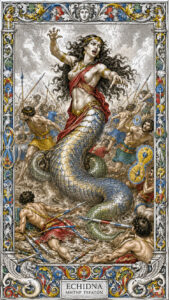
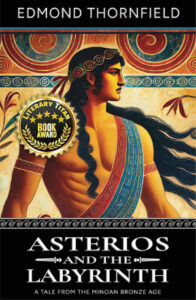
The second passage could not be further in tone from the first. Chapter Five of Asterios and the Labyrinth gives Echidna her first appearance on the battlefield, and the paragraph describing her killing of a young warrior is more graphic in my archaic register than it would have been in plain contemporary prose. That is not what I expected when I set out to write in Middle English cadences. I assumed the old syntax would soften things, the way distance often does. Instead it sharpened the horror.
A troop leader, his craggy features blanched to colorless chalkstone, falls upon his knees and says, “Lord of Archanes, we … we dare not lift blade against this chimera!” The man’s voice cracks like parchment over flame. “Our lances lie shattered at her feet. No mortal soul may halt her course.”
He offers him a hand, Daidalos also moving forth to lend aid, and summons reinforcements. The scaly horror then emerges from the brush, fangs sunk into the twitching form of a youthful warrior, his tunic shredded to ribbons.
Before the wretched victim may utter a scream, scaled coils as broad as a bull’s rump lash forth with blinding speed. One moment the poor youth’s torso rests untouched; the next, his mutilated remains fountain in a ruby whirlwind of viscera over the ground. Panicked cries rise from the Knossian ranks as the monstrosity advances, her prize still clutched in those fiendish claws.
 I have tried to improve that last paragraph, and every attempt made it worse. The original came whole, and I have learned to recognize what that feels like as it is happening: sentences that do not require revision are not the same as sentences I am too attached to revise. The latter are a writer’s vanity; the former are something truer.
Keep Faith With Me
The third example is not one sentence but several, spread across three chapters of Atalanta of the Wild, and I want to walk through them in order because the sentence that survived every revision pass is not any one of them. It is the line that connects them.
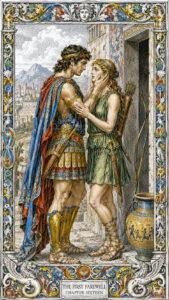
In Chapter Sixteen, after Meléagros kills his uncles and sends Atalanta away for her safety, he tells her, “Then shall I follow unto Tegéa, or wheresoever fortune leads you. Keep faith with me.” In Chapter Seventeen, saying farewell at the palace before she departs, he repeats it: “Safe passage, my love. Keep faith with me.” Both times the phrase came to me as it stands, and I kept it because it read like a promise a man intends to fulfill.
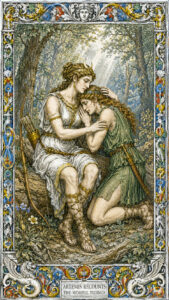 Then, in Chapter Nineteen, Artemis tells Atalanta how Meléagros died, and the account ends with his last words, dying in agony far from the woman he loved: “Keep faith with me no more, my truest love. I release you.”
I cry every time I reread that line. I have read it more times than I can count, across drafts, typesetting passes, and the read-aloud check before a manuscript goes to print. What undoes me is not the death. With his body failing and his kin and his sisters and his mother passing through his mind, his last thought was of her. He meant to keep his promise. He did not break faith by choice—fate broke it for him. His last act was to release her from a vow he had asked her to keep, so that his death would not become her cage. I did not plan that reversal when I first wrote “keep faith with me.” I did not know that I set a phrase aside to be returned to me, transformed, three chapters later.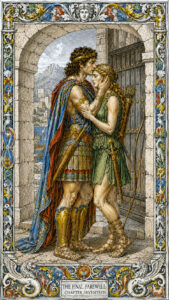
What Arrives Before Revision
These three passages did not arrive because I was a better writer than usual on those days. Some part of the story knew where it was going before I did, and these are the moments where it spoke through me without waiting for my editorial permission. My editing work exists to catch the sentences that have not yet finished arriving. It cannot improve the ones that have.
I have written this before and will say it again without embarrassment: I believe in the Muses, not as metaphors or as literary devices borrowed for atmosphere, but as presences closer to what the word meant to the people who first used it. They are a force outside the deliberate mind, one that hands a writer something whole and asks only that he have the humility to recognize it and the discipline not to ruin it. The barn merriment, the violence of Echidna, and the phrase a dying man uses to release the woman he loves did not come from my revision process. They came before it, and each time my revision process knew to step aside.
Gratitude, I have learned, is the correct response when the gift is this exact.
Rio de Janeiro, the xxi day of June, MMXXVI.

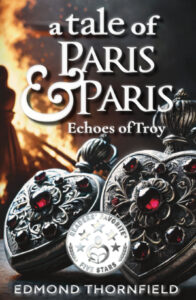

Click any cover to read a preview chapter and learn more.