I. The Flood
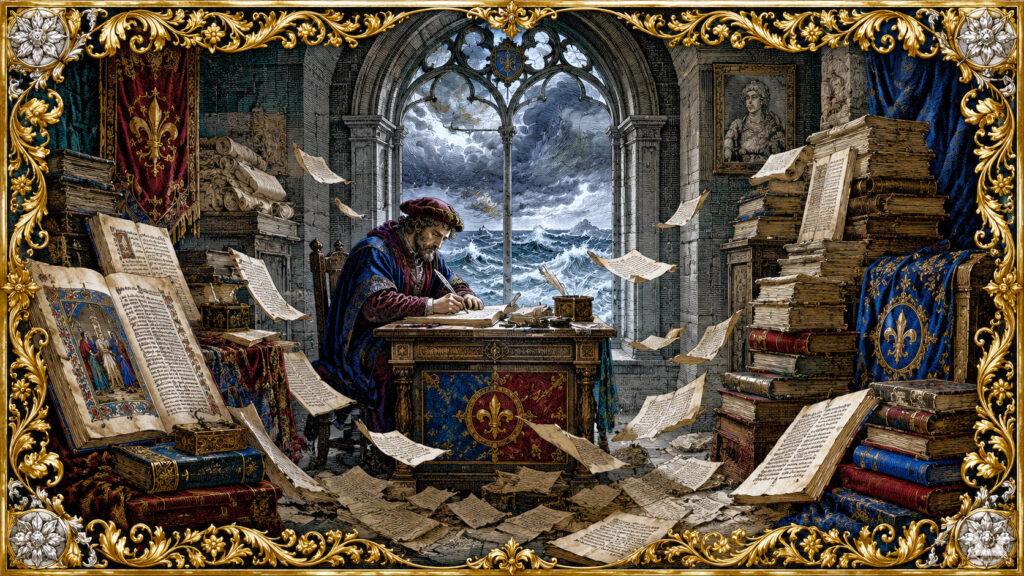
There is a flood upon the literary world, and it does not smell of river water. It smells of nothing at all—which is, perhaps, the most accurate description of what machine-generated prose brings to the page: a vast, odorless, grammatical nothing.
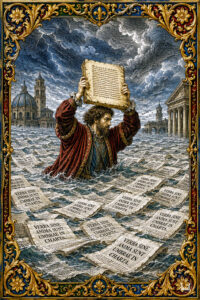 I am an independent author of literary historical fiction. I write one novel a year. Each requires archaeological fieldwork, primary source research across three languages, and the anguish of finding, through revision after revision, the sentence that is not merely correct but true. What I write does not permit haste.
Against this, consider what has entered the field alongside me: a new class of content producers, many operating with complete transparency about their methods, who publish twelve, twenty, fifty novels a year by issuing prompts to artificial intelligence engines and accepting the output with neither revision nor craftsmanship whatsoever. One prominent voice in this space describes the method as writing books “without compromising your creativity or ethics.” I am unable to locate the creativity or the ethics in issuing a prompt and publishing the result verbatim under one’s name. But the method is legal. It is spreading and drowning everything else.
This is not an essay about artificial intelligence. It is an address to you: the reader who loves books written by human beings, the reader who has memorized passages of Mary Renault or Dorothy Dunnett or Umberto Eco, who marks favorite sentences in pencil and returns to them. You are the person I am writing to, because you are the person I cannot seem to reach.
II. The Gatekeepers Have Closed the Gate
Before a human author’s novel reaches you, it must pass through an industry that has contracted its vision with remarkable determination. The literary agent, whose function is to represent authors, has become a curator of commercial trend. Audit the submission guidelines of literary agencies today, and you will find a striking uniformity of appetite: enemies-to-lovers romance, romantasy, psychological suspense, cozy mysteries, and a handful of adjacent categories cycling through fashion. Sometimes the language is blunt: not seeking literary fiction, not seeking historical fiction, not seeking whatever it is that does not fit the current commercial template.
The writer working outside these categories—the one who has spent four years reconstructing the interior life of a Minoan palace or the political intrigues of a Quattrocento hill town—is invisible. The system is not designed to surface him. It is designed to replicate what already sells, and to sell it faster.
I also note, without claiming sufficient data for certainty, that the client rosters of many literary agencies have become predominantly female. I raise this not to quarrel but to observe that a field which has historically excluded women has perhaps overcorrected in a direction that now excludes men. A literary culture that substitutes one exclusion for another has not solved the problem; it has relocated it.
The consequence for the reader is that large areas of serious fiction never reach the major presses. They survive, when they survive, in the independent publishing space, which is where the machine-generated flood is also concentrated, making discovery all but impossible.
 III. What the Machine Cannot Do
I have read samples of AI-generated fiction produced by content mills operating at industrial scale. To the trained eye, the tells are immediately apparent: overreliance on modifiers where strong verbs would suffice; similes that gesture at resonance but arrive at nonsense; point of view that drifts mid-scene without authorial awareness; syntactical constructions so uniform in their rhythm that the prose reads as an undifferentiated block of language rather than a voice; clichés of both phrase and feeling deployed not with the knowing irony of the master but with the confidence of a process that cannot distinguish between a well-worn observation and a dead one.
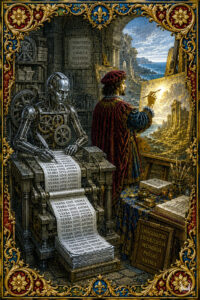
Machine-generated prose is competent in the sense that a photograph of a painting is competent: every element is present and in place. What is absent is the pressure behind the image—the knowledge that a human being stood at that canvas for hours, making decisions, changing his mind, suffering over the hue of a shadow. The photograph records. It does not feel.
Consider what it requires to write a single sentence of historical fiction that works. The author must know what the character knows and no more. He must know what the character would notice in that room, in that year, in that social position, and what would pass unobserved. He must render the period without the anachronism of modern sensibility, without the condescension of false archaism, and without sacrificing the reader’s access to the character’s interiority. He must do this while producing prose that has rhythm and texture, that gives the reader a physical sensation of inhabiting another time. No prompt produces this. No engine generates it. It is the product of a human mind saturated in research and alive to language; it takes the time it takes.
IV. The Discoverability Problem
Suppose you are looking for your next novel. You open Amazon’s historical fiction category. What you encounter is a catalogue of many thousands of titles, the majority generated at a speed and volume no human author can approach. One of my novels, Asterios and the Labyrinth, is on page eighty, or page one hundred, behind a screen-scroll of covers that all resemble one another, produced by a process that costs its operators almost nothing and floods the market with the confidence of a burst pipe. I spent a year writing it and a lifetime preparing to write it. It has received a Literary Titan Gold Book Award and a stellar recommendation from the Historical Novel Society.
I do not resent the reader who cannot find me. The system is not designed for finding. It is designed for volume, and volume has won.
What I do ask—and this is the plea at the center of this essay—is that the reader who cares about human fiction adopt a different posture toward discovery. Do not wait for the algorithm to surface what you want. It will not. The algorithm serves the flood. Seek the independent author through the channels where human curation still operates: specialist book blogs, the Historical Novel Society, independent bookshops whose proprietors know their stock, the recommendations of readers whose taste you trust. The human author is not absent from the market. He is buried in it.
 V. What You Hold in Your Hands
When you read a novel by an independent author who works without a major press, a literary agent, and a marketing department, who sets his type, designs his book covers, researches his history, and writes his sentences, you hold a rare artifact of human creative labor.
Every sentence in such a book was chosen by a person. Every detail was vetted by a person who traveled to the place, consulted the source, corrected himself when he was wrong, and went back to the page. The rhythm of the prose is the rhythm of that person’s mind encountering the world and finding language for it. This cannot be automated. It can only be done, one sentence at a time, by a human being who cares enough to do it well.
I am not asking for charity—I am asking for recognition. That when you choose to read an independent human author working at the edge of discoverability, you are not just purchasing entertainment. You are voting, with your time and your attention, for the continuation of a practice that is older than the printing press and, at this moment in history, more fragile than it has ever been.
The flood will not recede because we wish it to. It will recede, if it ever does, because enough readers refuse it: refuse the flavorless, the humanly empty. Choose, instead, the book that cost its author a year of his life. It will cost you a week of yours. It is a fair exchange.
Rio de Janeiro, the xviii day of June, MMXXVI.

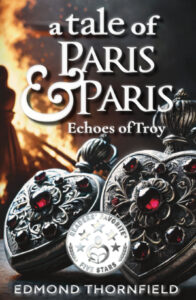
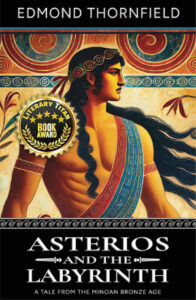

Click any cover to read a preview chapter and learn more.