On the difference between historical fiction with mythological elements and historical fantasy—and why the distinction matters

I. A Question of Ontology
This is the governing principle of my fiction, and it took me some years to articulate it: I do not write the ancient or Renaissance world as we understand it. I write it as its inhabitants understood it.
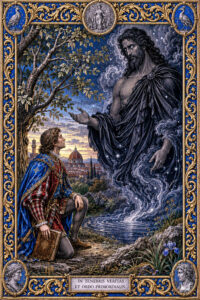 A reader described my novels as historical fantasy. I understood the impulse. Gods appear in them. Sorcery operates. A primordial deity of Darkness steps through a mirror of black vapor between the hazel trees and sits upon a fallen log to converse with a young Florentine nobleman about the nature of time. By one definition, that is fantasy. By the definition that matters to me as a novelist, it is history.
The distinction concerns the question of what kind of contract a novelist makes with his reader, and what kind of imagination he is exercising in the writing.
Historical fantasy builds a world in which the supernatural is added to history: an invented system of magic, a secondary cosmology, creatures that did not exist in any ancient source. The author’s imagination supplies what was never there. The pleasure of the genre lies in this invention. The reader understands that the gods or the magic are the author’s creation, layered over a historical backdrop.
What I write is something else. When Erebos steps through that mirror, I did not invent him. He was already there, in Hesiod‘s Theogony, born from Chaos before the world had taken shape, the primordial deity of Darkness who preceded the Olympians and whose existence for the ancient Greeks was a cosmological fact. I did not add him to the Bronze Age or the Quattrocento. I restored him to a world that already believed in him, a world in which his absence from the page would have been the distortion, not his presence.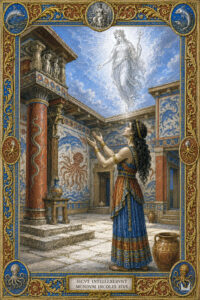
II. The World as Its Inhabitants Understood It
This is the governing principle of my fiction, and it took me some years to articulate it: I do not write the ancient or Renaissance world as we understand it. I write it as its inhabitants understood it.
For a Minoan woman, Circe was not a fictional sorceress. She was a figure of religious reality, a descendant of Helios and the Oceanid Perseis, a practitioner of the ancient craft called pharmakeia. For a Mycenaean huntress in Arcadia, Artemis was not a symbol. She was the Mistress of Wild Things, who visited her consecrated women in person, who sat on fallen trunks, clasped their hands, wiped their tears, and vanished when her counsel was given. To write these characters without the divine beings they would have experienced as real would be to impose a modern secular consciousness upon an ancient religious one—which is the precise anachronism historical fiction most needs to avoid.
I need not believe in Artemis for this to be historically true. I need only to understand, from the evidence of sanctuaries, votive offerings, hymns, and the testimony of primary sources, that the people I am writing about believed in her. Their world was populated by divine powers. My fiction restores that population.
 III. What the Research Requires
The most telling difference between historical fiction with mythological elements and historical fantasy lies not in the presence of gods, but in the quality of constraint the author accepts.
A writer of historical fantasy is free. He may invent his cosmology, adjust his mythology, combine elements from different traditions, create magical systems with internal rules of his own devising. This freedom is the genre’s primary creative resource.
I am not free in this way. When I write Circe, she must be consistent with the ancient records: her genealogy, her island, her herbs, her relation to Hekate and to Medea, her characterization across Homer, Hesiod, and Apollonius of Rhodes. When I set Echidna in the woods outside Knossos, she must arrive with the attributes the tradition assigns her: part maiden, part serpent, immortal, dwelling in a cave beneath the earth, mother of monsters. I cannot alter these facts any more than I can alter the architectural plan of the Minoan palace at Knossos, which I have walked, measured, and studied. The gods are primary sources. I am bound by them as I am bound by every other form of historical evidence.
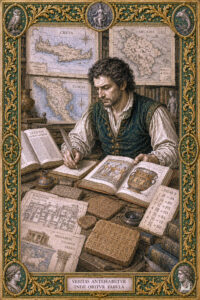
This is why I travel to the sites I write. This is why I immerse myself in archaeological literature before I stage a scene. The mythological content of my novels is not decoration; it is part of the historical record of what these people believed, feared, invoked, and encountered. To treat it as invention would be to treat the Linear B tablets as mere ornament. I use both as evidence.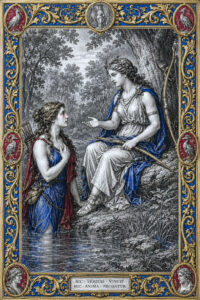
IV. The Test of Consciousness
There is a practical test I apply to every scene involving a divine or supernatural element. I ask: could a person alive in this time and place, with this character’s education, social position, and religious formation, have experienced this event as ordinary, not miraculous but real?
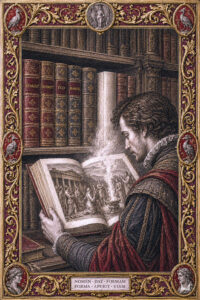
When Lorenzo recites the Greek incantation Milena the Ancient has taught him, he is performing a rite. Fifteenth-century Florence was not a secular city. It was a city in which Neoplatonist philosophers debated the reality of daemonic intermediaries between the human and the divine. The study of ancient Greek theurgy—the practice of invoking divine presences through ritual—was a live intellectual current, not a curiosity. Lorenzo’s incantation and Erebos‘s appearance in response to it fall within the range of what a learned Florentine of the period might have attempted and believed possible. The scene is not fantasy. It is Renaissance religious thought rendered as fiction.
Atalanta‘s encounters with Artemis operate by the same logic. She experiences her goddess not as supernatural but as her mistress, her protector, the divine figure to whom she has consecrated her life. When Artemis sits beside her and touches her cheek, Atalanta‘s response is not wonder but gratitude. That is not fantasy. That is the interior life of a Bronze Age woman who lives within a world where such meetings are possible and accepted.
V. Why the Label Matters
I am not defending a label for vanity’s sake. The distinction between historical fiction and historical fantasy has consequences for the reader who is looking for my books and for the tradition within which I am working.
 The writers of secondary-world fantasy are not doing something lesser; they are doing something different. The greatest of them, Tolkien, understood the ancient sources as well as any classical scholar and chose to build anew rather than restore. My choice is the opposite. Yet neither choice is the right one in the abstract: each is right for the writer who makes it.
The writers I consider my predecessors—Mary Renault, Dorothy Dunnett, Umberto Eco, Hilary Mantel—are not fantasy writers. Renault‘s Theseus encounters the Bull from the Sea; her Alexias moves through a world thick with divine presence and religious obligation. Eco‘s William of Baskerville navigates a medieval world in which the boundary between theology and the natural order is permeable. None of them are categorized as fantasy. They are placed within literary historical fiction because their primary commitment is to the historical record as evidence and the interior lives of their characters as historically formed consciousnesses.
That is where I belong. Not because I claim their company without earning it, but because I accept the same constraints, work by the same methods, and make the same wager: that the past, restored with fidelity and imaginative inhabitation, is more astonishing than anything one could invent.
I did not invent the gods. I returned them to the world they never left.

Rio de Janeiro, the xix day of June, MMXXVI.

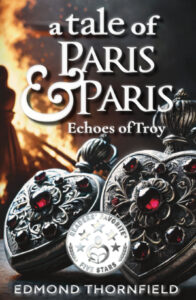
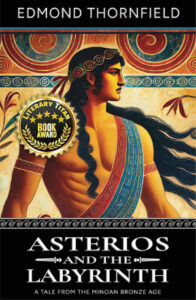
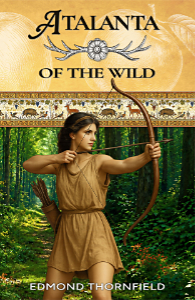
Click any cover to read a preview chapter and learn more.