I. The Problem Omniscience Does Not Have
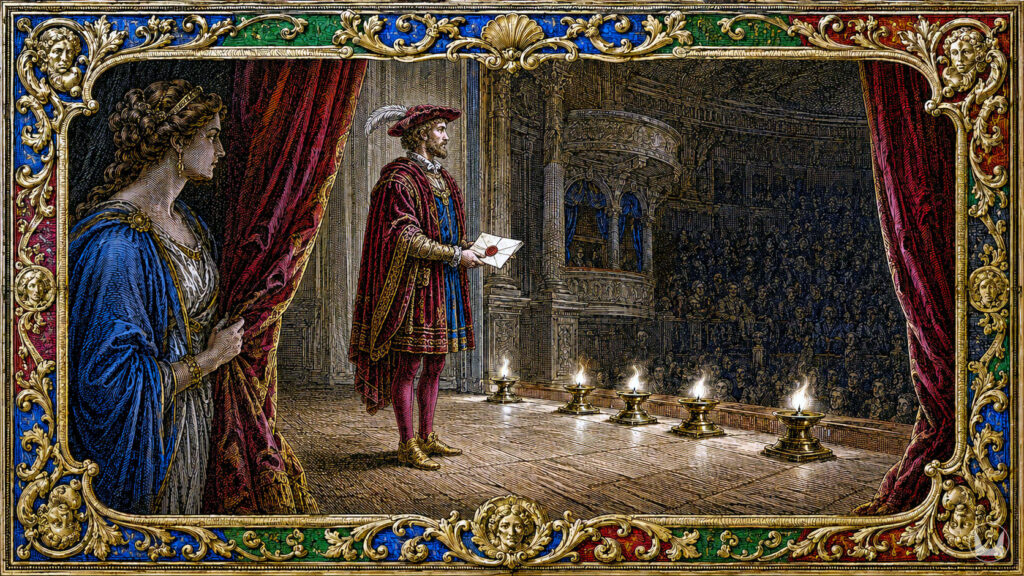
The omniscient narrator goes where he pleases. He enters rooms his characters have left, overhears conversations no witness reports, and delivers information to the reader with the authority of a god. He has no obligation to justify his presence. He is simply there, and the reader accepts him.
 The writer who works in close or limited third-person has no such freedom. He has made a covenant with the reader: the narrative will remain inside the consciousness of its designated characters. What those characters do not witness, they cannot narrate.
This is not a deficiency. It is a discipline. The close third-person novel earns its intimacy because it refuses the god’s-eye view. The reader inhabits the character rather than observing him from above. But the method creates a practical problem that every novelist working in this mode will at some point face: something important happens offstage, and no established POV character is present to see it.
The solution, if executed with care, does not solve the problem alone. It enriches the novel.
II. Lieutenant Tiepolo and the Architecture of A Tale of Paris & Paris
My first novel, A Tale of Paris & Paris: Echoes of Troy, rotates among twelve point-of-view characters. Twelve is an ambitious number, and I will not pretend it did not require rigorous management. The two male protagonists, Lorenzo and Vittorio, anchor the narrative; the remaining ten characters serve varying functions across the novel’s arc.
Among them is Lieutenant Stefano Tiepolo, Lorenzo’s right-hand officer.
I did not design Stefano for the function he came to serve. By inclination and practice, I am a pantser. Stefano arrived on the page the way many of my characters do: with name, rank, loyalty, and no fixed destiny. It was well into the unfolding of the novel that I understood what he was for. He could go where Lorenzo could not. He could move among the knights of the Pope’s Army with ease. He could serve the town’s resistance as a spy inside the machinery of the Greyfriar inquisitors. He was the instrument by which I could narrate events that no protagonist had witnessed, without reaching for the omniscient perspective I had declined at the outset.
Two other characters approached a similar function before claiming their territory. Gianmaria, the leader of the convent orphans, became enamored of Margherita; Rocco Friuli, another of Lorenzo’s allied soldiers, fell in love with Stella Prinelli. They earned their point-of-view scenes across several chapters not as narrative conveniences but as characters whose interior lives had become too consequential to leave unnarrated. The novel, meanwhile, contains what some critics have described as an LGBTQ+ narrative in the relationship between Lorenzo and Vittorio. I did not set out to write an LGBTQ+ novel. I set out to write a novel that reflects reality—and reality has always contained both heterosexual and homosexual love, regardless of what any society has chosen to permit or condemn. The label followed the work. It was not the work’s purpose.
Stefano, however, proved to be a literary instrument as much as a character, the officer whose presence allowed the novel to remain honest to its own rules.
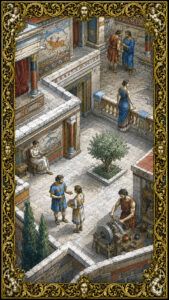 III. The Novel That Did Not Need the Device
Asterios and the Labyrinth rotates among six point-of-view characters, plus a being of divine origin. Two protagonists: Asterios and Phaistos. Two antagonists: Lords Koronos and Lykosander. Two secondary characters of considerable depth: Pasiphaë and her sister Kírke. And Echidna, whose nature places her outside the ordinary categories.
In the planning of Asterios, I did not foresee that this configuration would stand on its own. In retrospect, I wrote forward and discovered that every significant event in the novel had a witness among the established POV characters. Nothing of consequence happened beyond their lines of sight. The six perspectives, distributed as they were across the antagonist and protagonist divide, covered the novel’s terrain without gap.
This still surprises me. A pantser does not arrange such things; they arrange themselves, or they do not. In the case of Asterios, they did. I am grateful.
The lesson I draw from it is not that six POV characters are sufficient for any novel, nor that the device of the minor POV is always necessary. The lesson is that the problem, when it does not arise, should not be manufactured. The additional POV character is a solution; it is not an ornament.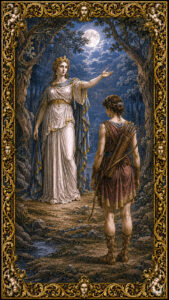
IV. When a Goddess Knows What No Witness Saw
Atalanta of the Wild is a dual-POV, close third-person novel: Atalanta‘s perspective and Néos’s. I intended the duality from the beginning, though it emerged from my usual absence of detailed plotting. For the greater part of the novel, two perspectives sufficed.
Then a secondary character died offstage.
In Ovid‘s Metamorphoses, the source upon which my retelling is built, the news of this death reaches the narrative through the omniscient voice Ovid commands without apology. I had no such voice. I had two characters, neither of whom had witnessed the death, and I had a reader who needed to learn of it.
I would not assign a point of view to another minor character to resolve the difficulty. The novel’s dual structure was integral to its design, and I would not dilute it for the sake of a single scene’s logistics. The solution, when it arrived, was simpler and more resonant than any structural adjustment could have been: I gave the news to Artemis.
A goddess does not require a witness. She knows what has happened because the nature of divinity grants access to events that mortal consciousness cannot claim. Artemis delivered the news to Atalanta as a goddess in ancient Greek theater delivers terrible tidings: with the full ceremonial weight of a divine announcement, in a scene that is among the most dramatic in the novel. The solution to a technical problem became one of the work’s finest moments.
The lesson here is different from the one Stefano taught me. He demonstrated that the minor POV character can be a recurring structural element, serving the narrative’s information needs across multiple chapters. Artemis demonstrated that the divine, in a novel that depends on its mythology, can perform the same function in a single scene—and that the performance will carry more resonance than any mortal messenger could.
 V. What This Means for the Writer
The instruction I offer is simple and without qualification: do not deviate from the POV mode you have established. Not once. Not for convenience, not for urgency, not because a scene would be easier to write from outside the perspective you have committed to.
If an event must be narrated and no established POV character was present to witness it, assign point of view to a minor character and proceed. The assignment need not be permanent. A character can anchor a single chapter, or a single scene, and then recede. What matters is that the covenant with the reader remains unbroken.
Head-hopping—the erratic movement between perspectives within a single continuous moment, without the formal assignment of a new point of view—is not a solution. It is a symptom of insufficient commitment to the form. Editors notice it. Readers feel it, even when they cannot name it, as a loss of the intimacy the close third-person promises.
The minor POV character, by contrast, is a gift the novel offers you when it needs one. Stefano arrived unbidden and became indispensable. Artemis was already present in the world of the story, waiting to be asked. In both cases, the technical problem, solved with care, produced something the novel would have been diminished without.
If the need presents itself, meet it. Assign, commit, and move forward with confidence. Editors and readers will be grateful. In time, so will you.
Rio de Janeiro, the xxiii day of June, MMXXVI.

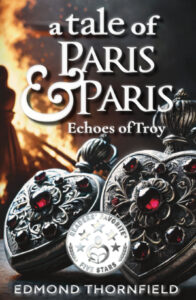


Click any cover to read a preview chapter and learn more.