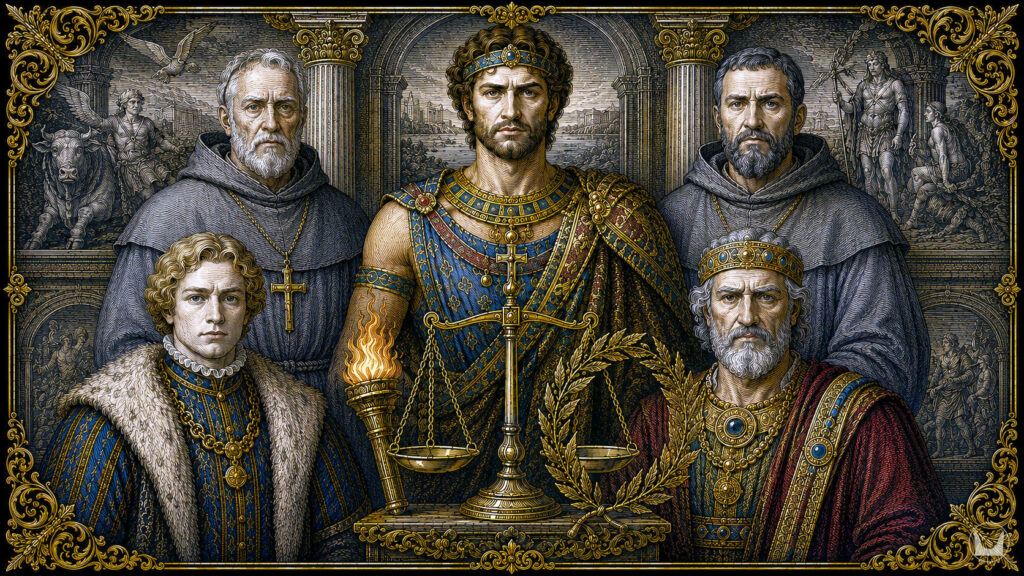
On antagonists who operate from a coherent internal logic and whether historical fiction can afford a pure villain.

There is a kind of antagonist who appears in lesser historical fiction with reassuring frequency: the man who enjoys being cruel, who oppresses because oppression pleases him, whose motives require no further excavation, as the author has decided that evil is self-explanatory. He is recognizable from his first scene until he is defeated or destroyed. The reader is never in doubt about how to feel.
This villain relieves the writer and the reader of the most demanding work historical fiction can ask: the work of understanding how a person formed by a specific time, place, and set of beliefs could do terrible things and experience no contradiction.
Sooner or later, the historical novelist who commits to that work arrives at an uncomfortable discovery: the antagonist who operates from a coherent internal logic is not only more truthful than the pure villain—he is more frightening.
 1. The Inquisitor Who Saves Souls
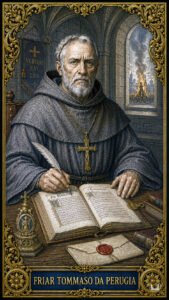
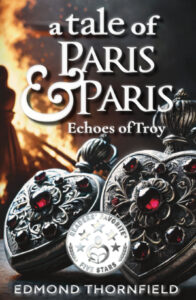
Friar Tommaso da Perugia, one of the chief Greyfriar inquisitors in A Tale of Paris & Paris: Echoes of Troy, does not consider himself an instrument of cruelty but of mercy.
This is not self-deception. It is a systematic theological position, held by serious men across centuries. The heretic’s soul is in danger of eternal damnation. The body is temporary. If the body must suffer to bring the soul within the reach of salvation, the calculation is not difficult. Tommaso has made it, and the mathematics satisfies him.
By any honest accounting, he is a hypocrite. He indulged in romantic affairs during his youth and fathered children, yet he does not experience this as disqualifying. The Church‘s mission to defend orthodox faith from corruption is not diminished by the private failures of one of its servants. The sin is confessed. The work continues.
What redeems Tommaso from the category of pure villain is that his human warmth is genuine. His friendship toward the older inquisitor Friar Adelmo shows true feeling. His care for Friar Giacomo, the young scribe who accompanies them, is real. He is capable of tenderness. He can also authorize the burning of a person he has never met on the basis of a confession extracted under duress. Both things are true of the same man, and the novel does not resolve the tension between them.
 2. The Inquisitor Who Reveals Nothing
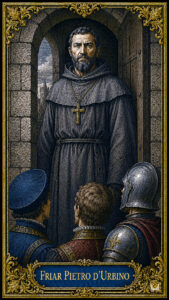
Friar Pietro d’Urbino arrives later in the novel as a harder case. Where Tommaso’s interiority is available to the reader, this Greyfriar does not offer the same access. His words are cutting. His methods are brutal. He instils in those around him a mixture of fear and admiration: the recognition of an unbending force.
Whether Pietro views himself as a villain or a mere function of the institution he serves, the novel declines to say. He fulfils his role as the most intimidating inquisitor in the narrative.
This too is a choice, not a failure. Some antagonists are frightening because they are closed off. Pietro is a weather system, not a psychology. The reader feels his presence as pressure rather than as a mind to be understood. In a novel that grants interiority to most of its major figures, his opacity reads as its own kind of characterization: the man who has become the role that nothing remains outside.
 3. The Man Who Mistakes Ambition for Virtue
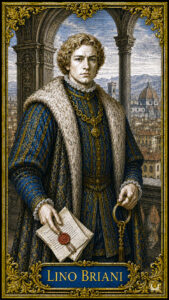
Costanza’s brother, Lino Briani, presents a different problem in the same novel. He is not an institutional figure operating within a theological framework. He is a political animal: a man vying to exert influence within the Florentine Signoria, who sees no wrong in the methods he uses to achieve it.
He blackmails Lorenzo into marrying his sister. He regards sodomites as abominations but will use one readily if it serves his position. By all reckoning, he is a man of corrupt morals.
His scorn for those he considers beneath him is the disdain of a man who upholds social order, not the sadism of a man who enjoys causing pain. His manipulation of Lorenzo is an exercise of leverage in a world where knowledge of secrets is the currency of power. Yet he believes he is ruled by virtue, which is to say that in his mind the ends justify not only the means but his character.
His fatal flaw is hubris: the inability to see beyond his own assessment. It is an ancient failing, one Lino would not recognize as such. He would read the word as a description of other men.
 4. The Lord Who Refuses an Unholy Union
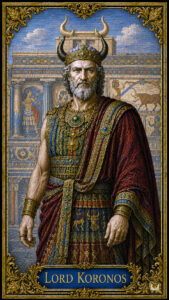
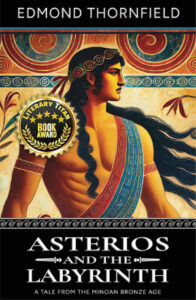
The first antagonist of Asterios and the Labyrinth, Lord Koronos, operates within the moral framework of the Minoan Late Bronze Age. His objection to King Asterios is not arbitrary. Asterios is in union with Prince Phaistos of Archanes, and for Koronos, this union threatens the continuation of the sacred bloodline of the Divine Bull, the theological foundation upon which Knossos rests its authority and its identity.
He has a personal interest as well: he wants his daughter Eleni on the throne and the elevation of his house that would follow. But the religious conviction and the political gain are inseparable in his mind. They reinforce each other with the ease of a man who has never had cause to distinguish between what he wants and what is right.
With his beliefs, in the world he inhabits, he is a man defending something sacred against those who would corrupt it—not a villain. That the reader may see the situation otherwise is the point. The distance between Koronos’s self-understanding and the reader’s assessment of him is where the historical novelist does important work.
 5. The Warlord Who Acts on Desire Without Restraint
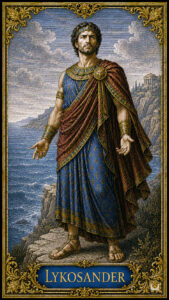
Lykosander, the Red Wolf of Zakro, is perhaps the most troubling of these antagonists, and the most difficult to place.
He is driven by ambition and a sense of superiority that seeks no external validation. He takes what he wants, when he wants it, including people. He does not pause at the threshold of an action to consider whether it is wrong; the concept seems absent to him. To the very end of the novel he believes everything he desires will be his, and even at the moment his aims are foreclosed, he does not recognize himself as a villain.
What makes Lykosander not only monstrous but tragic is that his certainty is absolute. There is no seam in him, no knowledge of his own hypocrisy, as there is in Friar Tommaso. He is not performing virtue while acknowledging failure in private. He simply does not inhabit the moral register in which his actions would be judged. He operates in a world where power requires no justification, and he has always had enough of it to avoid being corrected.
The reader sees something in Lykosander that defies easy definition. That is not an accident. I refused to make him legible on the reader’s terms.
6. Can Historical Fiction Afford a Pure Villain?
The question the essay has been circling is worth asking directly.
A pure villain, a character whose cruelty is motive enough and whose interiority needs no excavation, is not impossible. He offers the comfort of a clear moral position at the cost of the experience historical fiction, at its best, provides: the encounter with a person shaped by a different time and set of assumptions, whose actions are intelligible from within that formation even when they are not forgivable.
The villain who does not know he is one asks more of the reader. He must be understood without being excused, which is harder than either understanding or condemnation.
It is also closer to what history contains. The record is not full of men who knew they were doing wrong and did it anyway. It is full of men who were convinced of their own righteousness—and whose convictions, formed by their time, their faith, social position, and self-interest, produced results that other people paid for.
The historical novelist who renders that conviction without softening it into villainy has done something the pure villain can never accomplish. He has told the truth about how damage is done.
Rio de Janeiro, the vi day of July, MMXXVI.
Click here to read a complementary essay on
How to Write Villains Who Show Their Human Side.

Click any cover to read a preview chapter and learn more.