To this day I have not written a villain who is purely evil. I do not believe such a creature exists—not in life, not in honest fiction. At some point even the worst among us had a parent or a sibling who loved them, a pet that did, a life punctuated by trauma and loss that shaped them into who they became. The villain is not a monster dropped into the narrative from outside the human condition. The villain is the human condition, pressed into a particular and unfortunate form.
Above all else, what I ask of my villains is that they have heart. A villain without heart is a plot device. A villain with heart is a person—and persons, however corrupted, are what fiction is made of.
 I. Friar Domenico and the Inquisitors: When the Institution Is the Villain
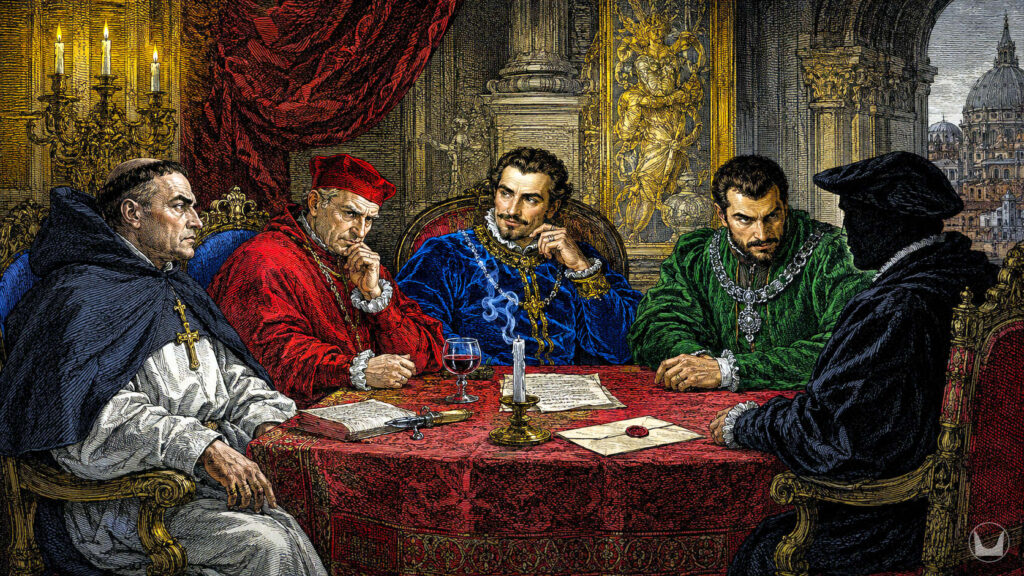
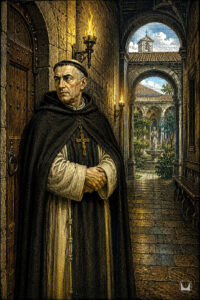
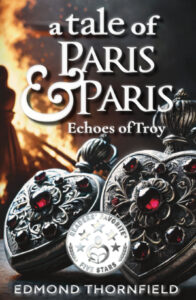
In A Tale of Paris & Paris: Echoes of Troy the first villain the reader encounters is Friar Domenico, Guardian of Cortona’s Convent of San Francesco. He is sour-faced, disillusioned, and dangerous, but he did not begin that way. As a boy, his father traded him to the Franciscan order in exchange for food. He has never forgotten it and never forgiven it. He does not think of himself as a man of God. He thinks of himself as a survivor, which is the more fitting description, and he will betray anyone who threatens the status quo that keeps him fed, housed, and powerful. Together with Friars Nardo and Paolo, two lesser villains with their own histories of deprivation and damage, he abuses the young orphans in his charge. His final act in the novel is to denounce Lorenzo to the Inquisition.
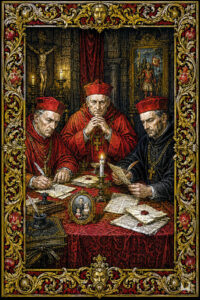 The inquisitors—Friars Tommaso, Adelmo, and later Pietro—are harder men and, in some respects, more frightening than Domenico because they believe in what they are doing. They are on a holy mission to save lost souls and purify the Church, and the fact that most of them have had affairs and fathered children troubles them not at all: they are the instruments of correction, not its subjects. Yet even they are not without human texture. They are loyal to one another. They love their families. They are capable of laughter and grief.
If one were to name the true villain of A Tale of Paris & Paris, it would not be any of these men individually. It would be the institution that made them: the Catholic Church of the fifteenth century, with its capacity to take damaged, frightened human beings and give their worst impulses the sanction of heaven.
 II. Lino Briani: Entitlement With a Human Face
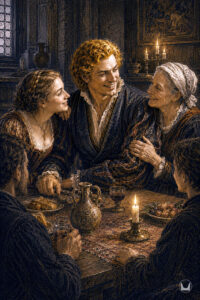
Lino Briani is the novel’s most intimate villain, and the one who cost me the most to write because he is based on a real person I once knew in Brazil. I know this type from the inside: the blackmailer who believes himself entitled to grandeur at the expense of others, who mistakes his own appetites for rights and other people’s generosity for weakness.
Yet at his first appearance I give him a sister who loves him and a nursemaid who has tended both their lives from childhood. To these two women, he is a person worth loving. That does not excuse what he later does, but it means he arrives in the narrative as a human being rather than a function. The reader’s reckoning with him carries a weight it could not otherwise have.
The real Lino also had people who loved him. Most villains do.
 III. Lord Koronos and Lord Lykosander: Prejudice as Tragedy
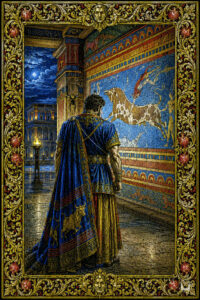
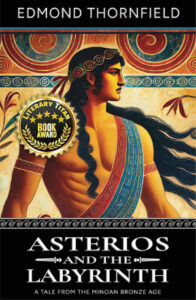
In Asterios and the Labyrinth the villains operate in a different register. Lord Koronos is a man whose prejudice against same-sex love is sincere, if mistaken: he has examined his convictions with intellectual rigor and concluded that nature mandates them. He is not a hypocrite. In his own mind, he is a principled man—which makes him more difficult to argue with than a hypocrite would be.
Lord Lykosander, the novel’s chief villain, is another matter. He weaponizes the same prejudice, deploying power and violation as instruments of dominance. What makes him irreducible to mere monstrousness is the moment near the novel’s end when his own logic turns against him: the realization, arriving in his most exposed and vulnerable instant, that what he has enacted upon others is, in his own distorted understanding, his conception of love between men. It is a grotesque insight, and a tragic one. Some readers feel pity for him then. I do not. But I gave him that recognition because the truth of a character matters more than the author’s feelings about them.
I will add that Asterios contains a further villain whose identity I will not disclose here, a figure presented in ambiguous terms until a revelation near the novel’s close that a number of readers have found surprising. Let them discover it themselves.
 IV. Atalanta of the Wild: A Novel Without a Villain
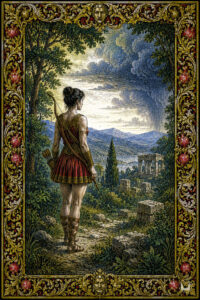
The strangest discovery I made in writing Atalanta of the Wild was that it has no villain. I did not plan it this way. It emerged.
Lord Iásios, who appears in the early chapters with every credential of the antagonist, the father who abandoned his infant daughter on a mountainside, proves to be a man undone by his own haste and redeemed by genuine remorse. Queen Althaea functions briefly as an antagonist, though she is neither a primary nor a secondary character of consequence. Aphrodíte is alluded to as a malevolent force, but she never appears on the page. And Hippomenes, who deceives Atalanta with the golden apples, who takes from her the footrace she should have won, by the final pages is revealed as her truest love. The trick was not malice. It was a last resort.
The antagonistic force in Atalanta is not a person. It is a circumstance: the prophecy that hangs over her, the doom she has been told marriage will bring. These are not villains one can argue with or defeat. They can only be endured or defied. In the end, they must be transformed.
Closing
A villain who is only evil is a missed opportunity. The antagonists who linger in the mind—Umberto Eco‘s Bernardo Gui, my Friar Tommaso, Medea, Lykosander, Lino Briani, even Friar Domenico, sold by his father for food—are unsettling because we can trace the path that made them. We can see the human being they might have been.
Fiction exerts strange powers when it refuses the comfort of a villain who is nothing more than the sum of his wickedness. Against our better judgment, we may even fall in love with them.
Rio de Janeiro, the xi day of June, MMXXVI.


Click any cover to read a preview chapter and learn more.